
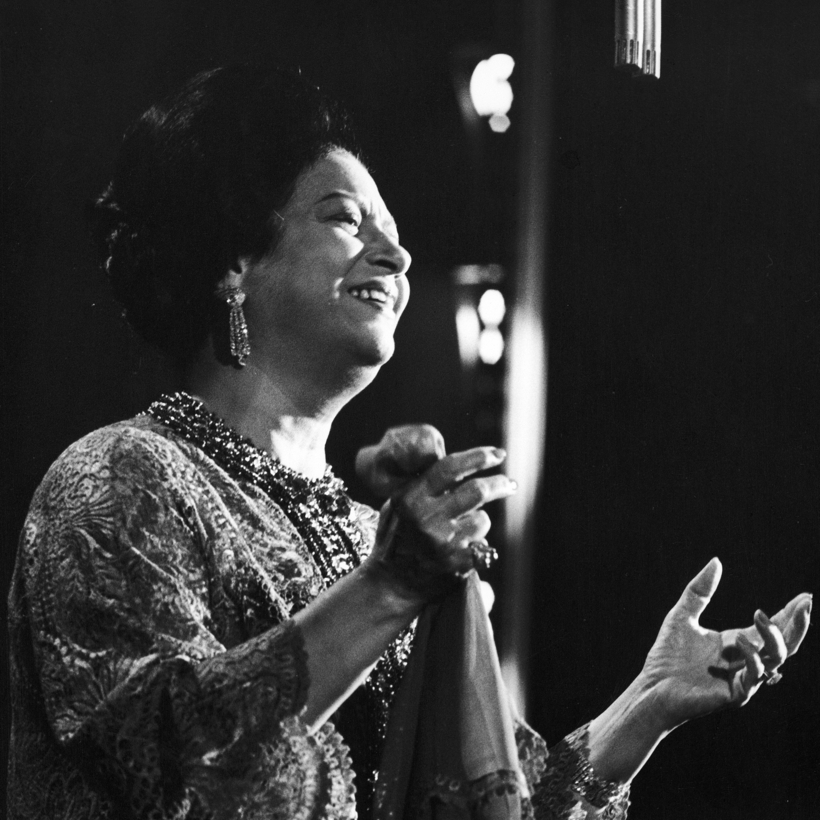

They moved like a great river, four million souls pulsing through the streets of Cairo for the 1975 funeral of the Egyptian singer Umm Kulthum, perhaps the most renowned Egyptian woman since Cleopatra. For much of the 20th century, it was said that the sole single event that could compel the Arab world—from the Persian Gulf to the Atlantic Ocean—to listen as one was when Kulthum performed on the last Thursday of every month, a practice that continues, through her recordings, to this day. Now, 50 years after her death, 2025 has been declared by Egypt and throughout the Arab world to be “the year of Umm Kulthum.”
“The day of her death was etched in my 10-year-old mind,” recalls Dr. Khalid El-Shami, an oncologist at Sibley Memorial Hospital, in Washington, D.C. “She was mourned in every household in Egypt, including mine, like it was the death of the family’s matriarch. Women donned black mourning dresses, eyes closed shut from incessant sobbing, and a sense of an ending permeated the air.” At her funeral, mourners wrested her casket from the official pallbearers and carried it aloft through the streets of Cairo, to her burial place.
To borrow a line from W. H. Auden, Kulthum has become her admirers. Her voice can still be heard in the cafés and hookah establishments across the Middle East as well as in Paris, London, Amsterdam, and Berlin. On a recent visit to Los Angeles, I heard it coming from a boom box in a public garden.
With an ability to produce 14,000 vibrations per second, Kulthum had to stand three feet away from the microphone so her voice would not overwhelm her listeners. Rolling Stone magazine included her on a list of the great voices of the 20th century. “Her goal was to induce in her listeners tarab, a state of rapturous enchantment, where time and self dissolve in the music,” according to an appreciation in The Guardian.
Maria Callas called her “the incomparable voice.” Led Zeppelin’s Robert Plant, who first heard her over loudspeakers in Marrakech in 1970, was “driven to distraction upon hearing Umm Kulthum’s voice,” he later recalled. “When I first heard the way she would dance down through the scale to land on a beautiful note, [she] had blown a hole in my understanding of vocals.” Bob Dylan has described Kulthum’s voice as an almost “cosmic instrument.” Beyoncé, another devotee, has sampled and even choreographed her music, and U2’s Bono has spoken of Kulthum with an almost religious awe.
Having grown up simply in modest circumstance, Umm Kulthum grew rich from her music and lived in a rose-colored villa on the Nile. For her final performance, in 1973, she received $50,000—an enormous sum at the time. Many of her personal possessions, including her trademark sunglasses as well as a necklace made of 1,888 natural pearls, will be part of a traveling exhibition paying tribute to “The Lady,” or “The Star of the Orient,” as she was variously known.
The nine-stranded, elaborate necklace was originally part of the crown jewels of the ruling al-Nahyan family of Abu Dhabi. In the 1970s, Sheikh Zayed bin Sultan Al Nahyan presented Kulthum with the necklace, which she cherished and often wore during her many marathon performances. In 2008, her family put the necklace up for auction at Christie’s, where it sold for $1.385 million to an anonymous buyer from Abu Dhabi. Eleven years later, the Kulthum necklace would be displayed at the Louvre Abu Dhabi for the exhibition “10,000 Years of Luxury.”
La Samaritaine in Paris is currently carrying reproductions of Kulthum’s bejeweled eyewear, such as her signature diamond-studded, cat-eye sunglasses. And Imaan Hammam, the Dutch-Moroccan-Egyptian model, has launched her own eyewear collection with the Moroccan label Port Tanger, as an homage to the legendary singer.
Kulthum broke the rules of traditional gender conformity for Islamic women by appearing unveiled in public. When she was a child performing in rural Egypt, her father dressed her as a boy so she would not face disapproval, but once she began performing on her own in Cairo, Kulthum abandoned the disguise. The power and beauty of her singing transcended her cultural transgression.
Ultimately, Kulthum summed up the idea of “Mother Egypt,” embodying the divinity of womanhood. “The ancient Egyptians idolized womanhood,” El-Shami observes. “The Key of Life, the most famous pharaonic symbol, is a diagrammatic representation of womanhood, from whence life itself sprang. Umm Kulthum summed up all these concepts with total spontaneity through her peerless art.” Like all great artists, she exists out of time.
Sam Kashner is a Writer at Large at AIR MAIL. Previously a contributing editor at Vanity Fair, he is the author or co-author of several books, including Sinatraland: A Novel, When I Was Cool: My Life at the Jack Kerouac School, and Life Isn’t Everything: Mike Nichols, as Remembered by 150 of His Closest Friends
