
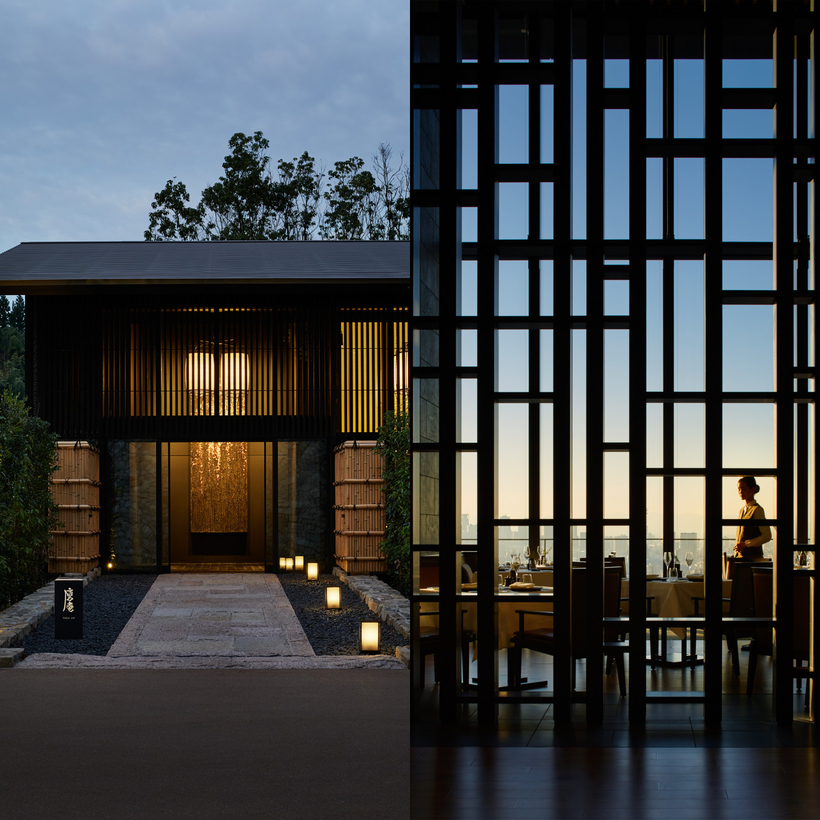
“What’s the best thing about Japan?,” I asked my friend Shuji recently. He and I have been comparing his country with the rest of the globe for all the 38 years I’ve been living around Kyoto. Without a moment’s pause, he said, “The silence.”

His words returned to me not long ago as I walked along mossy boulders through a secret forest of tall camphor trees and camellias north of the city. There was nothing to hear but water trickling down in openings in the rocks. Not a soul to be seen. Even in an overtouristed metropolis—more than 75 million visit the area every year—I was enjoying a rare sense of privacy and space.

In Tokyo, especially during cherry-blossom season, nature and urbanity coexist beautifully.

Just three days earlier, I’d been on the 35th floor of a Tokyo high-rise, looking down on the green roofs of the Imperial Palace, at the heart of the capital. I counted four helipads below me as the sky began to darken and red lights began to shine on every skyscraper. Yes, there was a TV in the room, but it remained completely hidden inside a blond-wood counter until I pressed a button. Huge windows were telling me that the real show was taking place outside, among the bright lights of the busy city, at my feet even when I was soaking in a deep granite tub.

Even in Tokyo, the Aman counters skyscraper views and sophisticated cuisine with tastes from the countryside.

Adrian Zecha, the 91-year-old visionary from Indonesia, in many ways created luxury hospitality for the new century when he founded Aman Resorts, in 1988. His intimate, elegant villas on unmarked roads made one feel as if one were visiting a fashion-designer friend for the weekend. The idea had been inspired, he once told me, by his stays in Japanese ryokans when he was a correspondent for Time magazine in Tokyo in the 1950s.

At the Aman Tokyo, which occupies the top six floors of the Otemachi Tower, architect Kerry Hill ensured that the views are enjoyed at every opportunity.

So now I’d decided to consider how one could elegantly travel across my adopted home by stitching together the three global ryokans that Aman has opened there. It was Aman, after all, that had introduced me to the idea of staying with the same company as you travel across an entire country when it opened a circuit of five hotels across Bhutan in 2004. There’s a grace in getting to enjoy the same aesthetic at every stop—and not having to carry your luggage from town to town.

Aman Tokyo is situated right at the center of the capital, but at its base is a tiny forest with a glass cube of a restaurant at its heart. In its lobby, roughly 90 feet high, one feels as if one is seated within a traditional lantern made out of washi paper. Aman Kyoto is set in the kind of hidden location that Zecha favored, with almost no signage along a narrow road leading out of the bustling city. Amanemu, near the sacred shrines at Ise, feels entirely pastoral, set among empty rolling hills, with flashes of Ago Bay in the distance.

Kamishichiken, a geisha district close to Aman Kyoto.

Though I’d been to Aman Kyoto for tea in November 2019, the month it opened, it was only by staying there, by gazing out at the bamboo fence as dusk fell and by seeing the rising sun filtered through a cathedral of trees in the early morning, that I began to appreciate how it might induce guests into a subtler way of being.

To find the Aman Kyoto, don’t bother looking for a sign.

The large boulders collected from across Japan by the textile merchant who used to own the property ensure that you walk slowly. The suzumushi, or bell crickets, chatter all day; they seem to heighten the larger silence. In the summer, I heard, there are fireflies under the stars; in the winter, thick snow. “If you told me we were in a castle in remotest northern Japan,” said my Kyoto-born wife, Hiroko, “I would believe it.”

It’s a rare treat to enjoy breakfast outside at first light and hear birdsong along with running water while gazing on 72 acres of forest. Deer sometimes saunter down from the nearby mountains to graze. And complementing the natural quiet is the Japanese restaurant Taka-An, where Hiroko and I savored an omakase feast served by Shinichiro Takagi, an English-fluent master who regularly takes his talents across the globe.

The Aman Kyoto, in the forested Takagamine district, north of the city, feels more remote than it actually is.

Aman Tokyo is the property farthest from the original Aman vision, taking up the top six floors of a 38-story high-rise in the Otemachi business district. But if Japan, like God, is in the details, then it’s a perfect introduction to the country. There are other places in town where kimonoed ladies play the koto as excited young women nibble on three-tiered afternoon-tea sets. But how many other reservation systems offer 35 different kinds of occasions that could be formally celebrated at its tables, from “Group Date” and “Team Drinks” to “Family Intro” and even “Proposal”?

Here, too, we were offered an omakase dinner served to us alone by a master chef, who harvests his own rice in his native Yamanashi Prefecture. He even made the bowls out of which we were eating. Yet the unexpected highlight was the Italian restaurant Arva. Not expensively priced, it offered finer Italian fare than I’ve ever had in Italy.

Amanemu, near the sacred shrines at Ise, is adjacent to Ago Bay, on Japan’s eastern coast.

It reminded me that at Amanemu, which opened in 2017, I had enjoyed perhaps the best meal I can remember, including sesame tofu with caviar and barracuda sashimi. The property, which had Zecha’s blessing, is classic Aman, which means there’s nothing there but emptiness, silence, and absolute privacy.

Amanemu, which opened in 2017, is Aman’s most pastoral property in Japan.

The hotel’s corridors—designed, as with all Japanese Amans, by Kerry Hill Architects—are constantly shifting essays in shadow and light, leading to a library that faces a courtyard with nothing but a cherry tree at its heart. The crowning glory is an outdoor onsen, a set of lanterned, interlocking baths that, in all, are as large as two infinity pools. I will usually do anything not to get into hot water, but these proved irresistible.

Aman purists may well be concerned that the company is now sprouting urban hotels everywhere, from Beverly Hills to Miami Beach, and opening residences as well. What was once a library in Aman Tokyo is now a boutique where you can buy Aman-branded souvenirs. The reticent cultural sanctuaries that Zecha pioneered are quickly turning into buzzy places glittering with stores, and Aman has even launched a somewhat lower-priced range of hotels called Janu.

Magical views, experiences, and cuisine await guests at Amanemu.

But as night began to fall outside our room in Tokyo, we could see Mount Fuji shining red behind all the gleaming glass towers, as in a Hokusai painting. It was hard not to recall the lines from the 12th-century monk Kamo no Chōmei that in some ways still define all Japan: “The river keeps flowing, though the water never remains the same.”

Pico Iyer is a Columnist at Air Mail and the author of more than a dozen books, including Aflame