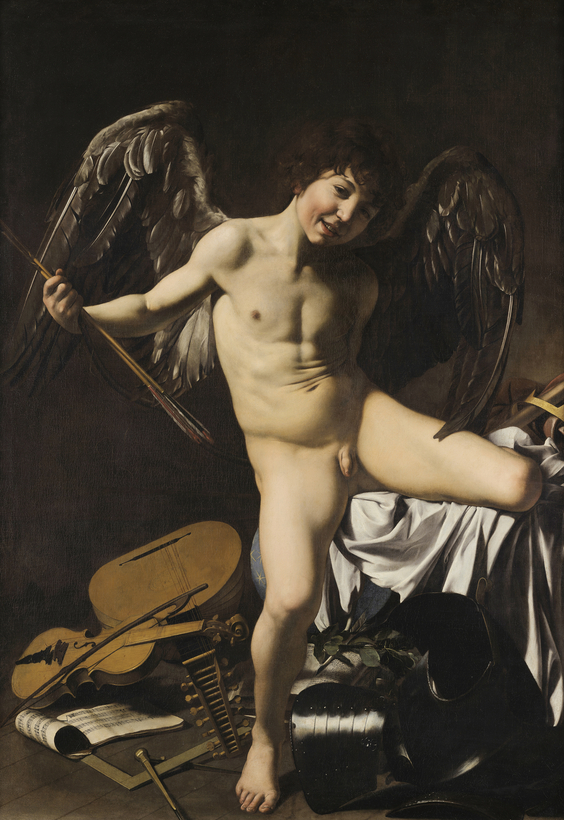
Looking at Caravaggio’s Victorious Cupid for the first time, it’s hard to escape the feeling that the instant one’s back is turned, the naked young boy in the picture will jump down out of the frame and run riot. Downright shocking in its life force, Caravaggio’s allegorical painting is unlike anything that came before or after. Indeed, it seems to bespeak some kind of Faustian pact.
Cardinal Francesco Maria del Monte, an early patron of Caravaggio’s, perhaps best captured his protégé’s artistry when he described it as “natural magic,” particularly in the way light and shadow were used to conjure the profundities of human nature. In Victorious Cupid, Caravaggio demolished Renaissance ideals of the chubby, celestial putto by depicting a young god with the body of an Adonis and the face and feet of a cheeky street urchin. On loan from Berlin’s Gemäldegalerie, and never before publicly on view in the U.K., this work is now the centerpiece of the exhibition “Caravaggio’s Cupid,” at London’s Wallace Collection.
It has long been believed that the model for Victorious Cupid, completed in Rome in 1601 or 1602, was Caravaggio’s young assistant and bedmate Cecco Boneri. The face certainly appears to be that of Boneri, who was also the model for two other Caravaggios. But while the luminous flesh tones of the body achieve a rare naturalism, the extraordinary physique echoes ancient sculpture and the attributes of an older boy. “I think it’s partly this juxtaposition which creates the picture’s shock value,” says the show’s curator, Helen Langdon, author of the seminal biography Caravaggio: A Life (1998).
Langdon believes that the widely held contemporary view of the painting as a manifesto of Rome’s homosexual demimonde, with Caravaggio at its center, is overdone. Too often overlooked is the part that Caravaggio’s erudite patron Vincenzo Giustiniani played in commissioning the work and advising on its literary theme of love conquering all. “There is no way Giustiniani would have been interested in showing in the very center of aristocratic Rome a painting about homosexual subculture,” Langdon tells me. “That doesn’t seem to me to be remotely convincing.”
When Victorious Cupid was completed, it took pride of place among the paintings and sculptures at the Palazzo Giustiniani, which became an opulent showcase for one of the most extensive art collections of the Baroque era. Giustiniani’s curator, Joachim von Sandrart, wrote about how he decided to put it behind a green silk curtain. “He was very precise about it,” explains Langdon. “He wanted it not to obliterate the pictures around it, which were great paintings by people like Titian. He also, I think, wanted to increase its incredible presence with a flourish at the end of his tour.”
Several years after Caravaggio died under mysterious circumstances in 1610, at the age of 38, Giustiniani wrote a letter to his lawyer Teodor Amideni asserting that Caravaggio had told him that it took “just as much effort to make a good painting of flowers as it was to make a picture of figures.” This gift for still life is made gloriously apparent in Victorious Cupid, where the young god has symbols of architecture, music, and warfare scattered at his feet. But there is no paintbrush or palette to be seen. “It makes me think that this is not just a painting about Cupid’s triumph,” Langdon says. “It is also about the triumph of Caravaggio himself and of naturalistic painting.”
“Caravaggio’s Cupid” is on at the Wallace Collection, in London, until April 12
Tobias Grey is a Gloucestershire, U.K.–based writer and critic, focused on art, film, and books
