
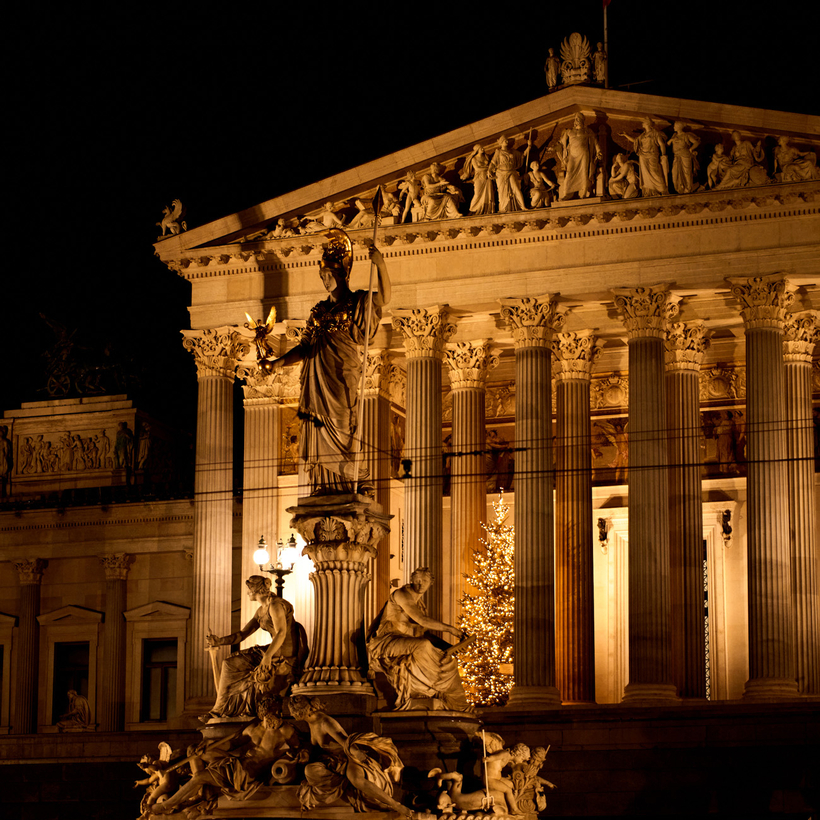

Vienna could really do without your belt bags and Hokas. Even in December, when subjects from all over the realm flock to its Christmas markets, standards must be upheld. Don’t even think about taking a selfie with the Vienna Boys’ Choir. Lateness, whether it’s for the Vienna State Opera or your Uber reservation, will not be tolerated. And you really should dress for dinner. (Sequins? Fur? Perfect!)

The building’s original architect was Alfred Keller, a key figure in the Art Nouveau scene.

This time of year, Vienna is almost oppressive in its merriment. Oversize baubles, snowflakes, and hearts hang over every major thoroughfare. At the markets, countless ornaments costing less than $10 are handmade by artisans who spend much of the year painting, felting, and papier-mâché-ing their way to this moment. (The best examples are at the Art Advent market in the shadow of Karlskirche, a Baroque church on the Karlsplatz.)

The overall mood is celebratory. Over a late Sunday lunch at Zum Schwarzen Kameel, a traditional coffee house in the First District, a table of 12 women in similar strains of bedazzled finery consumed at least eight bottles of wine, untold sausages and hash browns, and enough schnapps to keep a fire burning all night. They laughed, gossiped, and occasionally argued to great satisfaction as Gen Z tourists with inflatable lips came and went around them, joylessly Instagramming their schnitzels.

Even the check-in experience manages to feel homey.

“There are a lot of princesses in this town,” confirmed a taxi driver. “But now we have a queen.” He was referring to my hotel, the Mandarin Oriental, Vienna, which opened earlier this month after an 11-year wait. It has captivated the locals because it occupies a magnificent Art Nouveau building in the historic city center, a UNESCO World Heritage Site. It functioned as a courthouse until 2003, when it was decommissioned.

Many of Vienna’s five-star hotels are moody, masculine, and imposing, but the Mandarin’s 138 rooms and suites skew warm and feminine. The English firm Goddard Littlefair decorated the interiors in luminous shades of white, blue, and gold, with art at the center of the design. They commissioned 150 works from 25 local artists, including the renowned abstract painter Barbara Piller, that nod to Vienna’s golden age. The light fixture in the main lobby, an artful assembly of small spheres, is a wink to champagne bubbles.

The Mandarin Oriental has tempered Vienna’s fondness for the ornate with pared-back, soothing guest rooms.

The exuberance continues in the restaurant Atelier 7 Brasserie, which is already having a moment. In the evenings, the dining room is full of peacocking locals in their red velvet dinner jackets and strappy cocktail dresses, ordering plates of crudo and fillets of John Dory alongside Japanese-influenced cocktails.

But of the Mandarin’s many virtues, its exquisite, formal service is at the top. Venture into the spa, and a kneeling attendant liberates you from your shoes. Return home after a late night at the nearby Loos American Bar, and curtains open dramatically to greet you.

It’s tempting to sit by the pool, which is flanked by a sauna and steam room, but the city’s many delights beckon.

In Vienna, this sense of theater permeates everything and leads to spectacular cultural experiences. Imagine that a ballroom at, say, Buckingham Palace had a dirt floor—it would be similar to the arena at the Imperial Palace, where the Spanish Riding School showcases its Lipizzan horses. After their riders tip their hats to a painting of Emperor Charles VI, they perform a highly synchronized ballet under Volkswagen-size chandeliers.

Even that marvel is dwarfed by Sunday Mass at the Hofburg Chapel, best experienced from the rafters, which are technically rooms in the royal apartments. When the 16-year-old Duchess Elisabeth in Bavaria married Emperor Franz Joseph I there in 1854, she simply walked from the residence into the church without having to contend with the crowds outside.

On New Year’s Day, the Musikverein hosts an annual concert that is enjoyed on televisions all over the world.

Best of all may be a performance at the Musikverein, the gilded home of the Vienna Philharmonic. Recently, two orchestras (one stationed offstage) and nearly 100 choristers were deployed to perform Gustav Mahler’s Symphony No. 2 in C Minor. It’s one thing to watch these sorts of performances on PBS—the Musikverein is home to the annual Vienna New Year’s Concert—but the acoustics must be heard to be believed.

Perhaps this year, if a New Year’s resolution doesn’t sound too taxing, a December 2026 trip to Vienna might be a good choice. There’s no such thing as too early—or too grand.

The writer was a guest of the Mandarin Oriental, Vienna, where room rates begin at $700 per night

Ashley Baker is a Senior Editor at Air Mail