Mexico City is in the midst of a 21st-century renaissance, with an influx of talent that rivals the earlier 20th-century hotbed of artistic, social, and political innovation. Visits to the homes of the artists Frida Kahlo and Diego Rivera, the architects Luis Barragán and Pedro Ramírez Vázquez, and the political exile Leon Trotsky serve as a reminder of the manifold historic treasures of the city and the diverse and enduring accomplishments of its citizens.
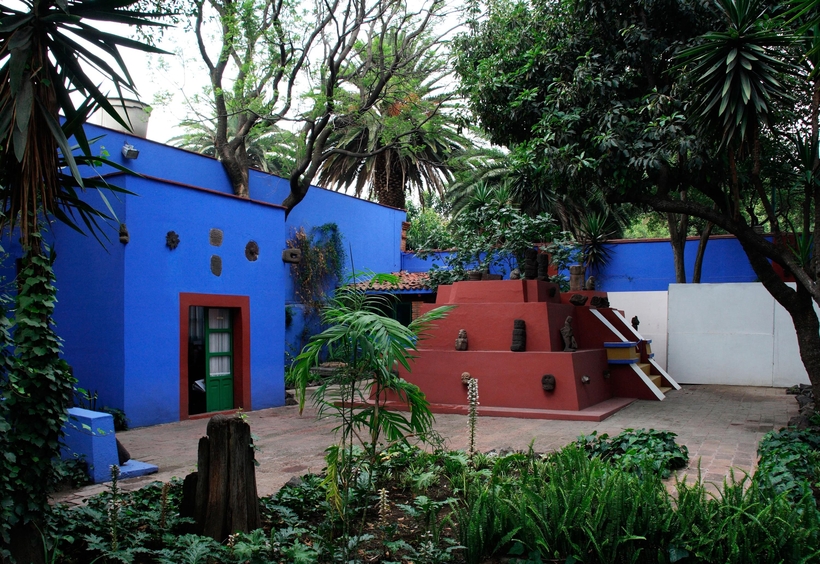
Casa Kahlo, Casa Azul, and Casa Estudio Diego Rivera y Frida Kahlo
Frida Kahlo is one of the 20th century’s most popular figures, admired for her daring and self-revelatory art, her role as a proto-political feminist, and her physical heroism after polio and a horrific trolley accident left her permanently disfigured. She also withstood being eclipsed and betrayed by her adored husband, Diego Rivera.
Also in partial eclipse has been her own family, which was always a source of support and refuge. Now her sister Cristina’s heirs have opened her second house, Casa Roja—close to the original family home, Casa Azul, in Coyoacán—to the public, though the actual time Frida may have spent there is left vague.
With the backing of a newly formed foundation and a wealthy private donor, the Kahlo heirs have resurrected and amplified the private family letters and artifacts kept safe by Cristina’s daughter, Isolda, with whom Frida was very close, though certain provenances have been questioned by experts. Frida allegedly acquired the home—now known as Casa Kahlo—for Cristina after her divorce left her alone with her children, Isolda and Antonio. What is verified is that Cristina alas repaid her sister by having an affair with Rivera, which caused the dissolution of Frida’s marriage. But Frida forgave them both: in 1935, she reconciled with Cristina, who remained a devoted companion, and in 1940 she re-married Rivera.
The goal of Casa Kahlo is to highlight “the circle of trust and love she grew up under,” says Mara de Anda Romeo, Isolda’s granddaughter, about Frida. Elaborate re-creations of the kitchen, dining room, and basement, and homages to the photographic career of her father, Guillermo—whom Frida assisted—and the culinary expertise of her mother, Matilde, accompany sophisticated digital interventions. One clear legacy is how camera-ready Frida always appeared despite her afflictions. A poignant installation about her later years as a teacher at the art school La Esmeralda demonstrates her evident delight in mentoring young artists.
Designed in part by the very sophisticated Rockwell Group and Pentagram architecture and interiors firms, there is a commercial sheen here that stands in contrast to Casa Azul—now Museo Frida Kahlo—purchased by Guillermo in 1904 and given to Frida and Rivera upon their marriage. Still the mecca of the Kahlo-Rivera collections, it was donated by Rivera to the government in homage to his late wife in 1957.
One cannot wander through the many rooms that reveal Frida’s youthful rebelliousness and precocious talent, as well as their hard-fought relationship, without being deeply moved. Featured are her elaborate Indigenous costumes, which she wore both as a proud Mexican and in order to better hide the hideous contraptions she was forced to wear; her single bed, with a canopy that nests a butterfly display made for her by her bedmate Isamu Noguchi; the photographs of her shot by paramour Nickolas Muray, which show her determinedly working from bed; and her fierce self-portraits, depicting her agonies. (Casa Azul has also been embroiled in scandal recently, over possible missing or misattributed artworks from the collection.)
Finally, don’t miss a visit to the Casa Estudio Diego Rivera y Frida Kahlo, the couple’s first home, in San Ángel, which they occupied in 1932. Consisting of separate but linked studios and living spaces, it is filled with folk art and was designed for the couple by the youthful Le Corbusier disciple Juan O’Gorman. Then you might head to the Aztec-inspired Museo Anahuacalli, which Rivera built to house his expansive collection of pre-Hispanic figurines.
As Frida has become one of the best-known art stars (a recent Sotheby’s auction achieved a price of $54.7 million for a self-portrait, El Sueño, a record for a female artist), the internecine factions of the Kahlo empire have been battling over her trademarks and her legacy. Despite that background noise, and in light of the enduring hold of the couple on our curiosity and imagination, these dwellings don’t fail to impress.
For more information on Casa Kahlo, visit museocasakahlo.org; for Museo Frida Kahlo, visit museofridakahlo.org; for Casa Estudio Diego Rivera y Frida Kahlo, visit inba.gob.mx.
Casa Estudio Luis Barragán
On an unassuming street in the Tacubaya neighborhood, Luis Barragán, an architect who first made his name in his native state of Guadalajara, acquired parcels of land a far cry from Jardines del Pedregal, where in 1945 he had co-founded an upscale development on the dramatic lava field of an ancient volcano. Homes in El Pedregal were conceived for wealthy patrons (Casa Prieto López, though re-done, is open by appointment; Casa Gálvez is sometimes open to professionals). The interiors and gardens are grand; the colors, vibrant. But Barragán, who grew up on a rural ranch, remained faithful to his roots. If a majestic tree was in the way, the house would circle it; nature had pride of place.
Beginning in 1947, the Tacubaya parcels, which Barragán had intended for gardens, became a laboratory and manifesto for his own house and studio, Casa Luis Barragán, an organic structure incorporating his reverence for light and space, his devotion to botanical life and the healing power of water, and his ardent Catholic faith.
A synthesis of modernism, Moorish design, and the Mediterranean, the whole is imbued with mysticism and a spirit of contemplation, evident from the moment you enter: the golden light emanating from the shimmering painting at the top of the stairs; the hues of the walls, which change depending on the time of day. Intimate spaces abound, from the library, with Barragán’s 1980 Pritzker Prize, to the master bedroom and guest room where Madonnas, arch-angels, and crucifixes mingle easily with Indigenous Mexican artifacts that sport their own mystical qualities. And everywhere, his signature silver reflecting balls act as mirrored centerpieces.
A pool of water next to the lush, overgrown garden is another space of reflection, where the double-height living-dining space with furnishings by Clara Porset appears through a proscenium-size window. “My house is a refuge,” he said, “an emotional piece of architecture.” By the time you arrive at the roof terrace, you, too, will feel transported. When he accepted his prize, Barragán expressed that his work fought everything he thought was on the verge of extinction—enchantment, serenity, intimacy, and awe.
For more information, visit casaluisbarragan.org.
Casa Pedro Ramírez Vázquez
In simplest terms, Pedro Ramírez Vázquez (1919–2013) was an architect and designer. But that vastly understates his role as a civic leader and the impresario of a new Mexico City. He was charged with designing many major midcentury educational buildings, modernist museums (including the grand National Museum of Anthropology), and religious structures. It was, however, as ringmaster of the city’s 1968 Olympics that he became the most ardent booster of its past and future glories.
It’s in his home and studio where Vázquez’s role as champion of design for political and social reform is abundantly archived. Reached by way of an exterior courtyard studded with monumental objects and the ubiquitous volcanic rock of El Pedregal, the horizontal structure, built in 1958, begins with a suite of gracious domestic rooms marked by low-slung sofas and religious iconography, which all give on to a glass-roofed interior patio. Evidence of Vázquez the collector—or, some might say, hoarder—is immediately apparent. In a study with high ceilings, a large desk anchors floor-to-ceiling bookshelves topped with paintings and memorabilia that cover every inch of wall space.
The ground-floor jumble leads to a small, winding wood staircase. Atop, an astonishing warehouse space, which extends the entire length of the building, holds thousands of objects—a testament to his prodigious output. Olympic memorabilia (including uniforms and capes to protect attendees from the nighttime stadium air) competes for space with architectural plans and maquettes, framed testimonials, posters, textiles, vitrines, still more bookshelves, figurines, souvenirs, and awards.
His son Javier Ramírez Vázquez, also an architect and graphic designer, as well as the current steward of this vast ensemble, holds the home dear not only for the warm personal memories but out of a desire to document his father’s commitment to bringing his beloved homeland into the 20th century without losing respect for the past.
For more information, e-mail Karina García at ramirezvazquezyasociados@gmail.com.
Leon Trotsky House Museum
After the splendors of the Kahlo-Riveras, the intimacies of Barragán, and the abundance of Vázquez, the Leon Trotsky house brings you down to earth. Trotsky, having emerged as Stalin’s fiercest critic, was exiled first from the Communist Party to Kazakhstan (then part of the Soviet Union) in 1927, then to Siberia, Turkey, France, and Norway before settling in Mexico in 1937. He and his wife Natalia Sedova rallied to become the center of Mexico City’s small circle of partisans, including Kahlo and Rivera, who convinced the Mexican president to give the Slavic couple asylum and then invited them to live with them at Casa Azul.
Political differences mushroomed between Trotsky and Rivera just as the latter sensed his guest’s growing intimacy with Frida, so the couple moved a few minutes away. Despite adding fortifications, they lived there for only a year before Trotsky was brutally assassinated in 1940, soon after a failed attempt led by Rivera’s onetime friend and fellow muralist David Alfaro Siqueiros.
Once in the dwelling, now known as the Leon Trotsky House Museum, the straightened circumstances of exile are apparent. The modest kitchen, a bedroom riddled with bullet holes, an armoire of threadbare garments and worn shoes, and the study where he was eventually bludgeoned with an ice axe each provide dramatic and tragic pentimenti of a lifelong clash with Stalinist powers.
Today, the site is also the home of the Right of Asylum Institute, dedicated to helping refugees. A central garden contains Trotsky’s beloved chicken coop as well as his remains.
For more information, visit museotrotsky.org.
Patricia Zohn has contributed to numerous publications, including Wallpaper, Artnet, the Huffington Post, The New York Times, and the Los Angeles Times
