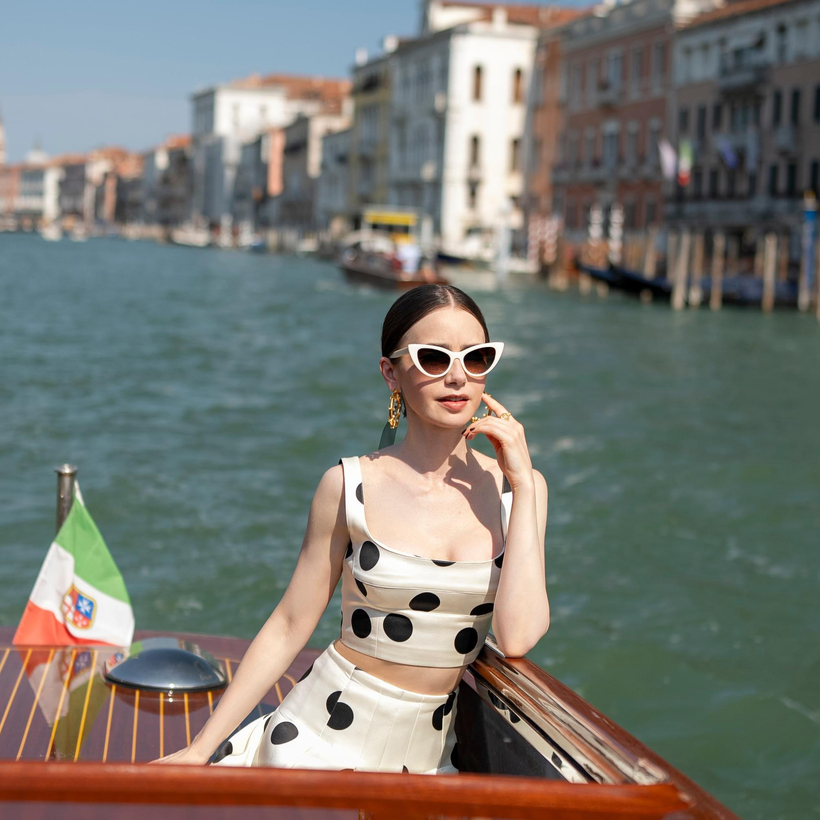
Every winter since 2020, when night starts to hit before 4 p.m. and it feels like the permanent state of meteorological affairs is grey drizzle, Netflix has been providing some sundrenched reprieve in the form of Emily in Paris, the rom-com series starring Lily Collins as a perky, slightly clueless, American marketing executive trying to thrive in the French capital.
Grim winters don’t really exist in the unapologetically fun and frothy show, except briefly in a cozy Alpine village — instead, Emily’s world is a perpetual runway of fabulous outfits and hot men set against stunning backdrops in the Latin Quarter, the Loire Valley, Provence and the French Riviera.
Unlike his heroine with her OTT fashion sense, the man behind it, Darren Star, is wearing an understated black T-shirt when he joins me to talk about the fifth series, which has Emily moving to Rome. Like Emily, he grew up in the American suburbs — her childhood was just outside Chicago, his in Maryland — and he tells me the show is inspired by old Hollywood films such as An American in Paris and Roman Holiday. “Those big Fifties movie productions gave people the same escapist feeling,” the 64-year-old says, flashing his brilliant white American smile.
After a long, successful career in TV, which started at just 27 with Beverly Hills 90210 and went on to include the game-changing Sex and the City, the writer and producer decided to make a show inspired by his time in Paris as a student and his love of the city.
The first series came out during the first Covid winter and showed an enchanting world, with flamboyant, colorful clothes (the costume designer, Patricia Field, also worked on Sex and the City and The Devil Wears Prada) and pretty shots of the center of Paris. Sure, there were clichés and cringeworthy lines but amid the gloom of the pandemic it was a multicolored, moreish escape. Not everything has to be The Wire.
At first critics lambasted it, luxuriating in the rarely used one-star rating. They said the drama showed an unrealistic version of Paris, but for Star this was the point. “I never understood the criticism of having somebody come and look at your country or city through a beautiful lens,” he says.
The writer had learned to develop a thick skin — “I can show you reviews for Sex and the City, the first season, they were just awful.” But then as time went on these haters allowed themselves to love, with a flurry of five stars for the second series.
The brief may sound women-orientated but two of my middle-aged male colleagues are now its biggest advocates. “I hear it randomly from men of all ages, they enjoy the show,” Star says, proudly. “They’re not embarrassed. I would hear more, ‘My girlfriend watches Sex and the City, my wife watches Sex and the City …’ at the beginning, it felt very female-centric. Emily in Paris — people just watch it.” Even the French got behind it: the series became the most viewed on Netflix in the country.
Having won over the Parisians, Star decided to move Emily to Rome at the end of the previous series — at least for a while. “I wanted to expand the footprint of the show and what it could be,” he says. “[Rome] represents another romantic fantasy.”
Sure, there were clichés and cringeworthy lines but amid the gloom of the pandemic it was a multicolored, moreish escape. Not everything has to be The Wire.
Once again some Italians complained about stereotypes. And yet it was then reported that the president of France, Emmanuel Macron, and the mayor of Rome, Roberto Gualtieri, were fighting over who got to keep Emily. “They really embraced us,” Star says about the Romans. “It’s evident in terms of the locations we were able to get access to” — including the Spanish Steps and the Trevi Fountain.
It’s striking in the present American political landscape where Donald Trump paints a picture of Europe as a hellscape overrun with migrants and crime. Does he think the escapist world he portrays appeals more to Americans because of the political situation in the US? “No, I completely take politics out of it.”
Brigitte Macron did do a cameo in the fourth season, though. Would he have included the prime minister of Italy, Giorgia Meloni, if she asked? “Well, it didn’t happen so it’s not something I have to consider.”
Why does he think he’s so good at writing about women? “I don’t know. I just feel comfortable writing them. I’m glad it connects. I always have close female friends, I have close female family,” he says. Also, when he worked on Sex and the City, “I knew sexually empowered women in their thirties who were successful and not married”.
Although he has a boyfriend and a 15-year-old son from a previous relationship, Star has been single at multiple points in his life — “you learn from those a lot”. He has spoken about how Sex and the City came at a time when people had been afraid of sex because of the Aids crisis, but when it was also becoming more normal to talk about it explicitly because of Bill Clinton’s affair with Monica Lewinsky.
“People were more open to a frank and honest discussion about sex,” he says. So why is Emily in Paris more chaste? “It’s just a different kind of show. [It’s] more of a romantic show.” Young women are reported to be having less sex these days. But as a single woman, I notice that Emily doesn’t use dating apps. “I don’t think she needs them,” he says. I guess it’s part of the escapism — a world where beautiful, nice men are plentiful.
“It’s also a lot about work. It’s about an office. She comes to Paris for a job,” he points out. “[Emily]’s got a pretty busy work life. Carrie [Bradshaw in Sex and the City] wrote a column, but she wrote it from home. Emily’s very busy.”
True. And as a result, Emily would do much better in the Bechdel test as, unlike Carrie, she doesn’t spend all her time talking about men. It’s representative of the societal shift encapsulated by the trend for saying “boyfriends are embarrassing”, sparked by a Vogue article in October. Star is amused but tells me he hasn’t heard of it.
“I never understood the criticism of having somebody come and look at your country or city through a beautiful lens.”
A crucial difference between the show and old Hollywood, however, is Emily in Paris doesn’t take itself too seriously. It asks viewers to laugh at themselves, both tourists and locals. And there’s a self-awareness of its secondary nature as a PR vehicle for the places and the brands it depicts, especially in the new series.
In one episode locals are distressed when a beautiful village is overrun by influencers after it appears in a perfume advert created by Emily and co — something that could then happen in real life because of the series, during a time when over-tourism is already bothering many Europeans.
Plus, Minnie Driver plays a wonderfully camp British aristocrat who makes her money promoting products on social media, including Peroni in one particularly outrageous scene, and is seen as tacky by the other characters despite the fact the show is promoting Peroni by including that storyline. It’s all very meta. As Star says: “This is a show about a marketing firm … [product placement] money helps, but it’s also organic to our storytelling.”
The two Golden Globe award nominations for the first series should have been a time for celebration for Star. But the Los Angeles Times published an article pointing out that the Hollywood Foreign Press Association, which conducts the Golden Globes, had been invited for a two-night stay at the five-star Peninsula Paris hotel when they visited the set of Emily in Paris, inciting some critics to say that influenced the voting process.
“That was ridiculous,” Star says, who up until this point has refrained from giving passionate responses. “I was very upset by the idea that there was press saying we didn’t earn or deserve our Golden Globe nomination. I think people sometimes love to have their knives out for things that are successful. I don’t know, but I would say that it was a very validating moment to get an Emmy nomination the same year.”
Alongside all this, his friend Deborah Copaken, who was a writer on the show, wrote an article saying her excitement about the Golden Globe nomination had been tempered by her “rage” that Michaela Coel’s I May Destroy You had been snubbed. She went on to allege that some of Emily in Paris was based on her own time in Paris and that Star had never properly credited her, something his team said was “blatantly false”.
“The whole thing was a non issue,” he says. “This got a little publicity but it happens more than you’d think.” People saying I told you this story and it ended up in your show? “Yes, all the time.”
Star has spoken of his love of I May Destroy You and says: “British writers are the best writers out there. I think they’re just excellent.” It’s interesting that Brits tend to go for grit rather than his style of escapism, I say, but he disagrees. “Can I mention Harry Potter, Bridget Jones’s Diary?” Yes, but they’re films, not TV. “I wouldn’t make a big difference between TV and film. Those are just the opportunities you get as a writer.”
His first glimpse of success was with a film script: while working as an assistant at a PR firm after graduating from UCLA, he sold one to Warner bros called Doin’ Time on Planet Earth. It was about a teenage alien prince mistaken for a child and received mediocre reviews, but getting a film made at just 24 was good going.
Then Beverly Hills 90210 happened and he became a TV king. He left 90210 and Sex and the City after three series, saying he liked taking risks and trying new shows, although with Emily he thinks he will stay until the end (he’s hopeful for a sixth series “and then we’ll see”). So Star wasn’t involved in the Sex and the City spin-offs, including the second film, which is one of the worst rated in cinematic history, and the widely panned And Just Like That… series, which ended this year with a diabolical finale. “I wasn’t watching,” Star says, carefully measuring his words. So it didn’t upset him? “I detach.”
He hasn’t ruled out a return to film. “It’s really about finding the right story to tell that’s meant to be two hours.” But his next project is a Netflix series about a female winemaker in Napa Valley. While there’s no release date, there is a title: Uncorked.
Does Star see Emily coming to London? “I mean, the door’s open. Alfie [Emily’s ex-boyfriend] is from London. Reasons to go to London,” he says, smiling. “You put that idea in my head.” Mission accomplished.
The new season of Emily in Paris is available on Netflix beginning December 18
Blanca Schofield is assistant culture-and-books editor at The Times and The Sunday Times of London