
A house by the architect Bruce Goff was not for the faint of heart. In 1949, in Aurora, Illinois, for instance, Sam and Ruth Van Sickle Ford—a civil engineer and an artist—commissioned a Goff home whose central structure would eventually resemble a pumpkin. Deciding they’d had enough criticism from neighbors, the Fords put up a sign at the construction site that read, We Don’t Like Your House Either.

A T-square ruler designed by Goff, shown here at his Redeemer Lutheran Church and Education Building, in Bartlesville, Oklahoma, circa 1950–60s.

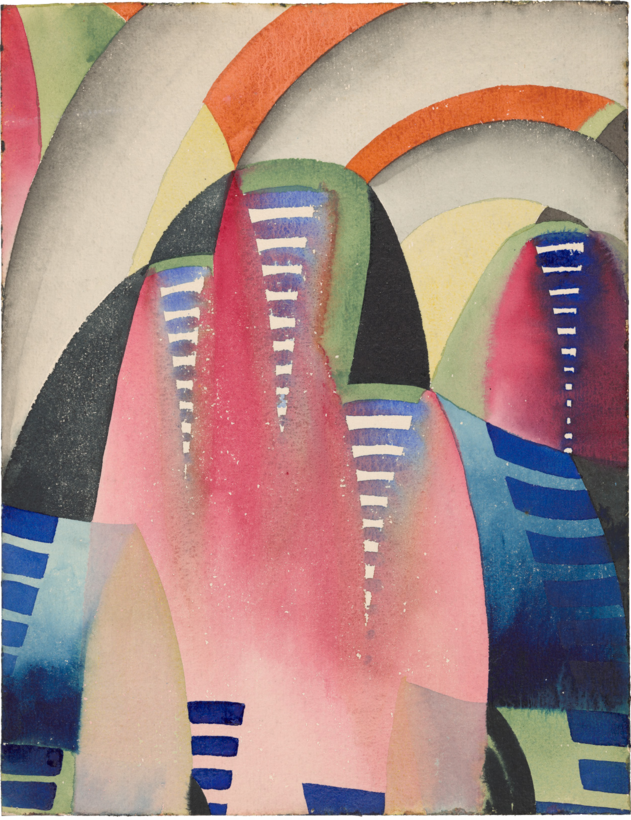
Today, plenty of people love Goff and his houses for the way they burst out of modernism’s stern functionality. Working mostly from the 1940s to the 1980s, largely in the Midwest, Goff produced hundreds of designs for homes and public buildings, with around 150 of them built. The more than 200 works in “Bruce Goff: Material Worlds”—an exhibition opening today at the Art Institute of Chicago—include architectural drawings and models, slideshows of the finished buildings, and examples of Goff’s abstract, rather mystical watercolors. For personal style, there are pieces of his own furniture, objects, and clothing. The fact that this is Goff’s first major show in more than 30 years suggests that his position as an architectural superstar remains a work in progress.

Top, a home built for Ruth and Sam Van Sickle Ford, in Aurora, Illinois, circa 1947–50; above, Untitled (Composition), 1932.

He was born in Kansas in 1904. When the family moved to Tulsa, Oklahoma, Goff was apprenticed at age 12 to the architectural firm of Rush, Endacott and Rush. Several years later, the firm was assigning him commissions and his champion Frank Lloyd Wright was urging him to skip a university degree, afraid it might stifle his unique talent. Goff’s gift lay partly in making almost every home unique, while binding the client’s wishes to his own artistic sensibility—often expressed in unexpected materials such as unprocessed glass chunks, cellophane, and surplus rope. The houses often seem to be frozen snapshots of some motion-filled moment in Goff’s restless, inventive mind.

Alison Fisher, a curator of architecture and design at the Art Institute, organized the exhibition with Craig Lee, an assistant curator of architecture and design at the museum. Fisher values two Goffian characteristics in particular: he insisted his practice include projects that were modest as well as luxurious, and he made listening to clients a priority. In contrast, to paraphrase the architectural historian Penelope Dean, Mies van der Rohe might tell them they couldn’t have closets.

A rendering of the Hopewell Baptist Church, in Edmond, Oklahoma, 1948–49.

Among those more modest projects was Goff’s 1948 Hopewell Baptist Church in Edmond, Oklahoma, which used steel pipe donated by a local oil company to form a 90-foot conical sanctuary. The top was dominated by an ecstatic, 12-pointed star-shaped skylight, and a hanging sculpture was made from aluminum cake pans. The churchgoers, many from the oil industry, helped build the church.

Top, a rendering of the Glass Block and Vitrolite House, Isometric, 1936; above, the Myron Bachman House, in Chicago, 1947–48.

Goff loved to re-purpose things. In 1970, for Glen Harder and his family, turkey farmers in Mountain Lake, Minnesota, Goff created a house evoking Japan, its deeply scalloped eaves suggesting the house might float off the ground entirely if it weren’t for the red-orange Astroturf covering the roof. (Pipettes that aid turkey reproduction ended up strung with beads as decorative items inside.) To build the Ford house in Aurora, Goff used ribs from a Quonset hut, a prefabricated staple for military use during World War II, to create the pumpkin-like central dome.

A home built for Glen and Luetta Harder, in Mountain Lake, Minnesota, 1980.

Goff, who died in 1982, had his share of reverses. In 1955, he resigned his leadership of the University of Oklahoma’s architecture school in the wake of a sting operation organized by local police. It was the early days of the “Lavender Scare,” a homophobic panic, and it was clear to Goff, a homosexual, Fisher says, “that the local community was hell-bent on removing him” from his post. In 1996, a fire destroyed what Fisher considers his magnum opus, an elaborate family home for the Asian art collector Joe Price. And Goff’s 1961 design for the Viva Casino & Hotel in Las Vegas, a space-age fantasy complete with medieval turrets, never got off the ground. But overall, enough remains of his creations to see that Goff, who also wrote poetry, did not merely do so on paper.

“Bruce Goff: Material Worlds” is on view at the Art Institute of Chicago until March 29

Peter Saenger has written and edited for The Wall Street Journal on such topics as art, art books, museums, and travel. His fiction has appeared in The New Yorker