
Yesterday, at the White House, Leon Black’s 40-year-old son Ben was sworn in by Donald Trump as C.E.O. of the U.S. International Development Finance Corporation. For Black, the billionaire co-founder of private-equity firm Apollo Global Management, the swearing-in was a proud moment. But given that he is currently under investigation by Senator Ron Wyden for the millions that he paid the late pedophile Jeffrey Epstein, allegedly for tax- and estate-planning services, and that Congress recently compelled the Department of Justice to release its remaining Epstein files, his son’s appointment to such a powerful post comes at a particularly fraught time.
Back in September, the House Oversight Committee released Jeffrey Epstein’s 50th-birthday book, which had been assembled for him by Ghislaine Maxwell in 2003. Inside, there were personalized greetings from dozens of well-known figures including Bill Clinton and Trump, whose entry reportedly consisted of a now notorious sketch of a nude woman with Trump’s signature standing in for pubic hair. (Trump has claimed that his signature is a forgery, and he is suing The Wall Street Journal, the paper that broke the story, for defamation.)
But the birthday book also contained something else that was intriguing: a 16-line poem, handwritten by Black. Entitled “On the Occasion of Jeffrey Epstein’s 50th Birthday,” it included these lines: “Five decades, L, or half century.… / Blonde, Red or Brunette, spread out geographically / With this net of fish, Jeff’s now ‘The Old Man and The Sea’ / Teaching math, trading options or foreign currency / Green eyeshades, schemes and plans, a unique tax strategy.” It was signed “Love and kisses, Leon.”
The 74-year-old Black was a longtime Epstein friend and business associate who had more than 100 meetings scheduled with him between 2013 and 2018. But it wasn’t until 2020, a year after Epstein’s arrest and subsequent death in prison, that Apollo’s board commissioned the Dechert law firm to produce a report on the pair’s relationship. While the Dechert report stated that Black had paid Epstein $158 million, it concluded that there was “no evidence” that Black was “involved in any way with Epstein’s criminal activities at any time” or that “Epstein ever introduced Black, or offered to introduce Black, to any underage woman.”
Nonetheless, Black was eventually pushed out of Apollo as the Epstein scandal metastasized alongside revelations about Black’s years-long extramarital affair with a Russian model named Guziel Ganieva, to whom he paid millions, and who sued him, alleging that he had raped her, which he denied. (Ganieva’s case was dismissed by a New York State judge in 2023.)
My previous investigation into Black delved into the $158 million that Black paid Epstein, revealing that Epstein used Black’s nine-figure payment to fund his sex-trafficking operation via a U.S. Virgin Islands–based entity called Southern Trust. It also discussed Wyden’s allegation that a solution Epstein had devised for a problem that Black had involving a GRAT—a trust used to minimize inheritance taxes—which had, according to Black’s lawyers, “inadvertently overdistributed income to Mr. Black,” was itself problematic and may have resulted in Black’s avoiding more than $1 billion in gift and estate taxes. (Black’s spokesman told me that the transactions that Wyden was analyzing were “lawful in all respects”—that they had been “conceived of, vetted and implemented by reputable law firms and tax and other advisors,” and that Black had “fully paid all taxes owed to the government.”)
Despite all this, Black’s net worth has increased dramatically alongside the price of Apollo stock, rising from $10 billion in 2023 to $14 billion today. Perhaps as a result, Black is still a trustee of the Museum of Modern Art and has maintained his position in New York’s elite social circles. This fall, Black sat courtside with his son at the U.S. Open men’s finals. At a party at the home of his art dealer, Larry Gagosian, he rubbed shoulders with Jerry Seinfeld and Lorne Michaels.
What follows is the inside story of Wyden’s continuing investigation into Black and his crusade to get Treasury Secretary Scott Bessent to finally release all the suspicious-activity reports regarding the enormous sums paid to Epstein, which the banks filed after Epstein’s death. Meanwhile, Ben Black is now installed in the Trump administration, in close working proximity to Bessent. This could set up a high-stakes Shakespearean drama of the very sort that Black himself loves, only with Ben Black positioned to play the part of the avenging son.
No “Verifiable Business Purpose”
While the Dechert report exonerated Black, it nonetheless provided a veritable road map to a host of questionable Epstein-related activities and transactions.
Wyden began his investigation by sending Apollo a detailed letter filled with questions. Apollo’s counsel, former U.S. attorney for Colorado Tom Strickland, responded that Apollo had not been given access to the materials in question, and so could not answer their questions. Wyden’s investigative team then began engaging directly with Black’s counsel, sending questions about what Epstein did to help Black with his various tax issues, including the solution he allegedly created for the GRAT.
According to sources with knowledge of the investigation, Black’s lawyers would reply to these letters by providing selective and incomplete answers to some questions, and simply ignoring others. While Black’s counsel gave Wyden’s team a copy of the GRAT in question, they declined to inform Wyden how much income it had “inadvertently overdistributed” to their client.
Black’s attorneys told Wyden that he “voluntarily answered more than a dozen of the Committee’s questions and also voluntarily produced more than 150 pages of personal taxpayer and estate-planning documentation—answers and documentation that he was not legally required to provide.” They also, however, denied a dozen requests, stating they fell “outside the scope of the Committee’s inquiry.”
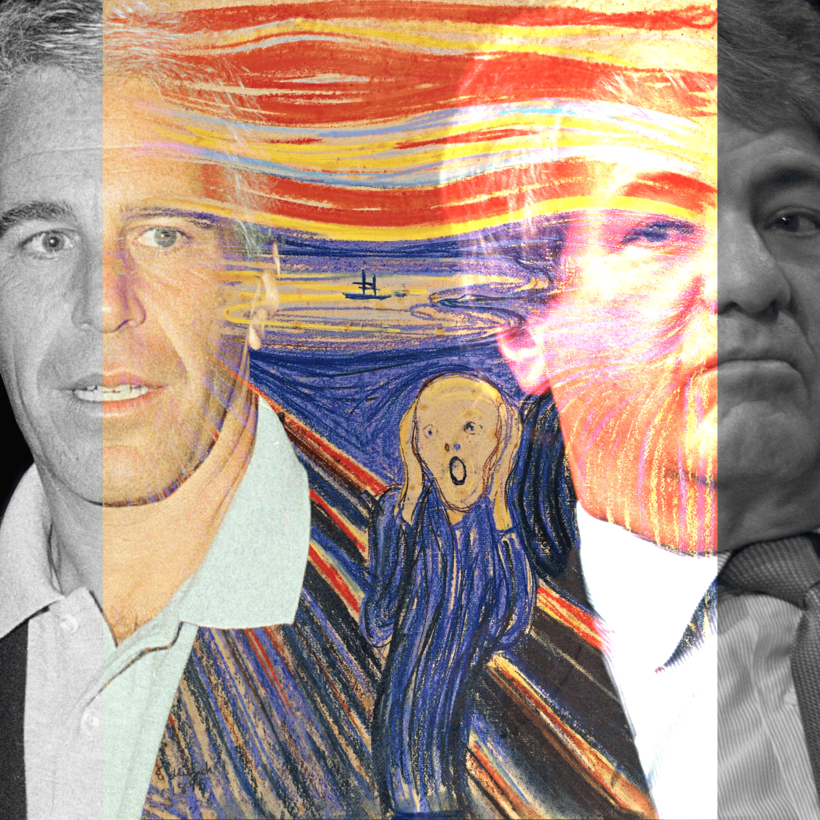
Black’s $1 billion art collection was also said to be off limits for discussion, according to sources with knowledge of the investigation, notwithstanding the fact that Epstein was involved in many of Black’s art transactions. To cite one notable example, it was Epstein who reached out to JPMorgan in 2012 seeking a loan, presumably to fund Black’s $120 million purchase of Edvard Munch’s The Scream. “Why on earth would [Epstein] be inbetween [sic] us and Leon?,” Mary Erdoes, the bank’s Asset & Wealth Management C.E.O., asked a colleague, in an e-mail exchange included in JPMorgan records recently unsealed by a federal judge. Epstein, a senior bank executive told her, was “Leon’s primary advisor and will be calling the shots.” Black’s spokesperson denies Epstein or JPMorgan had any involvement with the acquisition of The Scream. (JPMorgan declined air mail’s request for comment.)
“Epstein’s harassment and his relentless pursuit of more money crossed the line so Mr. Black ended the relationship,” says Black’s lawyer Susan Estrich. “Epstein was a braggart who embellished and exaggerated his role and responsibilities in many ways.”
According to sources close to the investigation, Wyden’s team met in person with Black’s counsel in Washington to offer a deal: if Black would explain to them how Epstein’s tax solutions worked and then come out and make a public statement acknowledging that these kinds of tax-avoidance structures should be reformed, their investigation would conclude. But Black’s lawyers turned them down. “Leon Black was offered a chance to privately explain his business dealings with Jeffrey Epstein, and he did not agree to do that,” said a source with knowledge of what transpired. “That is the hubris that Leon engaged in here. He thought he could just bottle this up without engaging in good-faith negotiation.” (Black’s spokesperson did not respond to a question about why he turned down Wyden’s offer.)
Several months later, in February 2024, came a breakthrough: the Treasury Department granted Wyden’s team access to its file on Epstein’s financial records, including the SARs filed with regards to Black’s Bank of America transactions. While Wyden’s team had asked Treasury for copies of the SARs, they were instead granted “in camera” review, meaning that they could go into Treasury to see the documents in person and take notes, but they could not photograph or make copies of the reports. (Previously, Treasury had granted Senate Republicans similarly restricted access to SARs involving Biden’s family.)
The “in camera” review of Black’s SARs enabled Wyden’s team to make several interesting discoveries. First, the total amount that Black had paid Epstein was not, as Dechert reported, $158 million. As it turned out, Black had sent two additional bank wires to Epstein, bringing the total to $170 million.
According to a letter Wyden sent to Attorney General Pam Bondi, F.B.I. Director Kash Patel, and Secretary of the Treasury Scott Bessent in March, Bank of America had filed the SARs because these payments did not appear to have a “verifiable business purpose” or an “apparent economic, business, or lawful purpose.” Some of the SARs pointed to a “suspicious use of multiple accounts.”
A number of the wires Black sent to Epstein were for enormous sums, as large as $12 million and $20 million each—and yet Bank of America may not have properly accounted for the payments, raising concerns about whether, or to what extent, it complied with anti-money-laundering regulations. As the source familiar with what transpired put it, “This is a compliance debacle of astonishing proportions.” (Bank of America declined air mail’s request for comment. They are currently being sued by Epstein victims in a class-action lawsuit filed in October.)
According to sources close to Wyden’s investigation, Black’s wires to Epstein came not only from his personal bank accounts but also those of his wife, Debra, and Black Family Partners. Even Black’s assistant, who had signatory authority and was empowered to transact on Black’s behalf, was flagged in a SAR.
A Minor but Important Character
Recently, Wyden’s team publicly criticized the I.R.S. for not auditing or investigating the tax- and estate-planning services that Epstein provided. Meanwhile, Ben Black opened his own investment firm in October 2020, the same month that Apollo announced it was hiring Dechert to investigate his father’s ties to Epstein.
While many financial firms are named after their founders, their locations, or, as with Apollo, a Greek god, Ben Black chose to call his company Fortinbras Enterprises, after a minor but important character in Hamlet. A young prince of Norway whose father was murdered by Hamlet’s father, Fortinbras announces his intention to reclaim the land his father lost to King Hamlet at the start of the play. In the end, the entire Danish royal family is dead and it is Fortinbras who triumphs, avenging his father’s murder by ascending to the Danish throne.
Leon Black probably gets the reference. He endowed a chair in Shakespearean studies at his alma mater, Dartmouth College; once declared in an interview, “Most of what I learned about how to do business I learned from Shakespeare, not Harvard Business School”; and has compared Apollo co-founder Josh Harris, his erstwhile rival, to Iago in court documents.
This past January, Trump nominated Ben Black to become C.E.O. of the U.S. International Development Finance Corporation (D.F.C.), a government entity with an approximately $50 billion portfolio of strategic investments in the developing world. Prior to Ben Black’s nomination, those thought to be in contention for the post included a former Florida congressman who sponsored the 2018 law that created the D.F.C., and a Texas businessman who was president of the D.F.C.’s predecessor agency, the Overseas Private Investment Corporation, during Trump’s first term.
In an article entitled “What Will Become of USAID Funding? A Billionaire’s Son Has Some Ideas,” The New York Times quoted an international-law professor who posited that Ben Black’s appointment stemmed from the fact that, just weeks prior to it, he had co-written a Substack essay with tech billionaire Joe Lonsdale entitled “How to DOGE US Foreign Aid.” “Clearly someone saw this essay and said, ‘This guy aligns with our worldview,’” the professor told the newspaper. But others on Wall Street, who feel that Ben Black is underqualified, suspect that he likely co-wrote the essay after he knew he was going to be given the appointment, and that he did so in order to make himself seem a good fit for the post.
Ben Black now serves on a small board of directors overseeing the D.F.C. alongside Treasury Secretary Scott Bessent. As head of Treasury, Bessent, who is widely seen as a Trump loyalist, controls access to all the SARs, including those filed on Leon Black. In addition, because Trump appointed Bessent acting commissioner of the I.R.S. this past summer, he now has power over both of our government’s most significant financial agencies, each of which may be key to Wyden’s investigation into Black. (The D.F.C. and the White House did not respond to air mail’s requests for comment.)
This past summer, while onstage at the Young America’s Foundation Conservative Student Conference, Bessent was asked whether the Treasury Department had “reviewed and acted upon the Jeffrey [Epstein]–related SARs in a comprehensive way to potentially identify co-conspirators.” Bessent did not answer the student directly; instead, he ventured a “guess” that there are SARs on Senator Wyden.
Wyden countered by posting a video clip of Bessent’s statement on X. “Scott Bessent doesn’t like that I revealed that he’s sitting on a massive Epstein file, so he’s resorting to making ridiculous accusations,” Wyden wrote. “Here’s my response to Bessent. Release everything. Release the files on Epstein. Release the files on Epstein’s pal Donald Trump. Release the files on you. You could release the files on me, but we both know there aren’t any.”
On November 18, the day Congress voted to compel the Department of Justice to release its Epstein files, Wyden took to Bluesky. “Let me tell you about the other Epstein files the Trump administration is STILL HIDING – records that aren’t affected by the bill Congress passed today.
“The Treasury Department has its own Epstein file containing thousands of bank records. My investigators reviewed a portion of those records last year. I’ve demanded [that] Secretary Bessent produce the file for further investigation. He has refused repeatedly.
“What would those records help reveal? Where Epstein got his money. How he acquired and controlled his victims. Who he trafficked them to … and what crimes they committed.
“We need to force the Treasury to release the bank records,” wrote Wyden. “FOLLOW THE MONEY.”
Now, five and a half years after Epstein’s death, the end stage of this high-stakes drama is finally playing out on Capitol Hill. Will Trump continue to deflect attention from his own ties to Epstein by emphasizing those of Larry Summers, Bill Clinton, and, as he put it recently, “the hedge fund guys that were with him all the time,” thereby potentially ensnaring Leon Black? And if so, might Ben Black seek to play the part of Fortinbras? The final act is just beginning.
Johanna Berkman is a Writer at Large at AIR MAIL. You can read her profile of Jumi Bello, which won the 2023 Deadline Club Award for Arts Reporting, here
