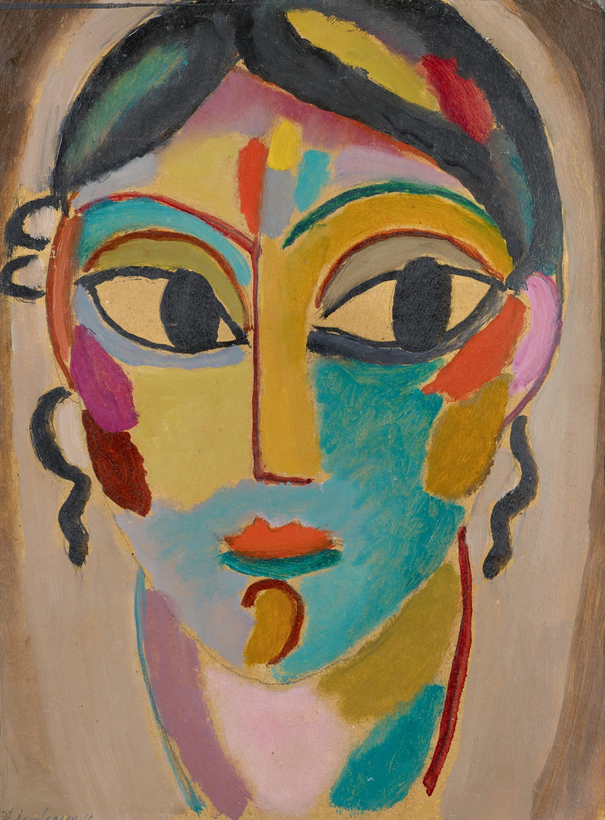
The Russian-German painter Alexej von Jawlensky was something of a sponge. Born in 1864 and channeled toward a military career, he was 18 when he experienced an epiphany upon visiting the All-Russian Exhibition of Industry and Art. By 1896 he had abandoned the czar’s army and left St. Petersburg to crisscross Continental Europe, soaking in the avant-garde. In France, he analyzed the Post-Impressionist pictures of Paul Gauguin and Vincent van Gogh, experimented with sizzling color in the studio of Henri Matisse, and exhibited with the Fauves at their maiden Salon d’Automne. In Germany, he befriended Gabriele Münter and Wassily Kandinsky, dabbled in Theosophy, and joined the Expressionist splinter group the Blue Rider.
And yet, as viewers will learn in “Alexej Jawlensky”—an exhibition that opens on January 30 at the Louisiana Museum of Modern Art, in Copenhagen—it wasn’t until World War I drove Jawlensky into Switzerland, at age 50, that an original artist was born. Through some 60 paintings on loan, the exhibition traces his career crescendo.