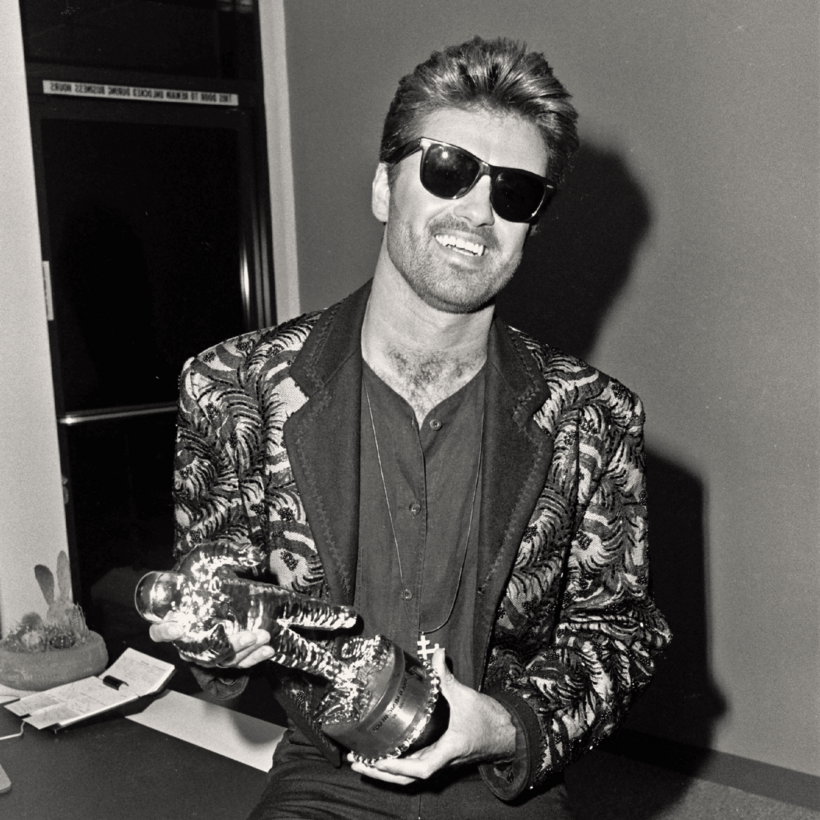
This year marks the 10th anniversary of George Michael’s death. It’s an excuse to re-evaluate his cultural legacy, which I have done at length in my new book, Tonight the Music Seems So Loud: The Meaning of George Michael. And when it comes to American R&B, one of the curious changes the Brit and former Wham! front man arguably helped bring about was the way the traditionally Black genre was classified and appreciated.
It all started in the late 80s, when the phrase “cultural appropriation” was still sociological jargon, and when Faith—featuring hits like “Father Figure” and the titular track “Faith”—made George Michael the first white soloist to lead the Billboard Top Black Albums chart. This success was followed by official accolades: at the 1989 American Music Awards, the public voted to anoint Faith the best Soul/R&B Album (beating Gladys Knight’s All Our Love and Keith Sweat’s Make It Last Forever), and Michael both Favorite Soul/R&B Male Artist (over Michael Jackson and rapper Bobby Brown) and Favorite Pop/Rock Male Artist (over Jackson, again, and Steve Winwood).
Michael was delighted, but many others were not. “Who does he think he is?” soul singer Freddie Jackson asked aloud in the Los Angeles Times. “Listen, the black man is still the soul singer.... White singers can have soul too, but it’s not the same as black soul. Black singers are born with soul, we live it.” Soul’s grande dame Dionne Warwick objected to Michael’s even being seen as a soul/R&B artist by the American Music Awards. “It’s a puzzle how that was even considered,” she commented.
As a genre, R&B has been simultaneously embattled and co-opted by the mainstream. White artists have been accused—often deservedly—of appropriating and exploiting the work of Black musicians going all the way back to the early 19th century. Concerns over the integrity of the genre were arguably even more intense in the 60s, when Billboard stopped publishing its long-running R&B singles chart for a period: some thought it wasn’t necessary in a world where R&B dominated the pop charts.
But the chart was reinstated in 1965, and it seemed that concerns about the influence of white singers on R&B were exaggerated—instead, the opposite was true. By the 1980s, with the success of artists such as Michael Jackson and Prince, the sound of pop was the sound of R&B. In the several decades since, R&B has evolved, but the genre remains both vibrant and mostly Black—and George Michael’s contributions arguably only added to its popularity.
Which is not to suggest that Black culture is not sometimes appropriated in insulting ways by white people in the music industry—it’s not hard to think of examples where negative stereotypes are perpetuated, or where aspects of a marginalized culture are adapted without due knowledge or respect.
But unlike Justin Bieber, who complained when the Grammy Awards categorized him as pop instead of R&B in 2020, Michael never claimed to be a “soul” singer. He usually classified his music as pop or MOR (an acronym for “middle of the road,” referring to easy-listening tunes made for the radio). When asked directly about his musical identity, Michael was quick to clarify: “I definitely know that I never thought I sounded black.” Michael was also a frequent collaborator with Black R&B musicians. He performed highly credible duets with Aretha Franklin, Whitney Houston, Ray Charles, Beyoncé, and Mary J. Blige, the latter of whom described his voice as “very soulful.... He had soul. Period.” There were cover versions of soul classics so intelligent that they attracted the praise of the people who wrote them, including Stevie Wonder, who called listening to Michael and Blige’s version of “As” “a magical experience,” adding, “I was in awe when I heard it.”
It’s impossible to deny that Michael broke down barriers in the U.S. charts. His success on the Black music charts in the 1980s had his manager Rob Kahane lobbying the magazine to change things all over again. “He was responsible for me going to Billboard and saying, ‘George is going to be entering the Black charts and he thinks it’s the stupidest name.’” In 1990, the Hot Black Singles chart was re-named Hot R&B Singles and Top Black Albums became Top R&B Albums.
The fact is that George Michael’s soulful pop transcended race and genre to an unusual degree, something that writer Aliya S. King focused on when she paid tribute to the singer just after his death, in 2016 at the age of 53. She confessed that when she fell in love with “Careless Whisper,” “a lingering ballad packed with heartbreak and heaven-help-me desperation,” she thought Michael was Black. “Why wouldn’t he be? Every black person I knew—friends, family, neighbors and camp counselors—they all loved the new song…. The sounds that came out of his mouth were simply sublime.”
Sathnam Sanghera is a columnist at The Times of London and the author of Empireland: How Imperialism Has Shaped Modern Britain