A key piece of covering the N.F.L.’s quarterly league meetings, as I have for a dozen years as a sportswriter for The New York Times, is trying to get the tight-lipped, billionaire team owners to talk about issues of the day. Mostly, it’s a fool’s errand. Few of them want to talk to the media, let alone be seen talking to you, and when they do talk, they are often guarded.

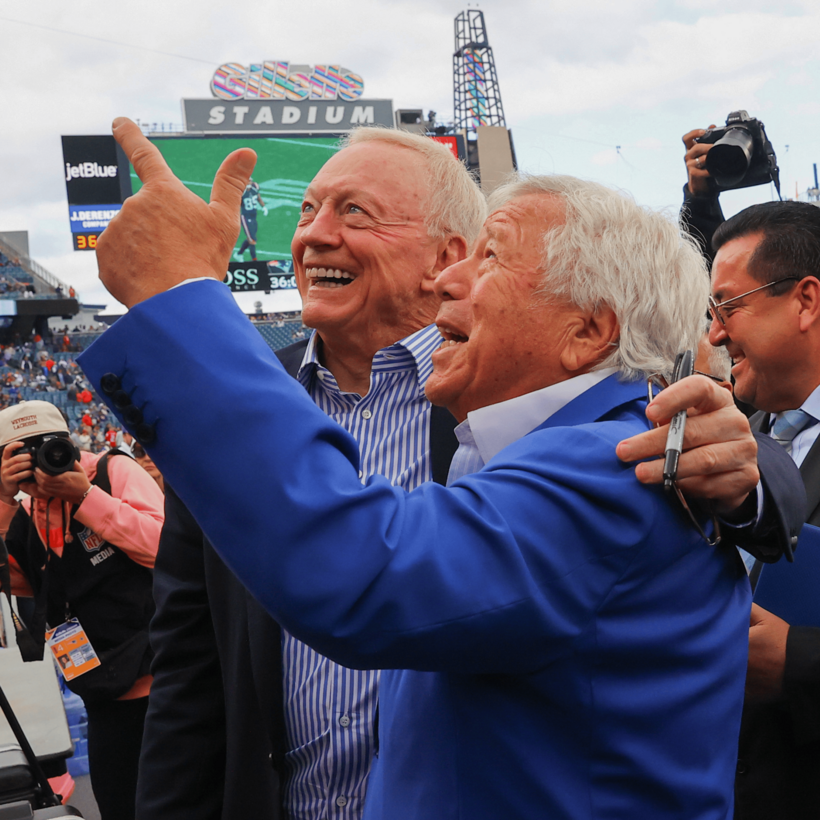
But the two most powerful owners—Jerry Jones, 83, of the Dallas Cowboys, and Robert Kraft, 84, of the New England Patriots—routinely speak with reporters, and their interactions say much about who they are and how they want to be perceived. Take the three-day owners’ meeting in 2023 at the Frank Lloyd Wright–inspired Biltmore hotel in Phoenix, Arizona.

One morning, Kraft’s spokesman, Stacey James, told several dozen reporters and cameramen to meet outside a conference center and be ready when Kraft came by during his lunch break. For half an hour, we stood between a narrow walkway and thorny red shrubs. Best I could tell, we were positioned there so an enormous saguaro cactus could provide an Arizona-themed backdrop.

For 15 minutes, Kraft flitted between deflection, self-deprecation, and candor. Without star quarterback Tom Brady, who had left for the Tampa Bay Buccaneers in 2020, the Patriots were now mediocre. Reporters wanted to know whether longtime head coach Bill Belichick would be the next to go.

“I think Bill is exceptional at what he does,” Kraft said. “But in the end, this is a business. You either execute and win, or you don’t. That’s where we’re at.”

Kraft then walked across a driveway to an NFL Network television set for another interview. After he finished, his wife, 51-year-old ophthalmologist Dr. Dana Blumberg, handed him their dog, Heisman, named for the Heisman Trophy, a Shih Tzu Kraft received on his 80th birthday from Ari Emanuel, the C.E.O. of Endeavor, the entertainment-and-media agency and the inspiration for the character Ari Gold on the HBO show Entourage.

After the meeting ended the next day, Jones spoke in his typically seat-of-the-pants fashion. Most of his fellow owners raced for their limos and private jets. A league spokesman eased their getaway by announcing that Commissioner Roger Goodell—the third subject of my book Every Day Is Sunday: How Jerry Jones, Robert Kraft, and Roger Goodell Turned the NFL into a Cultural & Economic Juggernaut—would soon start his news conference, forcing some reporters to give up on chasing owners and head instead to see Goodell.

Goodell is intensely bland at the podium, while Jones is a grab bag of hot takes, off-color jokes, and serpentine explanations. So I joined a gaggle of reporters who surrounded Jerry, as everyone calls him, as he headed to his Cadillac Escalade.

Jones is also the team’s general manager, so beat writers peppered him with questions about his team. But Jones rarely ducks a question, including the thorny topic of his friendship with Dan Snyder, the much-reviled owner of the Washington Commanders, who was trying to sell his team.

“I think that [the sale’s] a little more formal, but I think it’s that way because of the various issues that are involved here,” Jones said, referring to several investigations into allegations of sexual harassment in the front office, financial impropriety, and more. “It’s not ‘lovey-dovey,’ but it’s not really strained in any way.”

Kraft and Jones have been the faces of their franchises for more than three decades, and both see speaking to the media as part of their jobs. They can be charming and quirky at times. During an interview in his office in 2017, Kraft gave me a dozen eggs hatched by chickens he kept at home. Jones took me on a helicopter ride to see the Star, the team headquarters he was building north of Dallas. When the windows fogged up, he used the sleeve of his expensive suit to wipe off the condensation.

They have their limits. Kraft has felt burned by certain reporters and news organizations and has become more careful about whom he speaks with, particularly after he was swept up in a prostitution investigation at a “spa” in Florida in 2019.

Jones still talks to reporters outside the team’s locker room after every Cowboys game, something unheard of in the N.F.L., and speaks to local radio reporters during the week. He believes that all publicity is good publicity.

But there are exceptions. In October of 2024, Jones snapped at the radio hosts who interviewed him every Tuesday. Tired of their questions about the Cowboys’ poor performance, he threatened to have them thrown off the air. The station, after all, was the team’s radio-broadcast partner.

“If I’m going to be grilled by the tribunal, I don’t need it to be by the guys I’m paying,” Jones said later. “I can take it from fans and take it from other people. I take a lot of pride in how fair and how much I try to work with the media. We’re brothers and sisters. But I was a little frustrated there today.”

Ken Belson is a New York Times reporter covering sports, power, and money at the N.F.L.