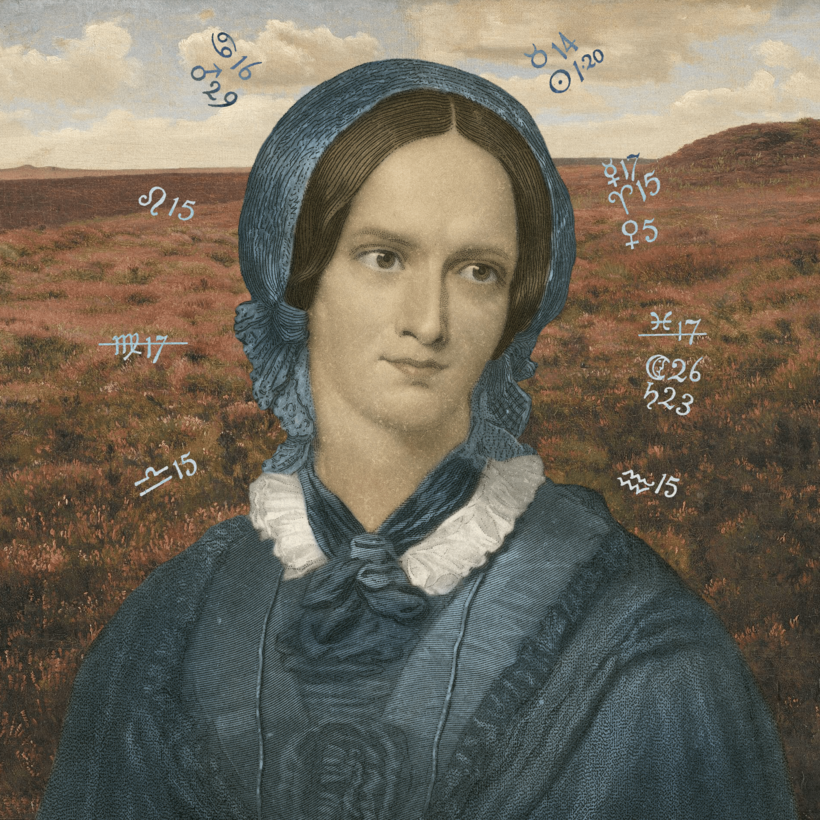
Shortly before she became one of the 19th century’s most scrutinized women, Charlotte Brontë told a friend that if strangers happened to look at her once, they made sure never to make the same mistake again.
She meant it humorously, but the remark also reflects her long experience of feeling underestimated, ignored, or pushed aside. Today, though, she is remembered as confident, erudite, and fiercely ambitious. Legend has given her a stature that life rarely did.
Between these two states was a mass of repetition and amplification. Gossip was repeated in Victorian newspapers, reinforced by the claims of people who said they had known her, and then cemented by a salacious biography. Astonishingly, I’m not describing a century of embellishment: Charlotte Brontë was transmitted from woman to myth over the course of a single extraordinary summer.
Drawn to the gaps in history, and to the liminal spaces in stories, I was intrigued when I discovered this. That so much enduring mythmaking had been compressed into the space of mere weeks sounded impossible. Or, less like the 19th century I thought I knew, and more like the viral social-media explosions of popular culture today.
Having read as many Brontë biographies as I could find, I knew that biographers typically ended the Brontës’ story with Charlotte’s death, in the spring of 1855. Even the events of the last seven years of Charlotte’s life—the deaths of her siblings Branwell (1848), Emily (1848), and Anne (1849); the publication of her last novel, Villette (1853); her obstructed courtship (her father felt that her suitor, the Reverend Arthur Bell Nicholls, was too poor) and brief marriage interrupted by her death, at 38—were usually compressed into a brief coda.
This period of Charlotte’s professional emergence as a writer—her first published novel, Jane Eyre (1847), propelled her into the exclusive London publishing world—and the settling of her private life was considered too domestic, too dramatically unsatisfactory, too tonally at odds with the unfulfilled striving of a Brontë gothic. It becomes an epilogue.
But it was during this period that Charlotte, newly embedded within the London literary set, first met Elizabeth Gaskell, who, like Brontë, had recently published her first novel. In conversations, Gaskell listened to Charlotte make sense of her past, turning her family’s calamities into a romantic tale of uncannily talented siblings isolated on the moors. A few years later, after Charlotte’s death, Gaskell would remember all this self-mythologizing when she was asked by Charlotte’s father, Patrick Brontë, to write his daughter’s life story, published in 1857 as The Life of Charlotte Brontë.
My biography, The Invention of Charlotte Brontë, unpacks those last years. It reconstructs Gaskell’s pursuit of the truth and her determination to settle scores on Brontë’s behalf.
Warning her publisher to have their lawyers on standby, she characterized Brontë’s father as a manipulative narcissist, and exposed Charlotte’s brother Branwell’s mistress, blaming her for his descent into addiction and his eventual death. Gaskell identified the real-life inspiration for the hellish girls’ school in Jane Eyre and accused its clergyman headmaster of being responsible for the deaths of multiple pupils, including Charlotte’s two eldest sisters. Gaskell chastised reviewers, publishers, and even those of Brontë’s friends whom she felt had mistreated or betrayed her.
Inevitably, The Life of Charlotte Brontë caused a furor the moment it was published. Those named in it threatened to sue Gaskell and her publisher, forcing them to issue a public apology and withdraw the book from sale. It was reissued twice in six months, with sections re-written under the supervision of a lawyer, but the scandal it generated in the English and American press produced the Victorian equivalent of doxing for Gaskell and her slandered subjects.
Today’s consensus is that Gaskell’s research was inadequate and her sources were unreliable; in addition, being a female novelist, she was inclined to invent what she did not know (a reflection of society’s inherent bias against female writers at the time). While her biography remains one of the most contested in the English language, I can demonstrate that many of these criticisms are far from accurate. In fact, many of them can be traced back to a single period: the first two weeks after Gaskell’s book was published. And all of it to one person: none other than the man who asked for the book to be written, Patrick Brontë.
Gaskell claimed in her book that the Brontë patriarch had been a volatile and neglectful father, citing his frequent explosions of rage in which he destroyed household furniture and the time he burned his children’s shoes to “save” them from vanity. When Patrick argued that Gaskell was slandering him, she maintained that she was simply the whistleblower.
Being encouraged to make a false confession of error to save her publisher from being sued cast a permanent shadow over Gaskell’s and the book’s legitimacy, and Patrick Brontë’s condemnation became the accepted version of history—until now.
I went back to the origins. I examined Brontë’s and Gaskell’s manuscripts, letters, and papers held in archives all over the world. I read the Victorian newspapers and every book written about the Brontës from 1857 to 1920. Speculation ceded to verifiable data, and a picture emerged that was different from the one history had handed down to us. Gaskell, rather than a gullible propagandist, was a diligent researcher who was unfairly caught in a narrative spun to discredit her and her defense of Charlotte.
During the summer of 1857, the scandal over Gaskell’s book spread details of Charlotte Brontë’s life and death through British and American newspapers. Readers, primed by Jane Eyre, now wept over the suffering heroine Gaskell depicted Charlotte to be. By the end of the year, Charlotte Brontë, the woman, had been replaced by an alternate: a cultural figure who represented, for many readers, wider truths about resilience, suffering, creativity, and passion. In an English magazine published in the winter of 1857, one commentator described reports of her ghost on the moorland, hair undulating in the wind and eyes blazing.
Charlotte Brontë, the myth, had been born.
Graham Watson is a U.K.-based specialist in the Brontës and Elizabeth Gaskell