Here’s one way of looking at the process of writing a nonfiction book. You start with a theory about your subject, be it a sports team, an economic phenomenon, an object, a quirk in child psychology, or, in my case, a long-dead Russian revolutionary. Then you spend months or years or decades trying to find out everything you can about the subject.
Naturally, the stuff we’re most interested in is fresh discoveries. What can I find out about this subject that nobody else knows? But these kinds of revelations are rare. So if that sort of knowledge isn’t available, the next best category exists in a sort of Goldilocks space: information that is strange and surprising enough about the person you’re interested in that it substantially complicates the theory you hold in your head about them, but not so strange and surprising that it completely undermines that theory and, thus, the premise of your book.
My new book, The Death of Trotsky, tells the story of Leon Trotsky’s assassination in 1940 by a young Spaniard, Ramón Mercader, who had managed to trick his way into the household Trotsky had created in Mexico City. When I began writing it, I hoped my theory of who Trotsky was would be broad enough to hold his many contradictions. He was an idealist who wanted to build a universal order that would set mankind free, but he was also central to the creation of the Soviet Union’s oppressive and brutal secret police, which would one day be turned against him. He was unyielding and austere, a punctilious timekeeper, and yet his thought and speech and clothes were characterized by a flamboyance that set him apart from all his peers. (Compare his spotless white linen suits to Stalin’s drab, darned tunics.)
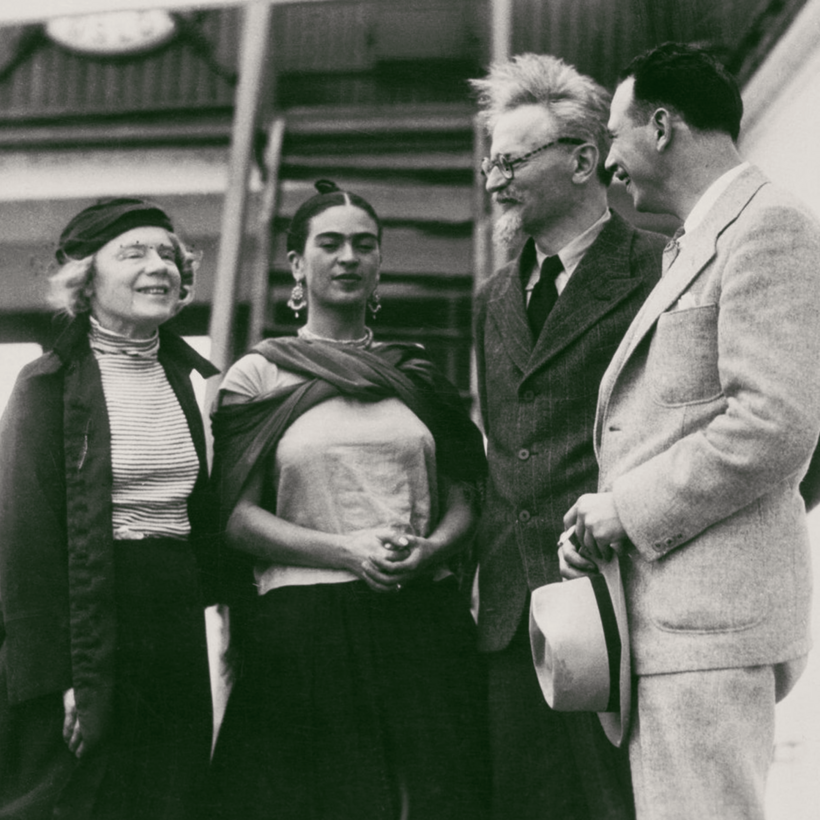
There was another contradiction that I didn’t spend much time thinking about. Trotsky was instrumental in the coup that brought the Bolsheviks to power in Russia in 1917. Ruthlessness and an almost manic willingness to spill blood allowed this small band of Communist revolutionaries to consolidate their position and win a brutal civil war. Few were as ruthless or as willing to spill blood as Trotsky. Yet, at the same time, he was a man of exquisite manners who wouldn’t allow dirty stories to be told in his presence, and he hated people swearing in front of women or children. Nevertheless, in 1937, not long after Trotsky’s arrival in Mexico—his final port of call in a near decade of exile that began when he lost a power struggle with his rival, Joseph Stalin—he began an affair with Frida Kahlo, in whose childhood home he was staying.
To begin with, it appeared to me simply as an interesting, faintly libidinous thread in the tapestry of Trotsky’s existence. He’d strayed before. He’d abandoned an entire family! Did a single affair say anything new about him?
It was the details that changed everything. I learned that this relationship had been preceded by an affair between Kahlo’s husband, Diego Rivera, and her sister, Cristina. I learned that, in part, Kahlo, 29 years to Trotsky’s 57, seduced the man she alternately called “Piochitas” (little goatee) and “el Viejo” (the old man) to punish Rivera for his torrent of infidelities. I learned that Trotsky and Kahlo exchanged notes hidden in books. I learned that they spoke in English so that Trotsky’s devoted wife Natalia couldn’t understand what they were saying. I learned that the followers who had accompanied Trotsky to Mexico were horrified by the cruelty and recklessness of his indiscretion. I learned that when the artist abruptly broke things off with Trotsky, he was distraught. And I learned that, later, during Trotsky and Natalia’s reconciliation, from a hacienda in the mountains where he had retreated for a break from the city, he sent Kahlo an astonishing letter that began with him announcing, “Since I arrived here my poor prick has not once got hard. It’s as if it doesn’t exist. It too is taking a rest after the tension of the past few days,” and then rapidly became even more graphically carnal.
This accumulation of pitiable, sordid details became something more substantial, and I realized how vividly this affair, this behavior, illustrated what happens to a person when he is hunted for over a decade. It’s what happens when he is forced to stand by impotently as his family and friends are liquidated by Stalin’s police and secret agents, one by one. It’s what happens when a man who once held the fates of millions in his hands is forced to hide behind the gates of a small house thousands of miles from his homeland.
Trotsky was a proud man. The smallness of his life in exile must have felt unbearable. And, eventually, something had to give. Still, this episode shows us Trotsky as something more interesting than a monster or a hero: a human.
Josh Ireland is a London–based writer and editor