Roger Dooley’s quest to find the San José—the 18th-century Spanish treasure galleon that would come to be called “the Holy Grail of Shipwrecks”—began in Seville, on a torrid morning in July 1984.
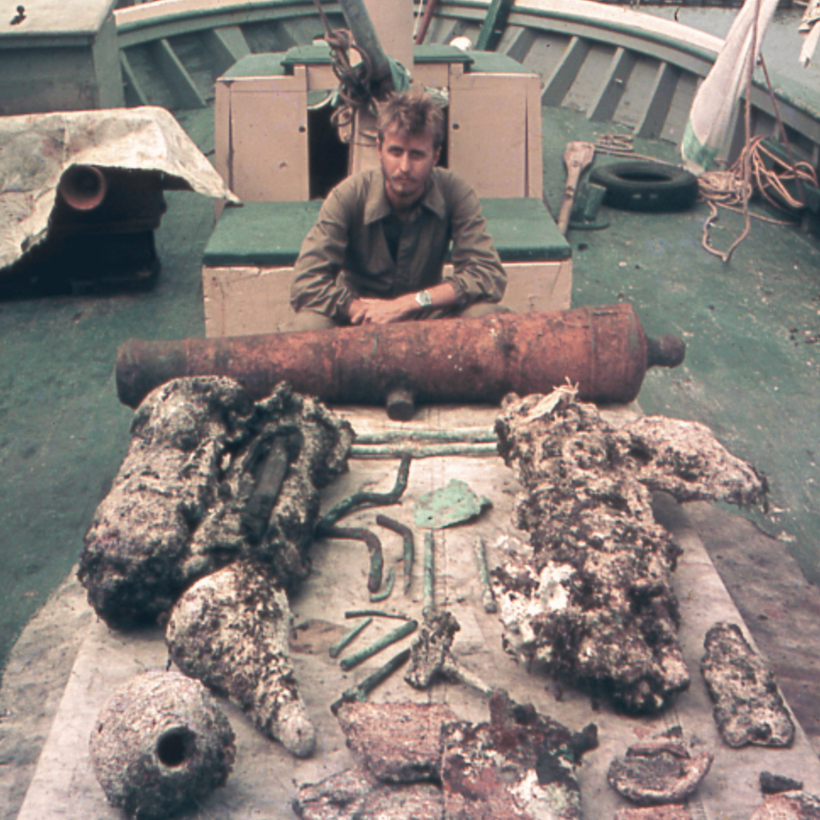
Tall and wiry, with deep-set eyes and a conquistador beard, the 39-year-old maritime archaeologist looked like a young Don Quixote and was imbued with a similar sense of purpose. Dooley, an American-born resident of Havana, was in Seville on Cuban government business. He was the chief archaeologist for a state entity called Carisub, formed on orders from President Fidel Castro to track down the many historic ships thought to have wrecked against the island’s treacherous shores over the centuries.
To archaeologists around the world, the organization’s emphasis on recovering treasure amounted to piracy, flouting international standards for the preservation of cultural heritage. But Dooley felt he had little choice. Castro had set his mind on claiming all the sunken treasure off his country’s coast and would brook no competition. For Dooley, who had dedicated his professional life to finding shipwrecks, Carisub was the only game in town.
When he joined the company in 1983, Dooley and his colleagues focused their efforts on finding a lost treasure galleon that was rumored to have wrecked in the shallows east of Havana in the late 17th century. Every so often, after storms, silver coins had been washing up on the beach. A year into their search, Dooley’s team of divers uncovered two enormous anchors, which the archaeologist determined could only have come from a galleon. Now he had traveled to Seville in hopes of identifying the ship, in preparation for an excavation.
Of the many galleons believed to have sunk in the Caribbean, only three had ever been found and identified, all of them ransacked by treasure hunters before they could be properly studied. If Dooley could lead the first thorough study of an untouched Spanish galleon, it could help fill in an all-important missing chapter in world history. More importantly, it would make Dooley’s name, a prize more precious to him than gold.
Since he’d begun delving into the four centuries worth of files housed in Seville’s General Archive of the Indies the previous year, Dooley had confirmed that the galleon he was after was no fiction. Its name was Nuestra Señora de las Mercedes, the vice-flagship of Spain’s Caribbean treasure fleet, known as the Tierra Firme Armada. On the moonless night of March 13, 1698, its hold overflowing with silver on its journey back to Spain, the Mercedes struck a reef east of Havana and sank, according to records, “in four fathoms of water, a musket’s shot from land.”
After endless hours of reading in the suffocating heat of the archives, Dooley discovered a packet of letters that would change his life. The missives dated back to 1708, exactly 10 years after the sinking of the Mercedes. He expected to sort through and discard them quickly. But as he scanned the papers, words and phrases called out like a siren song from the deep: “galleons,” “battle,” “English warships,” “gold,” “silver,” “His Majesty’s treasure,” “everybody drowned” …
These letters were indeed about a shipwreck. But as he read further, he realized that it couldn’t have been about the Mercedes. The letters had been dispatched from Cartagena de Indias, the rich port city on the coast of what is now Colombia, to Havana just days after what appeared to have been a horrific tragedy. At the risk of getting sidetracked, Dooley couldn’t resist reading on. The story the letters told was more dramatic than any adventure novel he’d ever read. The reports, he learned, had been smuggled past a blockade of Cartagena imposed by Great Britain—one of Spain’s adversaries in the War of Spanish Succession—in a small, inconspicuous sloop with the instructions that the governor of Havana should immediately send them across the Atlantic Ocean to Spain’s Felipe V, to inform him of the loss of his ship and a literal king’s ransom in gold and silver. Dooley realized then that he had stumbled upon critical clues to the whereabouts of the most valuable shipwreck in history: the mythical San José.
The Sinking
It was sunset when the galleon San José—the 62-gun flagship of the Spanish treasure fleet—confronted the English man-of-war Expedition off the coast of Cartagena, on June 8, 1708. As soon as the two ships were abreast of one another, more than 50 cannons went off from both sides in rapid succession, seeming to tear the very fabric of the air apart.
It was an uneven fight from the beginning. Not only did the Expedition have more guns and a more agile vessel, but they also had the wind in their corner, allowing the Expedition to lead the dance. The San José’s gunners, meanwhile, struggled to keep up with the cannonade, managing to get off only two broadsides in the time it took the English to unleash six.
A fire eventually broke out on the ravaged San José, sending the Spaniards into disarray. Their surrender was all but guaranteed. The Expedition’s captain, Royal Navy officer Charles Wager, could taste victory. He would soon be hauling his prize, the richest vessel in the seas, back to Jamaica.
Then, a powerful explosion came from deep within the galleon, according to English witnesses, shaking the ship and sending a shock wave across the water. The galleon “blew up,” Wager wrote later in his journal, and “the heat of the blast came very hot upon us and several splinters of plank and timber came aboard us afire.” As English sailors hurled the burning fragments of the San José overboard, they could hear Spanish screams from beyond the smoke.
In a matter of minutes, the Spanish side went silent. When the smoke cleared, the San José had vanished. Where the galleon had been was now a field of flotsam. Of her 600 souls, fewer than 20 men were left.
“She immediately sunk with all her riches, which must be very great,” Wager wrote with a brevity that belied his profound disappointment. The treasure that he had been seeking for months was now plummeting to unknowable depths, alongside the bodies of the Spanish fleet’s admiral, the Count of Casa Alegre, and his men.
The treasure of the San José is believed to be worth several billion dollars. Its legend took especially deep root in Colombia, where generations would dream of finding the inestimable hoard of gold and silver lying on the ocean floor just off Cartagena, fantasies made sweeter by the notion of reaching back in time to reclaim riches taken by the colonial oppressor. Such reveries play a key role in Love in the Time of Cholera, by the Nobel Prize–winning Colombian novelist Gabriel García Márquez. The book’s lovelorn protagonist, Florentino Ariza, is stricken with “an overwhelming desire to salvage the sunken treasure so that Fermina Daza”—his beloved—“could bathe in showers of gold.”
For three centuries, the wreck lay undisturbed, deep in the Caribbean Sea. As everything decayed around them, the thousands of gold coins aboard the galleon remained as brilliant as the day they were minted. Gold never sits idly in the human imagination. Even from the bottom of the ocean, the gold of the San José cried out for an owner.
The Discovery
Poring over accounts of the battle under the vaulted ceiling of the General Archive of the Indies, Dooley forgot for a moment about the reason he had come to Seville in the first place. The San José had eclipsed the Mercedes in his eyes.
“That’s when I fell in love,” he would tell me. “What a story!”
Even more enticing, the letters sitting on his desk at the archive, which the governor of Cartagena had sent in haste to inform King Felipe of the tragedy, contained numerous clues to the final resting place of the San José. A notion began to form in his mind, as in that of García Márquez’s lovesick hero—that he could one day reach the San José. Like Florentino Ariza, he had fallen in love at first sight, and his unrequited passion would only grow over the decades. But the ship, for Dooley, was not just a vessel for an immense trove of wealth. The object of his obsession was the galleon itself. It would become his Fermina Daza, the Dulcinea to his Don Quixote.
Over the following three decades—during which time he managed to escape Cuba and build a new life in Miami—Dooley patiently collected every scrap of information he could find about the San José. He eventually mapped out a search area off the coast of Cartagena, in which he was certain the wreck of the galleon had to lie. Through obsessive persistence, he acquired the financing, the equipment, and the permission from the Colombian government to mount the search expedition of his dreams.
In November 2015, at age 71—the same age the Count of Casa Alegre had been when he went down with his ship—Dooley found the San José. Images of the wreck, a neatly contained mound of artifacts almost 2,000 feet down, were more beautiful than he could have imagined. Bronze cannons lay strewn like pickup sticks, gold coins glinted tantalizingly on the seabed.
Yet Dooley would never get the chance to touch the artifacts with his own hands. As the Colombian government took ownership of the wreck, Dooley would be written out of the story, his involvement concealed for years. In late 2025, around the 10th anniversary of the discovery, the Colombian Navy raised the first few objects from the San José to see the light of day in more than 300 years: a cannon, a Ming porcelain cup, and three gold coins.
The operation, Dooley feared, had been done in an “anti-archaeological way,” prioritizing publicity over science. He believes that, as the man who knows more about the San José than anyone alive, only he can conduct the excavation the great galleon deserves. Forty years since his serendipitous find in Seville, Roger Dooley continues to dream the impossible dream.
Julian Sancton is the author of Madhouse at the End of the Earth: The Belgica’s Journey into the Dark Atlantic Night and a senior features editor at The Hollywood Reporter