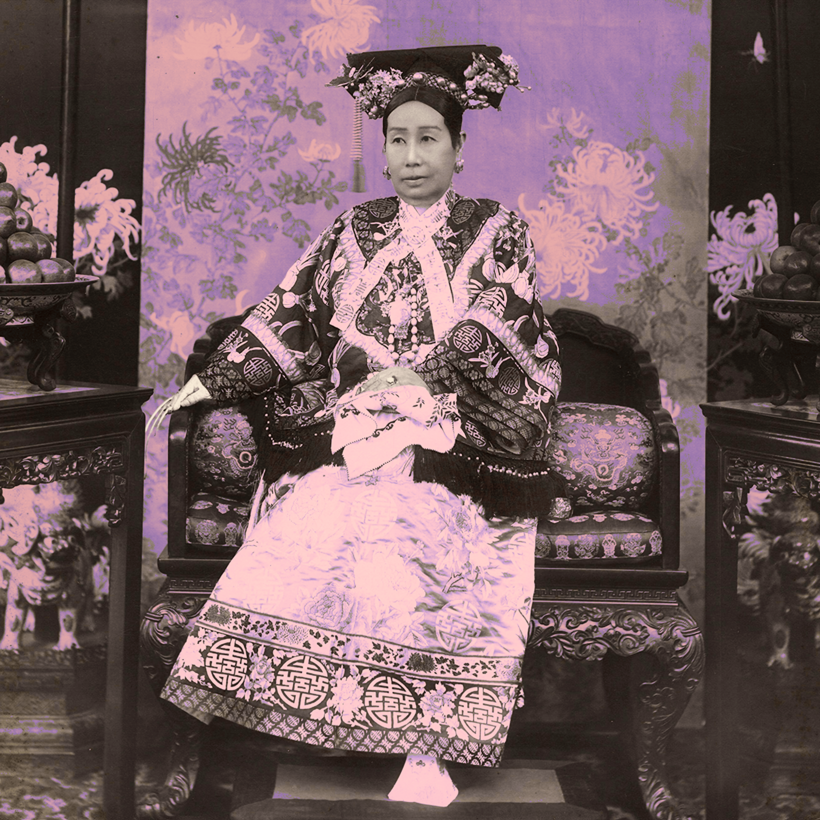
In our era of concern over the venomous influence of misinformation and propaganda, consider the case of Empress Dowager Cixi (1835–1908), of the Qing dynasty, who remains one of the most controversial figures in Chinese history.

In the minds of some historians, Cixi was a narcissistic “dragon lady” who would stop at nothing (including poisoning members of her own immediate family) to retain power. To others, Cixi was a victim of circumstances who tried to preserve the dignity of the Qing Empire and China in the face of voracious foreign interests.

What’s certain is that her legacy wasn’t helped by two British journalists—Sir Edmund Backhouse, second Baronet of England, and J. O. P. Bland—who, at the beginning of the 20th century, co-wrote and produced influential books and articles that cast Cixi in a particularly negative light. Their two major works, Annals and Memoirs of the Court of Peking (1914) and China Under the Empress Dowager (1910), characterized the empress dowager as “cruel and unstable,” “a dragon lady,” and “a greedy tyrant,” and were pivotal in shaping Western perceptions of her Qing court.

But time and research have revealed Backhouse and Bland to be thinly veiled propagandists who cast Cixi in the role of cruel and immoral villain—something we know isn’t unheard of when the interests of two nations clash and the journalists in question represent the interests of one side.

Backhouse, an Oxford graduate who had relocated to Beijing, was the source of most of the information in the books on Cixi and the Qing, and Bland served as the writer. Among Sir Edmund Backhouse’s claims (or boasts) was that he had affairs with Oscar Wilde, French poet Paul Verlaine, and the empress dowager herself.

In Décadence Mandchoue, an account of his sexual adventures published posthumously in 2011, the openly gay Backhouse (who pronounced his name “Bacchus”) claimed he met the aging empress after he returned looted artifacts to her palace. He wrote that, after doing so, he was called in for a private audience with the empress, during which he was washed and perfumed by eunuchs and called up to the 69-year-old empress’s bedchambers to perform sexual acts on her like a slave girl in a harem.

“She allowed me to fondle her breasts which were those of a young married woman; her skin was exquisitely scented with the violet to which I have made allusion; her whole body, small and shapely, was redolent with la joie de vivre; her shapely buttocks pearly and large were presented to my admiring contemplation: I felt for her a real libidinous passion such as no woman has ever inspired in my pervert homosexual mind before nor since.”

When Sir Edmund wasn’t frolicking with the “Old Buddha,” as Cixi was affectionately known, he was coupling with just about any young, attractive eunuch in her service. Sex with eunuchs—and with catamites in the “bathhouses” of Peking (now Beijing)—was Backhouse’s preferred form of eroticism. This is where he met the love of his life, whom he dubbed “Cassia Flower.”

When the empress called, however, Backhouse was dutifully present, even if a powerful aphrodisiac was required to get him through prolonged nights requiring three to four orgasms with his insatiable, near-septuagenarian royal partner. This exacting sexual schedule continued until shortly before Cixi’s death, at 73, in 1908—or so his memoirs attest.

Backhouse also contends that Cixi did not die of natural causes. No, she was murdered—with three brutal, point-blank shots to the abdomen—by none other than Yuan Shikai, one of the eight regional viceroys during her reign, who was later to become second president of the Republic of China.

He got this scoop, he claimed, from Cixi’s chief eunuch, Li Lianying, who happened to be Backhouse’s best friend and gave him his personal diaries detailing all his years of service to the empress. Unfortunately, those diaries and any of the other corroborating papers were lost, according to Backhouse.

Most of his claims are dismissed today as bunk. British historian and Regius Professor of Modern History at the University of Oxford Hugh Trevor-Roper—also a former M.I.6 officer and an expert in clandestine affairs—found that not only was Backhouse’s claim of being seduced by Cixi most likely untrue, he doubted that the British author had ever met her.

In his biography of Backhouse, The Hermit of Peking (1976), Trevor-Roper dismissed most of what Backhouse said about the Qing court as nonsense and exposed virtually all of it as fraud. He deemed the books Backhouse wrote with Bland “worthless historic documents.” As for his bawdy memoir, Trevor-Roper wrote: “No verve in writing can redeem their pathological obscenity.”

Trevor-Roper also pointed out that, despite Backhouse’s superficial appearance of affection for the Chinese, much of what he wrote about China fed into Western “yellow peril” stereotypes, which might explain their popularity when they were published.

Ralph Pezzullo is the author of the recent book The Great Chinese Art Heist. He is also the host of the popular podcast Heroes Behind the Headlines