I am, without shame, a weather nerd. In climate, I have only a passing interest. But weather enthralls me. I live on a farm in the Berkshires, and the lawns are festooned with devices to measure every aspect of the weather—anemometers, sunshine recorders, rain gauges, thermometers, hygrometers. Every Sunday morning I change the recording paper and slow-drying ink on my barograph (an instrument for measuring atmospheric pressure), and now have a quarter-century’s worth of records, more than 1,500 paper charts, in bundles in the closet. Pointless, essentially worthless—except, perhaps, as a collection for other weather nerds.
Wind direction is my particular area of interest. Speed, not so much—but whether a wind comes roaring in from the west, is an angry nor’easter, or else wafts zephyr-like from the south is a point-of-compass detail I cherish. On the barn roof is a bronze cow weather vane. When its damp nose points toward the sunset, I imagine there will be rain the next morning.
When writing this book, I knew that brutally strong winds can wreak violent terror, sending ships to the bottom of the sea, tearing roofs off houses, and breaking trees into splinters. But I knew little of any association between wind direction and world-altering events—that is, until I came across the meteorological details associated with the destruction of Reactor No. 4 at the Chernobyl Nuclear Power Plant, in Ukraine, in the spring of 1986.
The most significant consequence of that event—and there were many significant consequences—was the collapse of the Soviet Union.
In speaking of this, one weather-related fact should be borne in mind: the winds over Ukraine in the springtime blow robustly and regularly from the west. But uniquely, in the spring of 1986, they didn’t. They were fickle that season, and for three critical days they blew not from the west but from the southeast. And in doing so, they changed everything.
I remember one moment from that spring vividly. I was in the kitchen in my then home in Oxford when the BBC broke into its afternoon radio program. The Swedish government, the newscaster said, had detected a highly unusual spike in atomic radiation in the air north of Stockholm. From the signature of the particles detected, it appeared that there had been a serious nuclear explosion, somewhere close by.
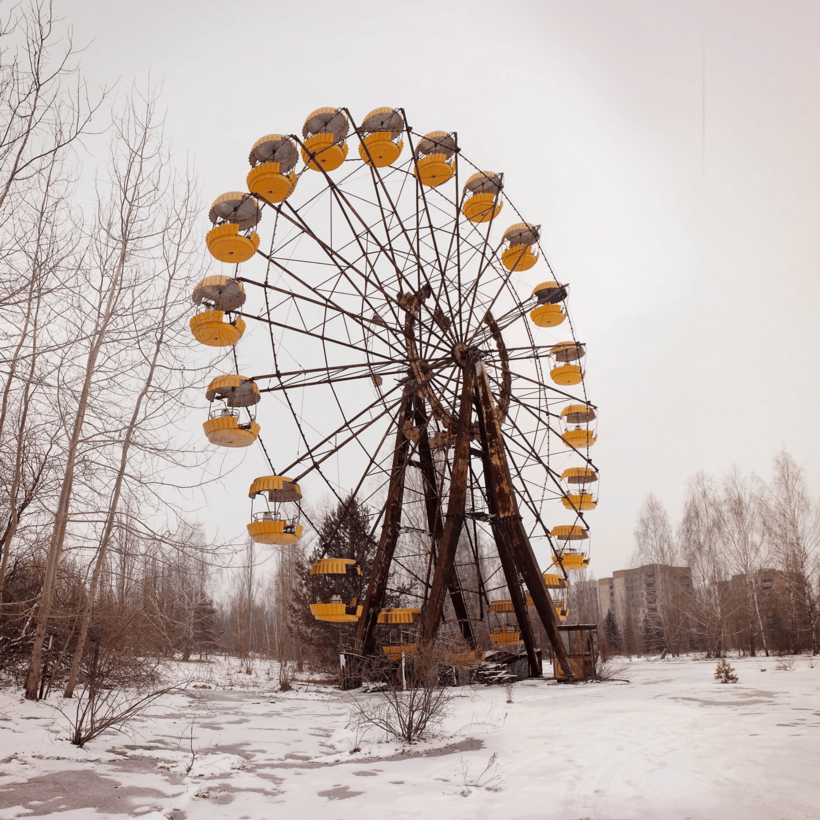
The local weather office was consulted. The winds south of Stockholm, across the Baltic Sea in Lithuania, Latvia, and Estonia, were all blowing in from the southeast that day—and there could be no doubt. The event, whatever it was, had occurred somewhere behind the Iron Curtain, in the south of what was then the Soviet Union. As the world soon learned, the exact origin was a power station in northern Ukraine near a town called Pripyat. The station was Chernobyl.
Radio Moscow, the voice of the Kremlin, said nothing. The radiation grew ever stronger, its plume beginning to drape itself over Poland, Germany, France, and the south of England as the winds changed. Western European governments began to panic, telling their people to stay indoors, distributing iodine pills, cautioning against drinking milk (cows being walking Geiger counters), and demanding of their various Soviet Embassies information on what had happened. For a second day, there was silence from the Kremlin.
But the radiation didn’t lie, and nor did the wind. The Soviets could no longer maintain the cover-up. Finally, they came clean, admitted there had been a disaster (their word, seldom employed before), and asked for help in cleaning up the mess—a cleanup which continues to this day.
Mikhail Gorbachev, some years later, said it was his certain belief that the Chernobyl catastrophe was the starting event in the five-year collapse of Soviet Communism, culminating in the breakup of the U.S.S.R. on Christmas Day, 1991, and the birth of the Russian Federation.
The world would look very different today had the Ukrainian winds in April 1986 been blowing as they usually did, from the west. The same accident would have occurred; the fire and explosions and deaths and evacuations. But the radiation would have spread eastward, first over republics then tightly controlled by Moscow, and eventually over the steppes and deserts of Central Asia and Kazakhstan.
There might have been rumors, but nothing more. No radiation detectors in Sweden chattering warnings. The BBC emergency announcement would not have interrupted my afternoon listening. Radio Moscow would have continued with its regular schedule of state-authorized programming, with maybe just a brief mention of an industrial accident somewhere near Kyiv.
But otherwise, nothing much would have changed, and the U.S.S.R. would have continued in its gray and untroubled way for, who knows, maybe a decade more, maybe even longer. But on this one occasion, the wind, invisible, ceaseless, and unpredictable, had other ideas. It spread the truth, the world listened, and global history was made.
Simon Winchester is a British-American journalist and the author of several books, including The Professor and the Madman