How to describe the Danish artist Vilhelm Hammershøi? In 1905, the poet Rainer Maria Rilke wrote, “Hammershøi is not one of those about whom one can speak quickly. His work is wide-ranging and slow, and at whatever moment one comprehends it, it will always provide an opportunity to talk about what is important and essential in art.” Born in Copenhagen in 1864, Hammershøi began drawing at the age of eight before enrolling at the Royal Danish Academy of Arts. At 21, he painted a haunting portrait of his sister Anna, a work that caught the eye of Pierre-Auguste Renoir, who greatly admired it. Hammershøi became known for his meditative interiors, portraits, and landscapes, rendered in muted mauves, grays, and pale yellows. His restrained palette lent the work a spectral stillness. “What makes me choose a motif are the lines, what I like to call the architectural content of an image,” he once explained. “And then there’s the light, of course. Obviously, that’s also very important, but I think it’s the lines that have the greatest significance for me.” This is Spain’s first Hammershøi retrospective. —Elena Clavarino
Arts Intel Report
Hammershøi: The Eye that Listens
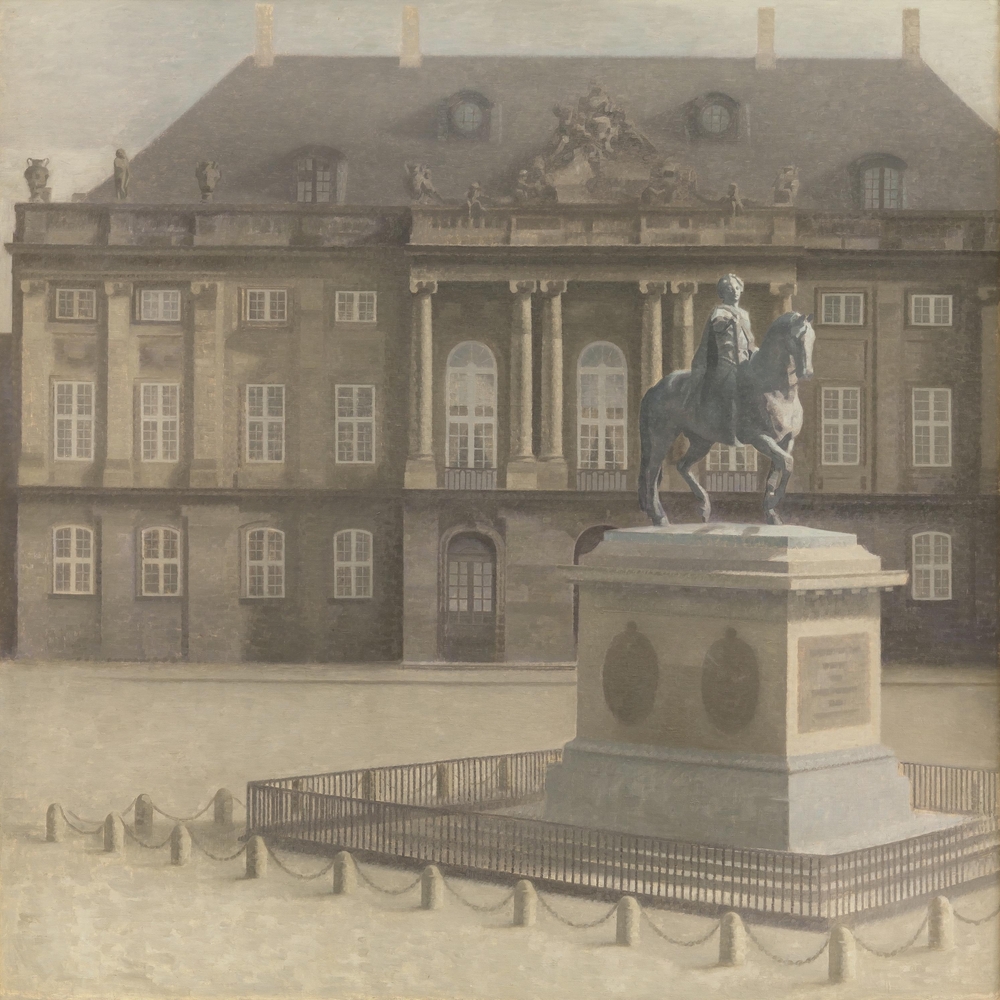
Vilhelm Hammershøi, Amalienborg Square, Copenhagen, 1896.