If off-key anachronisms set your teeth on edge, skip the opening wall text, which positions Raphael (1483-1520) as “one of the greatest influencers of all time.” The claim, it turns out, has no bearing on the artist’s first comprehensive American show. A blockbuster on a scale even the Met seldom mounts any more, “Raphael: Sublime Poetry” presents the precocious genius under three aspects. First, as the son of his father, the poet and painter Giovanni Santi of Umbria, a cradle of the High Renaissance. Second, as the pupil of the great Perugino, whose style he superseded. And third, as the master to Giulio Romano, his most talented disciple. There, the curtain drops, leaving Raphael’s further influence unexplored. Along the way, we catch glimpses of the backdrop against which his Bildungsroman unfolds. “By about 1510,” a later text tells us, “Raphael was collecting accolades as the most visible and prolific painter at the papal court in Rome; meanwhile, shut away in the Sistine Chapel, the secretive Michelangelo labored to paint his ceiling frescoes, which would deeply influence the younger artist, who snuck in to see them.” (Snuck! At age 27! That’s the kind of zest that curatorspeak could use more of.) But of course, what you came for is the pictures. With preparation that extended over the span of seven years, the Met’s highly persuasive Carmen C. Bambach reeled in some 170 stellar pieces of varying interest to different segments of the viewing public. Art historians will salivate over the masses of top-drawer drawings, which perforce are shown under crepuscular lighting likely to give a civilian a headache. The pious will genuflect before the legion of luminous Madonnas. Cultural tourists without immediate plans to visit the Vatican Museums will appreciate the peek at the four frescoed stanze from the Apostolic Palace (including The School of Athens), seen as chalky projections in a walk-in light box. For crowning exemplars of the promised poetry and sublimity, seek out the clutch of priceless portraits. Stars among them: the serene likeness of Baldassare Castiglione, paragon of the Renaissance gentlemen and author of The Book of the Courtier; the provocative baker’s daughter La Fornarina, popularly believed to have been Raphael’s mistress; and especially the warily self-possessed young woman cradling a unicorn foal. For grandeur, three monumental tapestries from the Acts of the Apostles sweep all before them. Woven from the full-size Raphael designs (or “cartoons,” treasures of the Victoria & Albert Museum, in London), each is a miracle of dramatic storytelling, composition, and spellbinding detail. Dwell a moment, if you please, on the tilt of the disciples’ halos in Christ’s Charge to Peter. Or lose yourself in the reflections on the living waters of the Sea of Galilee in The Miraculous Draught of Fishes, but that might take all the time in the world. —Matthew Gurewitsch
Arts Intel Report
Raphael: Sublime Poetry
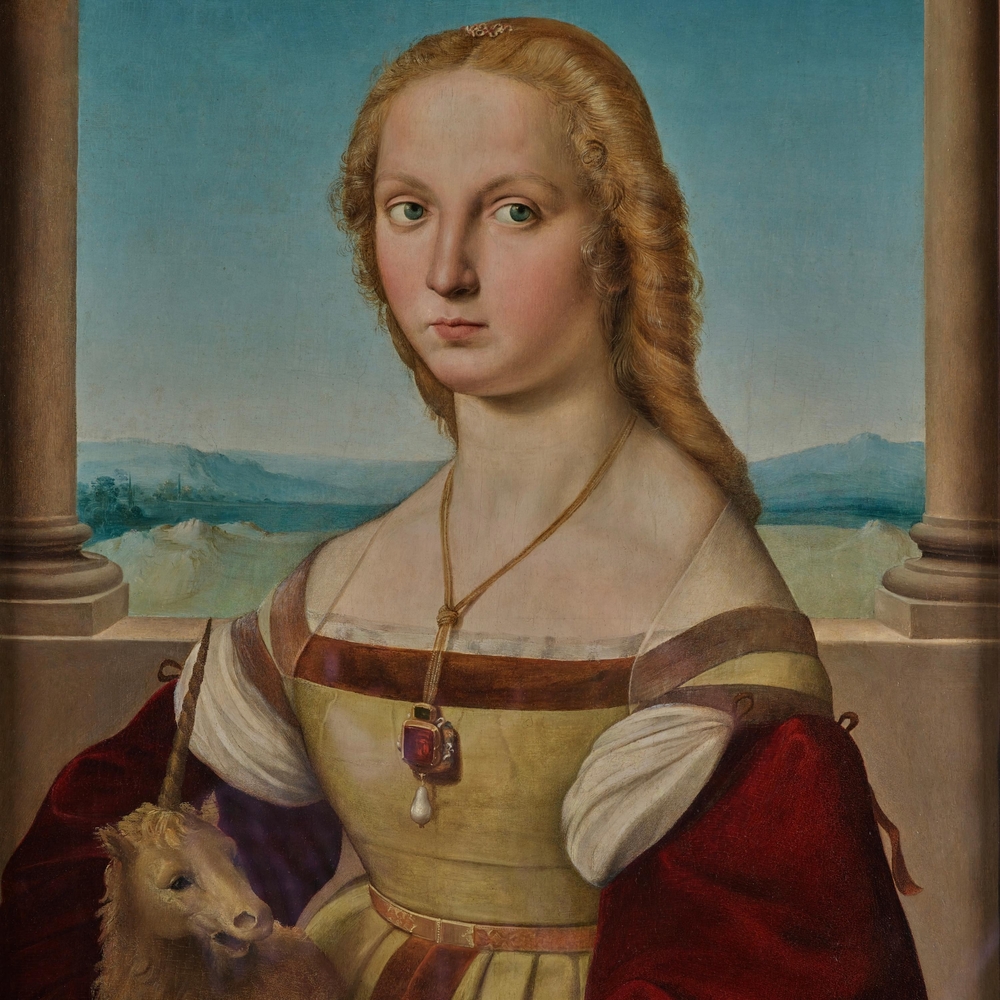
Raphael, Portrait of a Lady with a Unicorn, 1505-6.