Joseph Cornell, who lived from 1903 to 1972, worked alone in a house in Queens. It isn’t that he was unaware of what was going on in the art world of his time. It’s just that he didn’t need the genius of the scene, what Brian Eno called “scenius,” as so many artists do. Cornell’s genius was born of bits and bobs, a sensitivity to the stuff most of us don’t know what to do with: prints, feathers, maps, marbles, corks, shells, spools. He did know what to do with these things: he arranged them in boxes that are pictures of transience and transport. His assemblages recall cabinets of curiosity but have the energy of higher math and reach dream states that both beguile and frighten. Think of Hans Christian Andersen, E. T. A. Hoffmann, Dostoevsky. What did Cornell’s basement studio look like? The filmmaker Wes Anderson, a kindred spirit, has re-created the artist’s workspace in Gagosian’s storefront gallery on rue de Castiglione, in Paris. It’s a life-size shadow box that can be viewed through the gallery’s street-facing window, and it also contains a handful of Cornell’s marvelous artworks. What a wonderful holiday gift. —Laura Jacobs
Arts Intel Report
The House on Utopia Parkway: Joseph Cornell's Studio Re-Created by Wes Anderson
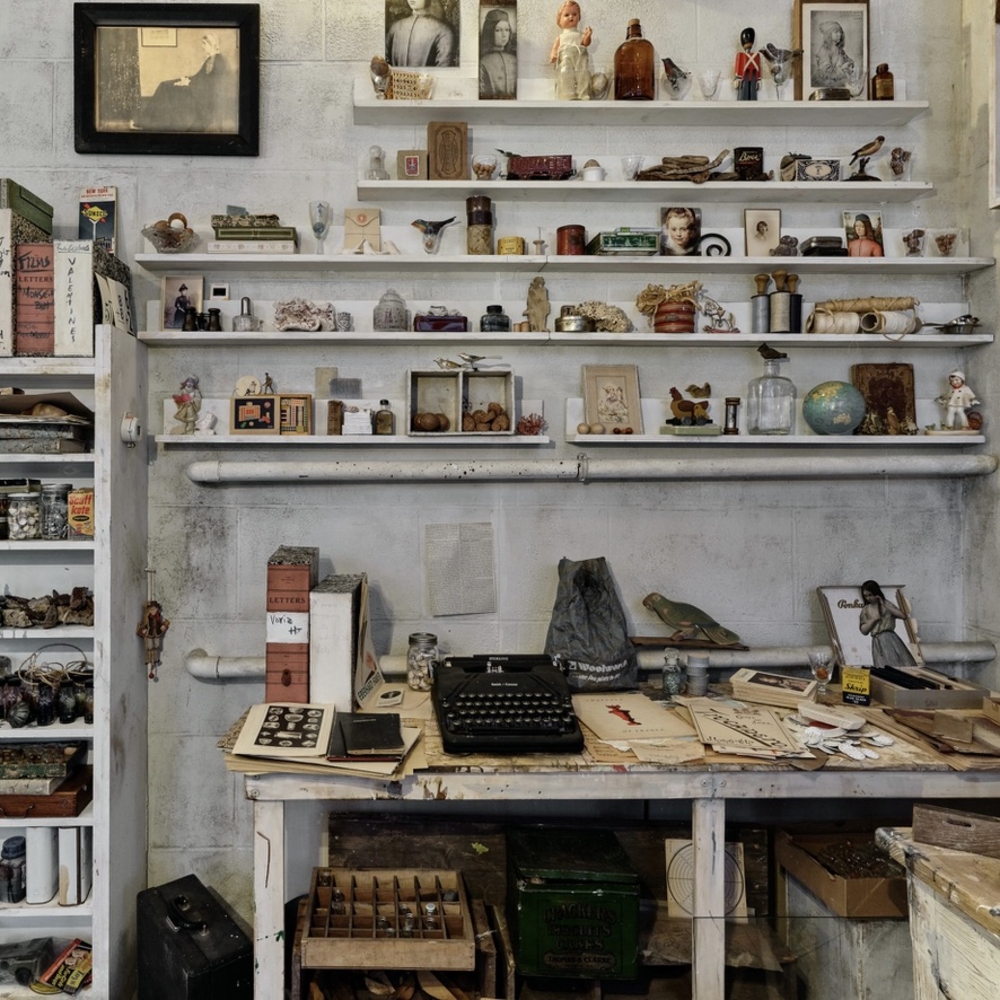
A view of the Joseph Cornell installation, curated by Wes Anderson.