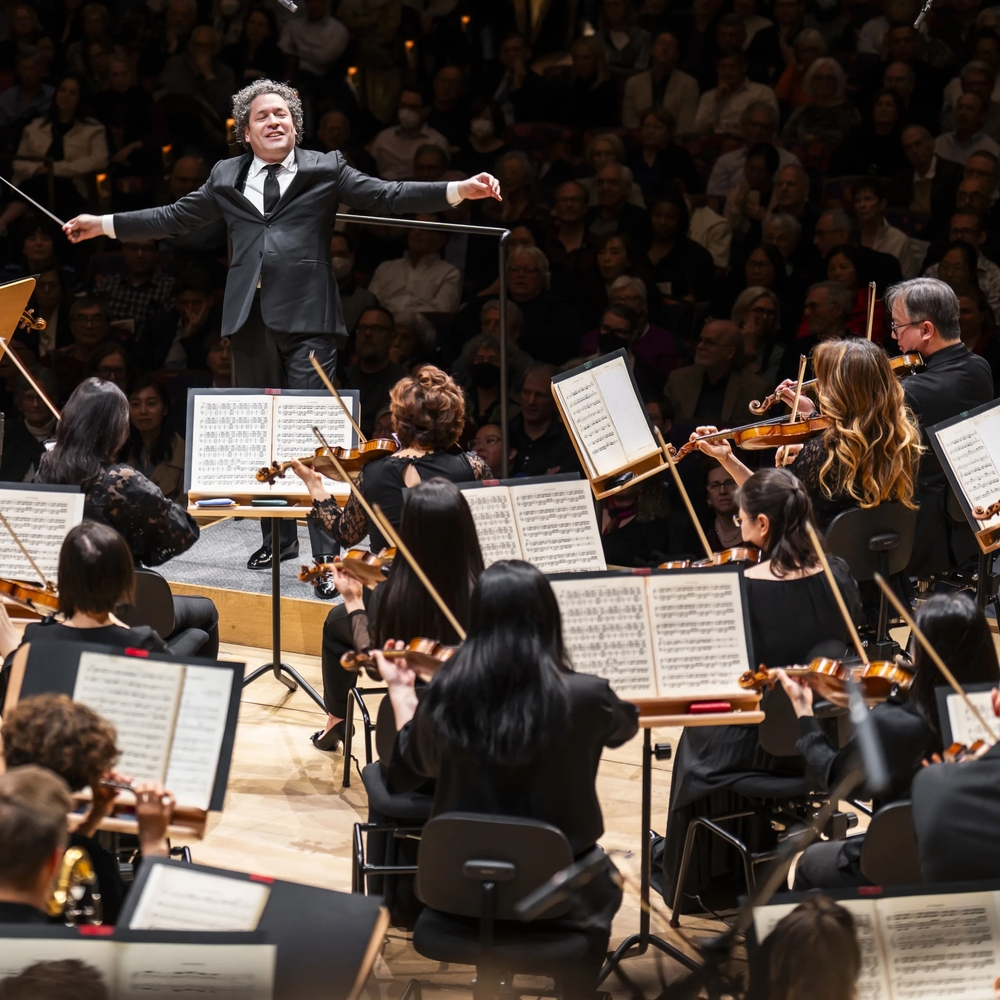
Adam Smith’s Bible of classical economics The Wealth of Nations was published on March 9, 1776—too soon to have influenced the Committee of Five in drafting the Declaration of Independence. Still, there’s such a thing as the zeitgeist. Dudamel’s program for March 19 to 22 is devoted wholly to David Lang’s new the wealth of nations, billed as “an enjoyable and thought-provoking 21st-century oratorio” intended, per the composer, to encourage us “to consider what we truly value.” Incorporating not only passages from Smith but also crosstalk from Franklin D. Roosevelt, Frederick Douglass, Ralph Waldo Emerson, Edith Wharton, and Eugene Debs, the wealth of nations dwells on the nature of commerce and free markets. Lang’s avowed touchstone, if you please, is Messiah. Yet he has scaled the running time back to 75 minutes and whittled the roster of soloists to just two (Fleur Barron, soprano, and Davóne Tines, bass-baritone). If there’s no “Invisible Hand” chorus to rouse us to our feet like Handel’s “Hallelujah!,” our disappointment will be keen. Skeptical? Bear in mind that Lang’s much-loved greatest previous hit was the Pulitzer Prize- and Grammy-winning chamber oratorio The Little Match Girl Passion (2007), a mashup of Hans Christian Andersen and Bach. —Matthew Gurewitsch