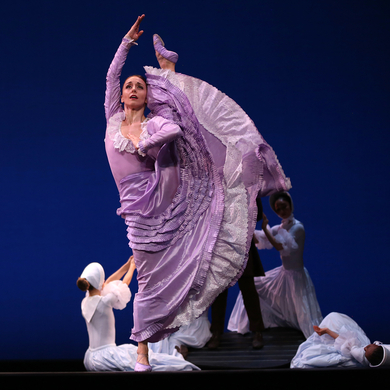
Setting aside Raymonda Variations—the frothy show finale—the curation of the New York City Ballet program “Masters at Work II” is especially inspired. Balanchine’s Kammermusik No. 2, his Le Tombeau de Couperin, and Robbins’s Antique Epigraphs translate the music’s atmosphere into the ensemble, which reigns in these three works. To the eerie plenitude of Debussy’s Antique Epigraphs, Robbins brings to lush, witchy life the women dancing on Grecian urns. Balanchine listed his dancers alphabetically to insist not only that choreography was king but also that dancing was. As the ground against which the principles figure, the corps rarely stops moving. But in the dream baroque folk dance Le Tombeau de Couperin, to Ravel’s homage to the Baroque composer Couperin, there is only ground—16 corps members in dazzlingly fleet geometries. With Kammermusik No. 2, the French voluptuousness of Debussy and Ravel give way to Paul Hindemith’s modernist spikiness while an ensemble of extravagantly semaphoring men, at once mannered and mechanical, replace the usual female corps. Look out for the program’s tremendous casts, including Emily Kikta in Kammermusik, Naomi Corti in Epigraphs, and Mira Nadon! Mira Nadon! in both. —Apollinaire Scherr
Arts Intel Report
New York City Ballet: Masters at Work II

The male corps in George Balanchine’s Kammermusik No. 2 at the New York City Ballet.