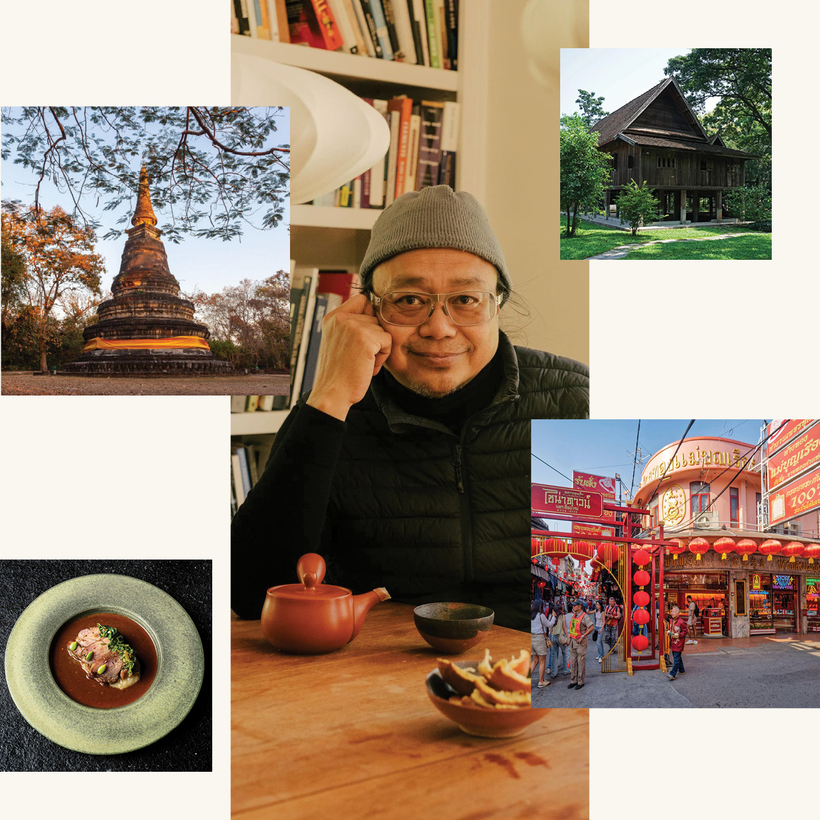
Rirkrit Tiravanija has always existed between cultures. The son of a Thai diplomat, he was born in Buenos Aires in 1961 and spent his childhood between Ethiopia, Canada, and Thailand. “I actually came to art without knowing anything about art at all,” he told Flash Art, and, after enrolling at the Ontario College of Art, Toronto, in 1980, quickly revealed an aversion to the exclusive culture of the gallery world. Instead, he valued accessibility.
Ten years later, with a master’s degree and a Whitney Museum residency under his belt, he created the work that would forever change the world of performance art. He presented Untitled 1990 (pad thai) at Manhattan’s now-shuttered Paula Allen Gallery, transforming the white cube into a kitchen where he cooked and served Thailand’s national dish to the exhibition’s attendees. “In the communal act of cooking and eating together, I hope that it is possible to cross physical and imaginary boundaries,” he said.
Today, Tiravanija splits his time between New York, Berlin, and Chiang Mai, where he continues to trade traditional art practices for an oeuvre defined by real-time experiences and human connections. Here, he shares his guide to the Thai city.

Wat Umong
Go for a walk at Wat Umong, which translates to “the cave temple.” It’s one of the oldest temples in Chiang Mai. They offer meditation lessons, as well as residences for Western monks. (tourismthailand.org)
Kamin Lerdchaiprasert’s studio
Visit the contemporary Thai artist’s studio to see the thematic exhibitions he curates there.

The Lanna Traditional House Museum
This house museum, on Chiang Mai University’s campus, features multiple examples of traditional northern domestic architecture. (accl.cmu.ac.th)
Sumrub Gubkao
Oddly enough, many northern Thai people love Southern cuisine! (facebook.com)

Blackitch Artisan Kitchen
Chef Black is part of Chiang Mai’s new generation of Thai chefs. At his high-end restaurant, you’ll find seasonal tasting menus, a mix of local ingredients, and inventive cooking. Reservations needed! (blackitch.com)
Khao Soi Lung Prakit Kad Kom
Khao Soi is a venerable noodle dish from Chiang Mai. There are major debates about which noodle stand makes the best version. This one is my favorite, but below are a few more so you can find out for yourself! (facebook.com)
- Khao Soi Lamduan Fa Hamm (tripadvisor.com)
- Khao Soi Samer Jai Fa Hamm (facebook.com)
Mengrai Kiln
A local ceramics kiln known for their celadon glazes. Here, you can browse the rejects and overflow—ceramic bowls and plates alongside furniture fashioned entirely from clay. Custom orders are available and will ship all over the world. (mengraikilns.com)
The North Gate Jazz Co-Op
Local and visiting musicians come jam at this live music venue. It’s a remnant of the old Chiang Mai scene. Be careful standing in the street as cars and scooters whizz by! (facebook.com)
Noise Bar
This is a tiny place where Chiang Mai’s hipster scene gathers. Everyone crowds around the DJ booth. Go upstairs for a breather. (instagram.com)

Kad Luang
Kad Luang (meaning “big market”) is the local name for the Warorot Market, where you can find a renowned Sai Oua (Chiang Mai sausage) stand. You’ll also see dried goods, local vegetables, and household goods. It has a great atmosphere and is a nice place to understand local culture. Ladies come here to sell home-grown fruits, vegetables, and foraged plants on the sidewalk as well. I recommend going for an early morning visit. Afterward, you can visit the wet market just across the street.
For more recommendations, check out Rirkrit Tiravanija’s complete list of restaurants in and around the city