Who knew that a host of engineering and intellectual accomplishments associated with Rome—arches, aqueducts, city planning, even “Roman” numerals—were in truth the intellectual property of a more ancient, long-eclipsed Italic civilization? “The Etruscans: From the Heart of Ancient Italy” aims to set the record straight. Why did these people effectively disappear? Because, like their Greek and Phoenician trading partners, they formed a federation of rival city states unable to form a united front against the centralized Roman juggernaut. As a blue-ribbon consolation prize, the Etruscans eventually gained Roman citizenship. (Remember Emperor Augustus’s right-hand man Maecenas, whose name became synonymous with patronage of the arts? An Etruscan.) But for the aesthetically inclined, historic revisionism will take a backseat to the joie de vivre embodied in stellar loans from the Vatican, the Louvre, the Victoria & Albert, the Getty, and other treasure houses. Though their provenance is widely ignored, certain objects belong to an image bank that is all but universal. Take the loving couple atop their sarcophagus, for example, reclining as if at a banquet, faces aglow with the renowned, serene “Etruscan smile”—or a bronze box handle in the shape of a fallen warrior attended by Sleep and Death. Among the luxurious grave goods expect jewelry of dazzling ingenuity as well as pottery positively exuberant in its inventive designs. Limber youths from an Etruscan mural recall the prelapsarian grace of Minoan athletes painted on Crete a thousand years before. You might not buy the case put forward for the equality of the sexes among the Etruscans, but this is 2026, and virtue signaling in such contexts is de rigueur. —Matthew Gurewitsch
Arts Intel Report
The Etruscans: From the Heart of Ancient Italy
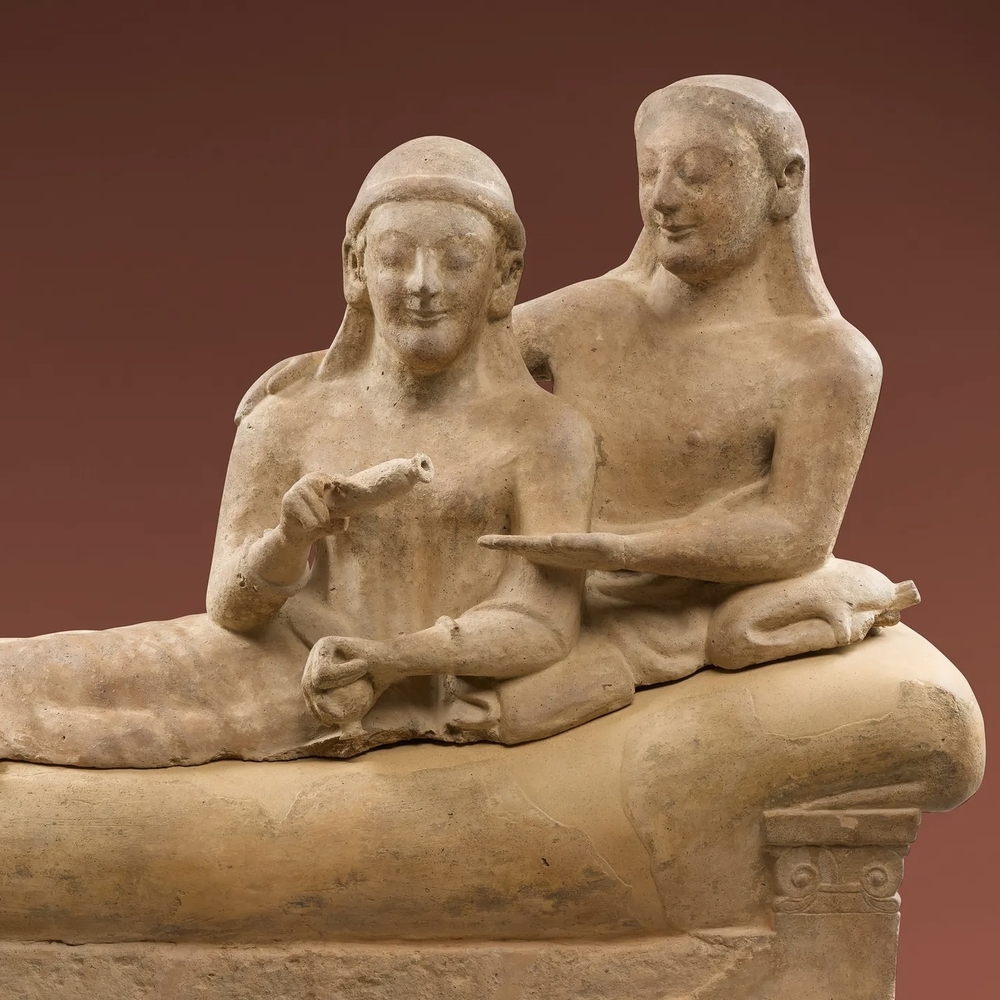
Cinerary urn of the spouses, Etruscan, Caere (modern Cerveteri) (detail), 520–500 BC.