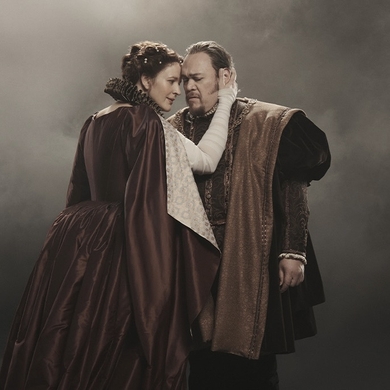
Like the characters Fiordiligi and Dorabella in Così Fan Tutte, Adriana Ferrarese del Bene and Luisa Laschi, their first avatars, were sisters. The Viennese public of 1790 knew this, though the sisters performed under their married names, and so, of course, did Mozart, who filled their duets within intertwining lines that underscore the intimacy they have shared since childhood. But the opera’s subtitle is The School for Lovers, and in the course of their education, the budding women grow far apart. Fiordiligi’s arias reveal a one-man woman—a paragon that ancient Romans termed an univira—who in her naiveté has pledged her heart to the wrong man. Dorabella’s, in vivid contrast, trace the evolution of a dater. Won’t it be nice if the Wallroth sisters Johanna and Rebecka channel Mozart’s cunningly calculated electricity? Giovanni Sala, a tenor of pinging vivacity, steps out as Ferrando, the more soulful of the sisters’ doofus lovers; the baritone Konstantin Krimmel, a specialist in the kaleidoscopic lieder repertoire, is the operator Guglielmo (can’t wait to hear their second-act serenade). Anna El-Khashem schemes as the ladies’ maid Despina, but it’s the veteran Bryn Terfel, once the Figaro of his generation, now the cynical philosopher Don Alfonso, who really holds the cards. Gábor Takács-Nagy, a Verbier fixture, conducts the Verbier Festival Chamber Orchestra, a finishing school for conservatory talents with their eyes on chairs in the world’s top ensembles. —Matthew Gurewitsch