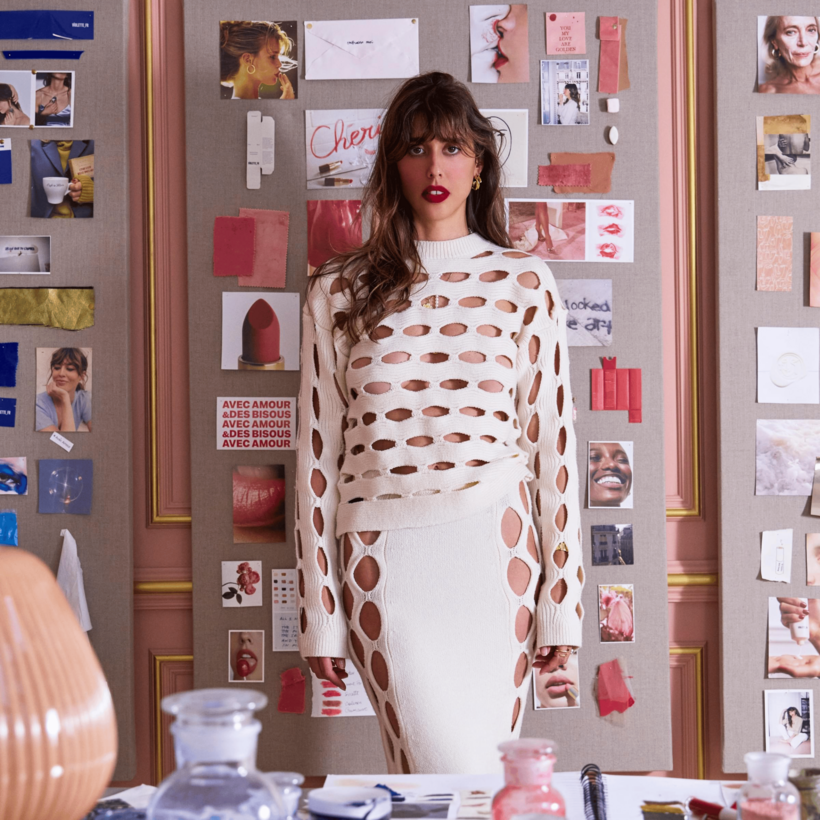
If Violette Serrat didn’t exist, the marketing director at some beauty conglomerate would have to invent her. With a full, red-lipsticked mouth, long Jane Birkin bangs, and a Jane Birkin gap between her two front teeth, you can guess where she’s from before she utters an accented word.
Like the English girl who became an unexpected emblem of French style, the makeup artist is popularizing and commercializing a particular French aesthetic with her beauty brand, Violette_Fr, which she started four years ago. It’s a romanticized notion that’s capturing the imagination of all those Americans quoting Audrey Hepburn (“Paris is always a good idea”) and standing in line outside Café de Flore for the privilege of posting their hot chocolate on social media.
“It’s almost cringe to us,” says Violette. Us, too. Despite the fact that her brand, even in name, is French, “that is not my focus….It’s really not welcoming. Do you feel welcome in the brand if I’m like, Oh, do you want to be like us? No.”
That said, many of the people who buy Violette’s lip stains and liquid eye shadows wouldn’t mind being like her. So why fight it? “There’s not a lot of French women experts in the industry that have their own line,” she says. “So my white space was right there….But instead of focusing on the French aspect, I really have a mission, and it is really more about helping people.” For starters, she’s helping people crack the code of French beauty and how to express it without the cringe.
Pretty much since day one, American beauty companies and consumers have been chasing Frenchness, as if it held not just style but some form of legitimacy. Paris has long been the capital of makeup, fragrance, and fashion, where those businesses and pastimes are revered. Even Colette, the beloved French novelist, had a beauty salon in Paris, where she offered makeovers and products. (She once wrote, maybe not so welcomingly, “I know so well what one ought to spread upon a terrified female face, so full of hope in its decline.”)
In the 1930s, Josephine Esther Lauder became an example of this yearning when she lopped off her first name and deleted a few letters from her middle one, adding an accent aigu to become Estée Lauder, the woman and the company. American-born creams were transformed into crèmes, and masks into masques. The tradition continued with American brands adding an aspirational accent or suffix to their names, from Clinique to La Mer to Glossier to Dieux to Cécred.
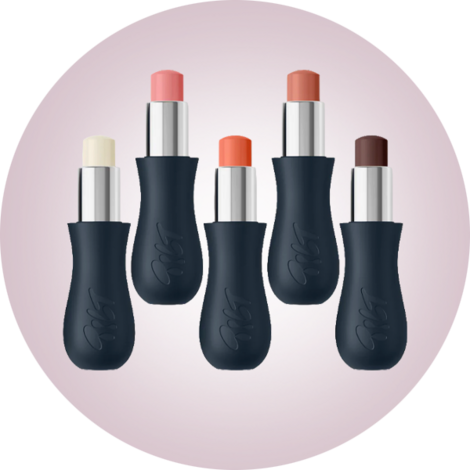
For Violette, that means translating a philosophy and technique into accessible products, starting, naturally, with the lips. She combines lipstick with silicones to make her bestselling Bisou Baum. “It was born out of the French way of doing your lipstick with a bit of lip balm, a bit of lipstick, and a piece of tissue to blur the edges.” The stick makes the lip color fuzzy and imperfect, like a bouche mordue, bitten lips. “That’s extremely anchored in my culture,” she says.
There’s an almost studied effortlessness to this aesthetic, and that also has its roots in France. “We don’t have contouring or false lashes—the whole thing. But the design of the clothes is great. It’s the right fabric. We iron our clothes. Because we love ourselves, that’s the attraction.”
Violette has no plans to make foundation, contour powder, mascara, or eyebrow pencils. “There are enough products on the market,” she says. “What am I going to reinvent with powders? It’s been done. Eyebrows? There’s good stuff happening, better than before. But so far, I don’t have much more to stay.”
She does have a few thoughts about concealer, first because she uses it instead of foundation, mostly to cover her under-eye circles. And second, because most concealers on the market are too yellow and end up making the whole face look wan and lifeless. She’s been working on shades, tweaking the undertones, for about five years. She’s patient, saying she went through a full 56 samples to finalize her first lipstick, Petal Bouche Amour Fou.
That sense of deliberation and restraint isn’t easy in a private equity-fueled business that values quantity and expansion to create those heady valuations and lucrative exits. One leading retailer told me that she believes private equity is destroying innovation in the beauty world. And yet, it’s irresistible. To be a brand founder in these intoxicating times, “your head has to stay cold,” Violette says. “At work, I have no fear. I’m not hesitant. I’m not nervous. If there’s a big success or incredible news, I’m super proud, and I’m very grateful, but nothing really gets imprinted on me,” she says. “And sometimes I’m like, Oh, I should celebrate. I should sit down and give this to myself.”
After a slow entrance into retail, starting with a pop-up at Le Bon Marche in Paris, Violette_Fr just hit the big time with shelves at 315 Sephora stores. It’s a clear sign of success, but also a beast that needs to be fed with a constant flow of product introductions at a pace that has felled other independent start-ups. Violette insists that the executives at Sephora “are not pushing me to create more or differently. It’s a very benevolent relationship so far.”
Many makeup artists start painting canvases before shifting to human faces and creating a brand from there. Violette wants to remind consumers of her connection to artistry, and she does it by adding what she calls a cabinet of curiosity to her store displays. At Le Bon Marche and Liberty of London, it’s an actual cabinet. At Sephora, it’s a glass box filled with inspirational objects: a beaker of Yves Klein blue paint, a feather, rose petals, small drawings, fabric swatches, a shell. Violette paints the botanical watercolors and builds the prototypes herself.
Since moving to Brooklyn and establishing her headquarters in Dumbo, “I’m totally Americanized,” she says. “I work out, I’m organized now. I have rules, and before everything was messy. Even in France, my friends make fun of me. They tell me, we’re really not worried with you not looking French.”
And maybe that also sums up her brand. It’s French without the insistence. It’s French with an appeal to American consumers. “At the end, you want to feel like you are accepted for the way you are.” She believes that self-acceptance is built into the French psyche. “We never try to be perfect. We never try to be sexy glam. Our mentality is, This is who I am. I don’t need you to like me.”
Violette_Fr bridges the gap between aspiration and accessibility, between French hauteur and American friendliness, packaging it in a tube with just the right amount of pigment. “It is so French that we don’t even have to say it.”
Linda Wells is the Editor at Air Mail Look


