Charlie Davidson, co-founder and longtime proprietor of the Andover Shop, a tiny Cambridge, Massachusetts, men’s-wear store—roughly a thousand square feet of selling-and-sewing space in a freestanding midcentury building just a chip shot from Harvard Yard—was talking about bow ties: “When people ask me if I’m married, I always say yes, but I’m not a fanatic about it. So here’s Rule Number One: Do not wear bow ties all the time. Keep the viewer off balance. Wear them once in a while, the way you might eat liver.”

Hardly a fanatic, Charlie was a high-stepping haberdasher who lived to mix it up, from the clothes he sold—a collision of the traditional and the far from it—to the people he attracted. My Harvard classmate Rob, old Boston down to his shoelaces, got a part-time job at the shop during sophomore year and still remembers rushing from lunch at the Porcellian Club to help fit a new white suit on a renowned jazz musician. He and Charlie became friends for life.

The fullness of this world is dazzlingly captured in Constantine Valhouli’s 2023 book, Miles, Chet, Ralph, and Charlie: An Oral History of the Andover Shop, a generous, detail-rich chronicle of the shop, its orbit, and the irresistible man at its center.

Charlie had been a tail gunner over the Pacific in World War Two, having met what Valhouli notes was the most stringent physical requirement—a frame short enough to tolerate the lack of headroom in the butt end of a B-24. He was diminutive, but his appetites were outsize and ran to the best of everything. Wonderful clothes, jazz music, good writing, beautiful women, alcohol, sports: he loved the lot and hurled all five feet of himself at them like a dodgeball.

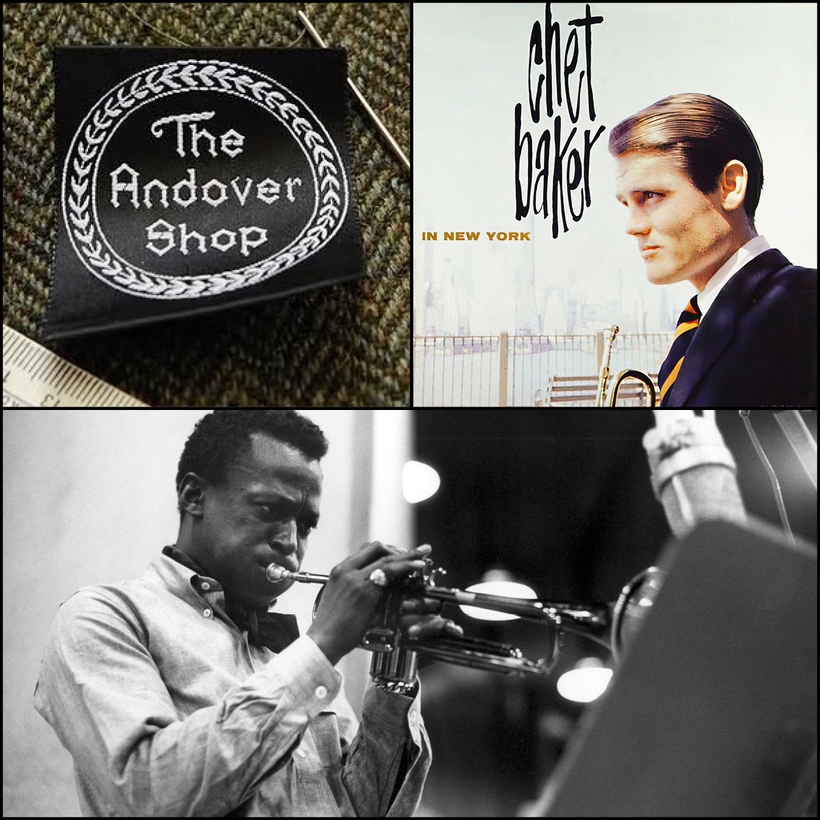
A stitch in time: the original Andover Shop, in Andover.

An operation for throat cancer in the early 60s had left him without a larynx, so he spoke through a device which required him to trap air in his chest, and then release it in a series of burps he had trained into words. Because the volume was low and he was almost always shorter than the person he was talking to, he would stand close with his head tilted up—usually with an expectant half-smile, like an eager bird waiting to be fed. And the close range would create a feeling of intimacy. Sometimes he would take your hand or even, as former employee Miles Fisher recalls in the book, cup your face with his hands, “a bit like a mafioso.”

“Do not wear bow ties all the time. Keep the viewer off balance. Wear them once in a while, the way you might eat liver.”

The Andover Shop became the focal point of an extraordinary assortment of worlds. Malcolm Gladwell, writing many years later about “six degrees of separation,” singled Charlie out as one of those rare people who seemed to know everyone. The oral history gives voice to the same idea: Miles Davis, Chet Baker, and Ralph Ellison were only some of the standouts in the force field Charlie created.

I had known Charlie in passing as an undergraduate at Harvard, but when I moved back to Cambridge in 1974, we became closer. I had accepted an offer to play late-night piano at Club Casablanca, a legendary local bar, and arrived with a little street cred. Shortly before the move, one night at the Café Carlyle in New York, I mentioned my plans to Bobby Short. “Well, I’m going to haunt you,” he said. “I’m up there all the time. Charlie Davidson at the Andover Shop is one of my best friends.”

The Epicenter of the Universe

Charlie’s father, Leon, an entrepreneur of Armenian descent, had been a Texas farmer before migrating to Massachusetts, where his son was born in 1926. He settled in Andover, developed the Andover Country Club, and owned a sizable property at 127 Main Street. In half of that building he operated a popular burger joint, where Charlie worked as a teenager. His tenant in the other half was a J. Press store.

The family’s growing prosperity allowed Charlie to attend Phillips Academy, the prestigious local prep school, from which he was quickly booted. He graduated from public high school and, after military service, made it through one semester at Bowdoin College before calling it quits for good. As Charlie liked to say, he never met a test he could pass.

Best friend to many: Charlie Davidson in the Andover Shop.

Something pulled him to the men’s-wear business. After a brief stint at J. Press in New Haven, Charlie, at age 23, in partnership with his brother-in-law, opened the first Andover Shop, at 127 Main Street. The Cambridge branch followed in 1953, and soon he would come to see Harvard Square as “the epicenter of the universe.”

John Finley, the eminent classics professor and master of Harvard’s Eliot House, recalled a suite of roommates that included Stephen Joyce, Paul Matisse, and the Aga Khan, lineal descendant of the Prophet Muhammad. “Where else but Harvard could you find living together the grandson of Joyce, the grandson of Matisse, and the great-grandson of God?” he said. Or as Charlie put it, “The whole world goes right by, and comes in here.”

In the early days, students and faculty made up much of the clientele. Professor Finley became a regular. Charlie remembered him coming in one day: “As usual, he started looking over the ties. He caught my eye and said, ‘They don’t make polka dots the way they used to, do they?’ How the hell do you reply to that?”

The Andover Shop sold the unofficial college uniform—flannel trousers, khakis, button-down shirts—but Charlie added colors that could jolt, like orange, pink, yellow, peacock blue, and grass green on a Shetland sweater. Tweed was at the core of Andover Shop style, and Charlie collected rare bolts of it for special clients. As former Town & Country editor G. Bruce Boyer told Valhouli, Charlie avoided “muddy, bland tweeds” in favor of cloth that carried “hints of exuberant colors, whether that was the flecks of a Donegal or the overcheck on a traditional pattern.”

“Where else but Harvard could you find living together the grandson of Joyce, the grandson of Matisse, and the great-grandson of God?”

John Spooner, writing about Charlie and the Andover Shop in The Atlantic, said, “It was a club, not a store. And not everyone became a member. Money meant nothing to him. It was style.” And Christian Chensvold, former editor of Ivy Style, told Valhouli, “When it comes to style, Charlie reserved his greatest appreciation for everyday men with individual panache,” not slavish followers of fashion. “Who wants to look like a fucking Polo mannequin?” he would say.

Charlie was a master salesman who thrived by never seeming to sell. Someone would come in, and Charlie would strike up a conversation about anything but clothes while he sized him up. Occasionally the person failed the quiet gut check and would be told, “I don’t think we have anything for you.”

Other times the jury stayed out. In a story told by Spooner, one day a rich businessman named Zachary ordered three suits. Charlie said they’d be ready in a month. Five weeks later, the customer called. “Not quite yet.” More calls, more delays. “He’ll get the message,” Charlie said. “I’m not sure I like the cut of his jib.” Four more weeks and Zachary called, irate. “What the hell do you guys do over there, make the clothes alphabetically?” Charlie made the suits.

The Spirit of Duende

One night in 1954, Charlie, a lifelong jazz fan, was at Storyville, the leading Boston jazz club, and was introduced to a man called George Frazier—and with that, his social and business life went into overdrive. Frazier, the Harvard-graduate son of a South Boston fireman, had been writing about jazz and fashion since his student days. “They quickly realized their taste in books, clothing, music, and joie de vivre were nearly identical,” says Frazier’s biographer, Charles Fountain, in the oral history. “From the night they met, Charlie became George Frazier’s closest friend and confidant.”

Style in everything—clothes, music, language—ruled their lives. And there was one word that said it all. Frazier came across the word duende in an article by Kenneth Tynan about Miles Davis. The Tynan piece ran in Holiday magazine, but Valhouli’s oral history traces the word’s migration into Charlie’s circle. Tantalizing for its lack of easy definition, it meant, roughly, the ability to convey deep feeling with maximum restraint—or, as Frazier wrote, “someone who came into a room like the first notes of a Lester Young solo—a proclamation of being, a style that could be mistaken for no-one else’s.” For Charlie and Frazier, that was enough to build a religion around.

Kind of beige: Miles Davis’s order sheets at the Andover Shop.

Charlie and Frazier and their friends would sit over drinks and play the duende game, trying to top each other with ideas about who had it and who didn’t. Fountain recalls in the book, “Nantucket had it, but Martha’s Vineyard did not. Fred Astaire had it, but Gene Kelly didn’t. And, my personal favorite, Ted Williams had it when striking out, while Stan Musial didn’t have it even when he was hitting a home run.” Frazier wrote that the Andover Shop had duende and Charlie swore someone called and asked what colors it came in. It could be said that the word they couldn’t define defined them.

“Someone who came into a room like the first notes of a Lester Young solo.”

Through Frazier and Storyville owner George Wein, Charlie began meeting the stars who played there. “Sometime around 1954,” Chensvold wrote, “jazz great Miles Davis walked into the Andover Shop and, single-handedly, turned the world of style upside down. Miles emerged from the store clad head-to-toe in traditional ‘Ivy League’ style clothing, and in so doing merged two separate worlds—those of the Establishment and the Black jazz artist.”

The shop was Charlie’s living room, and if you were a friend—professor, politician, musician, whoever—you were welcome. On Saturday mornings, Frazier or some other notable might be holding forth in the chair at the back, critiquing the tailoring Charlie was doing in their midst. As one interviewee recalled, the hoarse voice could belong to Miles Davis: “The sleeves are too long, Charlie.”

Charlie made a purple-and-white seersucker suit for the great jazz drummer Philly Joe Jones. When he came in to get fitted, he told Charlie not to worry about doing the alterations—he’d do them himself. Charlie asked where he’d learned to sew. Philly Joe smiled: “Prison.”

The full Andover look: the album cover of Chet Baker In New York.

When the Gerry Mulligan Quartet came East from California in 1954 with their new recruit, Chet Baker, on trumpet, they played Storyville. George Wein’s style-conscious assistant took one look at Baker’s giant “Hollywood” shoulder pads and told him, “You can’t be seen here like that.” The first of many visits to the Andover Shop ensued, Valhouli’s book recounts. By the time the album Chet Baker in New York came out, in 1958, the cover showed the trumpeter wearing the full Andover look: navy jacket, button-down shirt, and rep tie.

Senegalese native and longtime Andover Shop tailor Mor Sene saw how Charlie’s love for jazz meshed with his hatred of racial prejudice. “Inside him, in his soul,” Sene told Valhouli, “Charlie always suffered for the question ‘How can someone not respect Satchmo or Miles because they’re Black?’ While we worked, Charlie and I would listen to Miles’s songs. ‘Mor, did you hear that? If you heard it and you got it, how could you not cry?’”

Jazz and jazz people had become central to the life of the shop, but the university crowd never stopped coming. “The Andover Shop was basically an extension of the English Department faculty lounge,” recalled the literary scholar and jazz historian Robert O’Meally in Valhouli’s book. “I ran into Ralph Ellison himself in the shop. At that point I’d spent a year reading his works, trying to understand the man, and there he was, on a small platform, getting a new Burberry overcoat with the plaid lining tailored.” Another customer remembered seeing former Harvard president James Conant in the shop with Ellison, “discussing the texture of various gabardines, the subtle changes in Burberry’s trench coats, and the success of an olive-colored chambray shirt against Ralph’s brown skin.”

“How can someone not respect Satchmo or Miles because they’re Black?”

The clothes were always at the center of the action. George Frazier’s son, in an interview with Valhouli, recalled seeing Charlie and his father “hunched over the high table with a bolt of cloth spread out, for a custom jacket, with two different sets of buttons. They were leaning over, maneuvering buttons over the tweed as if they were war-gaming with a set of Prussian soldiers.”

Ivy Style devoted a cover story to what it considered the Andover Shop’s unique contribution to men’s fashion: patchwork tweed. Using scraps left over from their made-to-measure and bespoke work, they had a trick to make the salvage sing. “We connect horizontal lines into different patterns across a solid color block, so that there is continuity,” the shop’s head tailor explained, “or we carry through one minor color into the major color of the next block … this blue overcheck patch segueing into a blue herringbone-tweed patch.” He could almost have been describing a Miles Davis solo: “The whole piece has to have a rhythm and balance…. It takes molto lavorare to make it look effortless.”

Friends and Enemies

The Andover Shop took care of Charlie’s material needs—a summer house in Newport, all the nights out his constitution could take, even a Thoroughbred racehorse called Porkchopper—so he wasn’t beholden to anybody and could pick his friends as he saw fit. He didn’t suffer fools, was indifferent to rank, and saw red at the first sign of bias or bigotry.

As Sene recalled to Valhouli, Charlie stomped upstairs fuming after a blowup with a longtime customer.

When Miles Davis appeared at the Newport Jazz Festival in 1955, wearing a button-down shirt, seersucker suit, and bow tie, it was said that “all the other musicians went home and burned their zoot suits.”

“We were talking about Duke Ellington’s lyricist [Billy Strayhorn] and he said something I really didn’t like,” Charlie said.

“What?,” Sene asked.

“That Strayhorn’s nothing but a faggot. I told him, ‘Don’t ever say that again. Not just about Billy Strayhorn, and not just in front of me, but ever.’”

If not goaded directly, Charlie could couch his displeasure more gently. During his brief spell at Phillips Academy in Andover, he had been classmates with George H. W. Bush, and the two had stayed friends. “Wonderful man, an absolute gentleman. We didn’t always agree on matters of policy, but you couldn’t ask for a kinder man,” Charlie told Valhouli. And what about his son George W. Bush—Bush 43—what did Charlie make of him? Pause. “Forty-four long.”

He didn’t suffer fools, was indifferent to rank, and saw red at the first sign of bias or bigotry.

The people who rubbed Charlie wrong were few, and the ones he loved, even adored, were many. And they reciprocated. “There’s no question but that the time spent with you … marks the high spot of our summer,” Ellison wrote, in a letter quoted in the book. G. Bruce Boyer was one of a group Charlie took to hear Bobby Short at the Café Carlyle. When Charlie walked in all the musicians rose. “Charlie is the only person I’ve ever known,” Boyer told Valhouli, “who, on entering a venue, received a standing ovation from the band.”

My own appearances at Club Casablanca had been a bit of foolishness from the get-go. The owner, a gregarious Syrian, had heard me play piano at a few small gatherings and carelessly offered me a job. Tom Lehrer, the piano-playing Harvard math professor, and a friend of my landlady’s, looked in on me one night to take my measure—“musical malfeasance” was how he put it.

And maybe word was getting around, because it was some months before Charlie made it in to hear me. Then one night he showed and caught the end of a set. I finished and we sat together over a drink, but the conversation drifted off quickly. It felt like my music was lying there between us like something deceased. He clearly wanted to react but—intimate of Chet Baker, Miles Davis, Bobby Short—how? He was stymied, but only for a minute. He took another sip of his drink, and I could see him gathering oxygen. Nodding toward the piano, he leaned in close. “Keep at it,” he burped.

Scott Asen is a private investor and the founder and president of Turtle Bay Records, a New York–based jazz music label

Miles, Chet, Ralph, and Charlie: An Oral History of the Andover Shop by Constantine Valhouli is available to buy from the Andover Shop