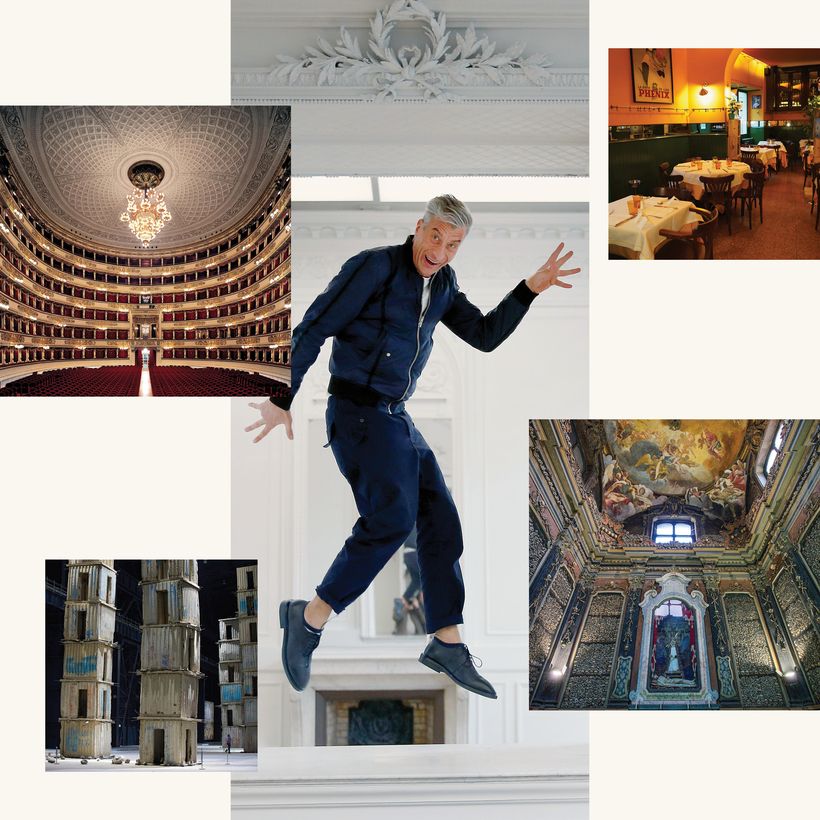
Maurizio Cattelan had never spent a day in art school before becoming the industry’s court jester. Born in Padua, Italy, in 1960, the self-taught Cattelan learned by reading art catalogs and creating his own exhibitions. “Making shows has been my school,” he once said.
Mischievous in nature, Cattelan considers himself an “art worker” rather than an artist. His exhibitions are more stunts than shows—in 1989, his first simply featured a sign that read “Be Right Back.” And in 2016, over 100,000 people gathered at the Solomon R. Guggenheim Museum to view America, his 18-karat gold toilet. Viewers used it, and critics labeled it the successor to Marcel Duchamp’s Fountain.
Over four decades later, that subversive style, which bridges the gap between the grotesque and the absurd, has not faded. While Cattelan once proclaimed retirement in 2011, the provocateur remains active in the art world, living and working in New York and Milan. Here, he shares his guide to the Italian city.

Santuario di San Bernardino alle Ossa
This is not just a curiosity and not just a church, but a room made of bones in the middle of the city. It’s beautiful and obscene at the same time, reminding us that before fashion, business, and good taste, there were structures that didn’t care about any of it. (sanbernardinoalleossa.it)
Cimitero Monumentale
A place where the city slows down. It’s almost like an open-air museum, with names like Alessandro Manzoni, Arturo Toscanini, Umberto Boccioni, and the Campari family sharing space with humans and angels. Beautiful without trying, it’s also good for thinking, walking, and even for a date. (monumentale.comune.milano.it)

Teatro alla Scala
You don’t understand La Scala from the red seats. You understand it from above, among the unforgiving fans. Here opera turns into sport, applause into verdict—it’s uncomfortable, far away, and brutally honest. (teatroallascala.org)
San Siro Stadium
Not architecture, not a monument: San Siro is a temporary city. You go for 90 minutes and find noise, belief, anger, and choreography. It’s opera without the subtitles and politics without the speeches. You don’t watch the crowd—you become part of it. (sansirostadium.com)
Piazza degli Affari’s L.O.V.E.
Too explicit to serve as decoration, and too simple to be ignored, this monument is as loud as an accusation. (instituteforpublicart.org)

Pirelli HangarBicocca
Huge, industrial, comfortless. What matters is their program: exhibitions you don’t just pass through but spend time with. (pirellihangarbicocca.org)
Piscina Cozzi
A rationalist temple. You go to swim and realize you’re inside an old but timeless sanctuary of discipline, hygiene, and public order. (milanosport.it)
Mercato Ittico Milano
Milan’s fish market is a well-oiled machine. Crates, ice, trucks, and bodies move there before the city wakes up. It’s Milan without the style. Go at dawn.
Sforzesco Castle’s Two Kiosks
Two no-frills kiosks where the city becomes edible: one names sandwiches after politicians, the other after footballers. You eat standing and looking at the park, mosquitoes biting you during the summer. The view and the irony beat any well-groomed place.

Ristorante La Balera dell’Ortica
Part ballroom, part bocce court, this restaurant hosts couples who’ve been dancing forever and kids who have just started. It’s one of the few places where different generations don’t observe each other—they mix. (labaleradellortica.com)
La Libera
When La Libera’s longtime owner, Italo Manca, died in December, the city was scared his trattoria would go with him. But it’s still there, now run by his family. (lalibera.it)
You can explore our complete, constantly-updated guide to Milan here