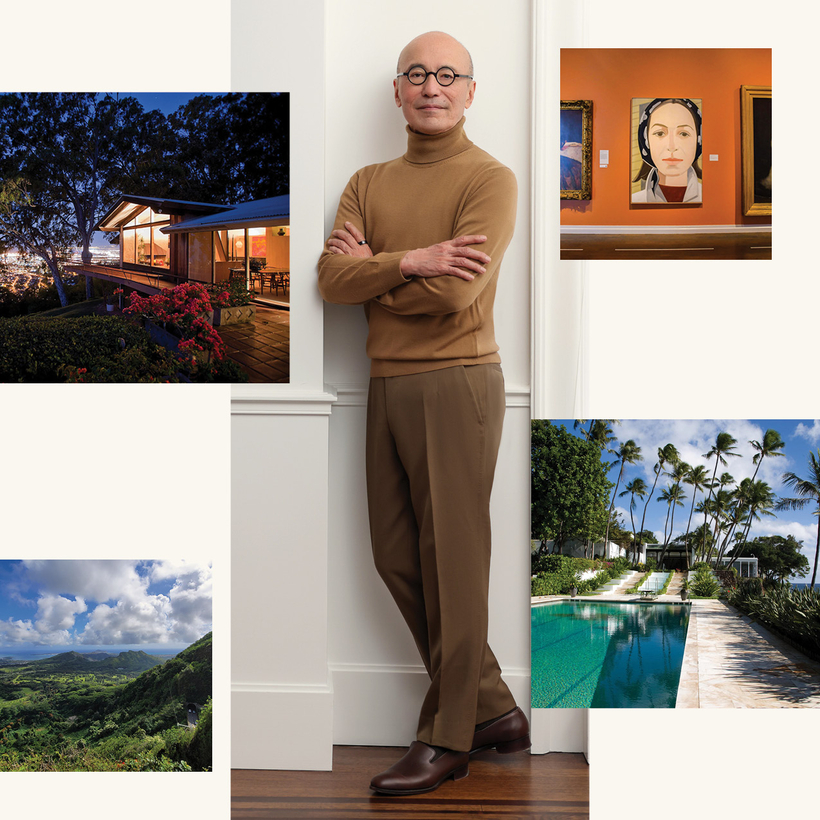
When Harold Koda arrived in New York from Honolulu in the 1970s, he was an art history graduate of the University of Hawaii, eager to break into the fashion industry. He landed a job with Vogue’s former editor in chief, Diana Vreeland, and quickly got to work, lending his eye to landmark fashion exhibitions at the Metropolitan Museum of Art, like “The Glory of Russian Costumes” and “Diaghilev: Costumes and Designs of the Ballets Russes.”
In the early 1980s, Koda moved to the Museum at F.I.T., where he joined forces with the fashion historian Richard Martin. Together, they examined how modern fashion came to be, mounting shows on everyone from Balenciaga to Halston.
When Martin took a job at the Met’s Costume Institute in 1993, Koda followed, eventually becoming its chief curator seven years later—a role he held until his retirement in 2016.
Throughout it all, he never lost sight of the Hawaii of his youth. “I like to revisit the Honolulu I remember from the 50s, 60s, and 70s,” he says. “That place now exists mostly in my head, though Honolulu’s small downtown, surprisingly, still retains many of its nostalgic elements.”
Here, the fashion expert and academic shares his guide to the city where he grew up.
Pai Honolulu
At Pai, fresh and locally sourced products are transformed into exquisitely plated, heavenly dishes. Kevin J. Lee, its chef, is by strict definition a malihini (newcomer), but every item on his refined menu is infused with the island’s ‘uhane (soul). (paihonolulu.com)
Senia
Senia’s chef, Anthony Rush, has a great backstory: he set up shop in Honolulu after stints at Per Se, the Fat Duck, and other stellar kitchens. That internationalism, anchored in Hawaii’s abundance of exceptional ingredients, translates into an inspired, multicultural menu. (restaurantsenia.com)
Fête
Fête bills itself as hapa, Hawaiian for half-and-half, and in this case, equal parts Honolulu and Brooklyn. Chef Robynne Maii trained in Hawaii as well as in New York, and now brings the farm-to-table concept to downtown Honolulu. Like the other great restaurants enlivening the area, the use of local ingredients defines Fête’s kitchen. Where Fête distinguishes itself, however, is in Maii’s robust kama’aina (native born) cooking style, which she infuses with a touch of Williamsburg. (fetehawaii.com)
Palace Saimin
Palace Saimin is my “Madeleine de Proust.” Locals will debate who makes the best dashi or noodles, but most would concede, even given their own favorites, that you can’t go wrong at Palace. Go there and get your bowl loaded with every add-on. (palacesaimin.com)
Sushi Sho
Sushi Sho is a 16-seat omakase. The restaurant feels like a cocoon designed for serenity and attentiveness. Located off of teeming Kalakaua Avenue, it offers a refuge of calm, which amplifies the experience. The chef’s deft handwork is without histrionics, but instead authoritative in its restraint. With each nuanced yet distinctive course, the culinary mastery unfurls. If eating can approach a religious experience, this is it. The check will send you to hell. (ritzcarlton.com)
Bar Leather Apron
The recent emergence of lively cocktail bars downtown is in keeping with its wartime history. During World War II, bars and brothels along Hotel Street proliferated with the waves of new military personnel. Happily, to me, that louche aura still persists. When you enter Bar Leather Apron, however, any neighborhood funkiness dissipates. Justin Park’s cocktail lounge reflects his status as Hawaii’s premier mixologist. Have his Mai Tai to savor his talent and then advance through his increasingly inventive series of heady concoctions. (barleatherapron.com)
Podmore
Podmore is a restaurant with great food, but drop in for its wildly idiosyncratic and creative cocktails. Some are so savory that they should be considered as meals. (barpodmore.com)
Reyn’s and Bailey’s Antiques & Aloha Shirts
Hawaii is really about a beach bod, so clothing is less a matter of style than a basic concession to decency. Especially when it comes to malihini (newcomers), though, women can go for tongue-in-cheek tropical print slip dresses and sarongs that are sold everywhere and cost nothing. As Mrs. Vreeland said, “We all need a splash of bad taste … it’s hearty, it’s healthy!” And, you’re on vacation.
When George Clooney wore an aloha shirt in The Descendants, he famously said: “All right, I’ll never get laid again in my life.” Reyn’s carries the muted reverse-print style of the kama’aina establishment, whereas Bailey’s Antiques and Aloha Shirts sells mind-bogglingly loud and raucous, ready-to-party prints. Their shirts are to island menswear what mullets are to hair. And, you’re on vacation. (reynspooner.com; alohashirts.com)

Shangri La
In 1935, “Poor Little Rich Girl” Doris Duke built Shangri La, a winter retreat at the foot of the Diamond Head crater. To visit this Orientalist fantasy, now a museum of Islamic art, you must make reservations a month in advance. It takes planning, but do it. The villa and its pool house are as intensely personal as the Villa Kerylos on the Côte d’Azur or the Casa Malaparte in Capri. Shangri La was only possible thanks to an incomparable setting, a romantic imagination, and a bottomless fortune. (shangrilahawaii.org)

Honolulu Museum of Art
The required shuttle to Shangri La leaves from and returns to the Honolulu Museum of Art, which is also notable architecturally. The building, with a restrained, almost self-effacing facade, is an elegant blend of Mediterranean and Chinese architectural influences. Organized as a series of courtyard pavilions, its airy, light-filled interior complex is a meandering sequence of galleries. Seek out the monumental early 11th century Guanyin in the Chinese galleries. Also, be sure to see the Eakins painting of William Rush and his model, with its (scandalous at the time) depiction of female nudity, and Whistler’s Arrangement in Black, No. 5, the artist’s first portrait of Lady Meux. The second is at the Frick. (honolulumuseum.org)

The Liljestrand House
The Liljestrand House is the only example of Vladimir Ossipoff’s domestic architecture that is open to the public. If any man influenced midcentury Hawaiian architecture, it was Ossipoff. This masterpiece of Tropical Modernism hovering above Honolulu resulted from the collaboration of the architect with the Liljestrands, sympathetic clients who shared and informed his vision. To get there, you must take the Tantalus Drive—a wonder in and of itself. (liljestrandhouse.org)
Waioli Kitchen & Bake Shop
The Wai’oli Kitchen and Bake Shop is a Bungalow-style building on the National Register of Historic Places. Preserved examples of this once ubiquitous form of Territorial architecture are increasingly rare. Visit Wai’oli for its laid-back café and open-air porch. (waiolikitchen.com)
La Mariana Sailing Club
La Mariana Sailing Club opened when I was in middle school and hasn’t, from what I can tell, been refurbished since. The vibe is 50s Tiki Lounge. The menu is long, heavy on seafood and local classics, but the reason to make your way there is to see the last authentic example of this Beach Shack genre. (la-mariana-sailing.club)
Chinatown
Chinatown is the last urban vestige of pre-statehood Hawaii. The low-rise blocks haven’t changed since Chinese merchants wearing traditional clothing stood outside smoking from long-stemmed tobacco pipes. It’s still possible, weaving between the corporate high rises, to see the architectural styles of pre-Statehood Hawaii. Zigzag from the Iolani Palace and the Kamehameha I statue, in the direction of Chinatown. Going back and forth on Bishop and Fort Streets, you will see the Alexander and Brewer building (my favorite), the C. Baldwin Building, the magisterial Castle and Cooke Building, and the Aloha Tower, all within a few blocks.

Nuʻuanu Pali Lookout
The Pali Lookout is the site of King Kamehameha’s decisive battle over Oahu. It’s breathtaking, and can be even more dramatic in inclement weather. Do not let a little rain deter you, though umbrellas will be useless against the Pali’s powerful updrafts. On your drive up, keep an eye out for the exit to the Nu’uanu Pali Drive. A local road canopied by old monkey pod trees and banyans, it loops off and back again to the main highway. This detour is a verdant reminder of the historic drive that originally bifurcated the island. (gohawaii.com)