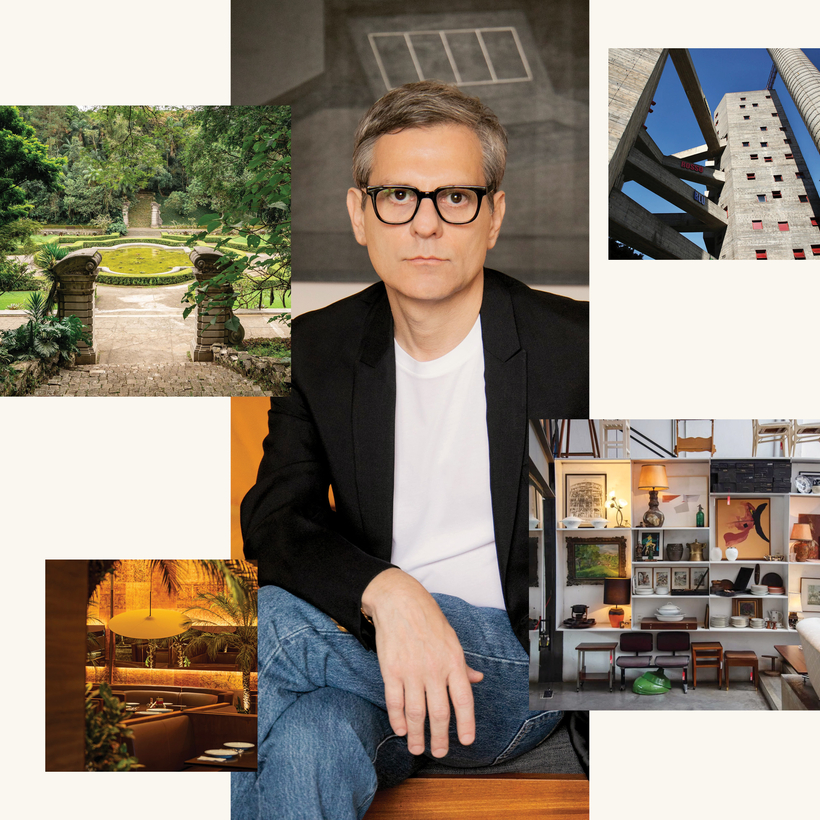
Born in Copacabana, Alexandre Gabriel came of age in the 1980s, just as the country’s 21-year military dictatorship was coming to an end. Brazilian contemporary art was entering an energetic new period, characterized by a newfound embrace of free expression. How could he stay away?
Gabriel moved to Saõ Paulo and quickly found his way to Galeria Fortes Vilaça, a small gallery founded in 2001 by Márcia Fortes and Alessandra D’Aloia. By 2016, he had become a partner—the gallery was renamed accordingly—and has since seen it grow into what it is today: an outpost in Rio, an office in Lisbon, a roster of 45 artists, including Beatriz Milhazes and Erika Verzutti.
When he’s not on a plane, Gabriel is at home in São Paulo’s Praça da República neighborhood. Here, he shares his favorite spots in the city.

Almanara Restaurante
One of São Paulo’s most traditional Middle Eastern restaurants. It’s been around since the 1950s and helped popularize Lebanese cuisine in the city. Brazil has the largest Lebanese diaspora in the world outside Lebanon, much of it rooted in São Paulo. (almanara.com)
Balaio IMS
Located on the ground floor of the IMS Paulista, this contemporary Brazilian restaurant by chef Rodrigo Oliveira serves underappreciated regional ingredients. Be sure to stop by IMS, the contemporary cultural institute focused on photography and socio-political shows, before or after a meal. The building’s top-floor terrace also offers one of the best views of Paulista Avenue. (balaioims.com)
Shin-Zushi
A high-end, traditional Japanese restaurant led by chef Shinji Hasegawa and known for its Edomae-style sushi. Its approach resonates with São Paulo’s deep Japanese heritage—Brazil is home to the largest Japanese population outside Japan, rooted in immigration that began in 1908. (instagram.com)
Dōmo
Located in a former shoe shop, this cocktail bar serves creative drinks and has a vinyl-only music selection. (instagram.com)
TERRAÇO ITÁLIA
A piano bar with a nice view—it’s on the 41st floor of the Edifício Itália, a building built in 1965. At the time, it was the tallest building in the city (and one of the tallest in Latin America), symbolizing São Paulo’s vertical growth in the mid-20th century. (terracoitalia.com)

Loja Teo
Specializing in the golden age of Brazilian furniture, this design store sells original modernist pieces made between the 40s and 70s. It has a strong focus on restored pieces and collectibles, and operates between a showroom, gallery, and restoration space. They will soon be opening a new space in a former factory in Bom Retiro. (casateo.com.br)
Egrey
A São Paulo-based fashion brand known for its contemporary menswear. It combines good tailoring with relaxed silhouettes. (egrey.com.br)
Pége
An independent brand focused on handcrafted leather goods, and known for its artisanal, small-scale production and sculptural approach to design. While many of their styles are for women, some items are offered in a wide range of sizes. (estudiopege.store)
AURORAS
An independent art space set in a 1960s modernist house in the Morumbi area. It hosts a strong program of contemporary art exhibitions. (auroras.art.br)
CASA DE VIDRO
The architect Lina Bo Bardi’s former home. Located in a more residential neighborhood, it preserves much of its original atmosphere. It’s also suspended on thin pillars in the middle of nature, which is rare in São Paulo. Bo Bardi and her husband, Pietro Maria Bardi, began living there in 1951—it became a gathering place for artists, architects, and intellectuals, since Pietro directed MASP for decades. The interior still holds an important part of the couple’s art collection, including works by Candido Portinari, Di Cavalcanti, and Lasar Segall, alongside pieces of Brazilian folk art that Lina deeply valued. (institutobardi.org.br)
Casa Modernista
Designed by the Russian-Brazilian architect Gregori Warchavchik as his own home and completed in 1927, this is widely considered Brazil’s first modernist house. It even caused controversy at the time for breaking with traditional styles.
Casa Zalszupin
Built in 1962, this is the former home and studio of the Brazilian designer Jorge Zalszupin. Today it operates as a house museum and cultural space, hosting exhibitions and talks on Brazilian modern art and design, with Zalszupin’s original furniture, archive, and studio still intact. (casazalszupin.com)
Galeria Metrópole
Built as a modernist gallery in downtown São Paulo in the 1960s, it’s now a fashionable shopping hub with independent fashion designers, furniture studios, bookstores, vintage shops, and small cafés and restaurants. (metropolegaleria.com)
MASP (Museum of Art of São Paulo)
MASP is not just one of Brazil’s most important museums, but also has one of the most significant art collections in Latin America. They recently expanded by building an annex next to Bo Bardi’s original suspended concrete structure. (masp.com.br)

SESC Pompéia
Designed by Bo Bardi inside a former drum factory, this cultural center has exhibition spaces, artist studios, a sports center with a pool, a theater, and a large communal dining hall. Bo Bardi designed the project down to the smallest detail, even thinking of staff uniforms and custom furniture, out of which came the iconic SESC Pompéia wooden bench. (sescsp.org.br)
Casa do Povo
Located in Bom Retiro, this historic cultural space was founded by Jewish immigrants in the 1950s. Today, it hosts a wide range of experimental, political, and community-driven art projects, often developed in collaboration with local groups. It’s also a great entry point into Bom Retiro, a neighborhood shaped by several waves of immigration (Jewish, Korean, Bolivian), and now known for its diversity, garment industry, and growing Korean food scene. (casadopovo.org)
Teatro Oficina
One of Brazil’s most influential experimental theaters, led by Zé Celso since the 1960s. The space was radically redesigned in the 1980s and 1990s by Bo Bardi and Edson Elito, who turned it into a long, linear stage that removes the boundary between actors and audiences. It’s considered groundbreaking for its experimental nature and countercultural role during the military dictatorship, and has also become a symbol of resistance to private development. (teatroficina.com)

SÃO PAULO BOTANICAL GARDEN
Outside the city center lives this green space, created in the 1920s to preserve the native vegetation of the Atlantic Forest. It was part of a bigger scientific and environmental project led by botanist Frederico Carlos Hoehne to study and conserve Brazilian flora. I particularly love the glass orchid garden. (jardimbotanico.com.br)