The history of the Nguni peoples is a history of movement. For centuries, communities linked by language and culture lived across the grasslands, river valleys, and coastal plains of southeast Africa. But in the 19th century, competition for cattle, land, and trade, compounded by colonial pressure, sent the region into upheaval. Kingdoms rose and communities splintered. King Shaka forged the Zulu Kingdom; Mzilikazi established the Ndebele Kingdom in what is now Zimbabwe; and the Nguni pushed farther north, founding states in Zambia and Malawi. Today, Nguni languages including isiZulu, isiXhosa, siSwati, and isiNdebele are spoken by nearly half of South Africa’s population. That history is the subject of the first major exhibition devoted to Nguni art, presented at the Yale University Art Gallery and curated by James Green. The 150 objects on view range from hide shields and intricate ceremonial axes to snuff containers, baskets, beadwork, and dazzling jewelry of bone and brass. At the center of the show stands an isibaya, the circular cattle enclosure that formed the heart of a Nguni homestead. It held the family’s cattle—among its most valuable possessions—but was also sacred ground, where animals were slaughtered as offerings and ceremonies were held to address ancestors, asking for their protection, guidance, or blessing. Yale’s reconstruction is made from 36 wooden posts given to the gallery by the Nguni king Mpezeni IV, who died in May. Alongside the historic works are Jabulani Dhlamini’s photographs of sacred landscapes and sites of cultural revival, and Nomawonga Khumalo’s film on Nguni oral traditions. —Elena Clavarino
Arts Intel Report
Nguni: Migrant Nations of Southeast Africa
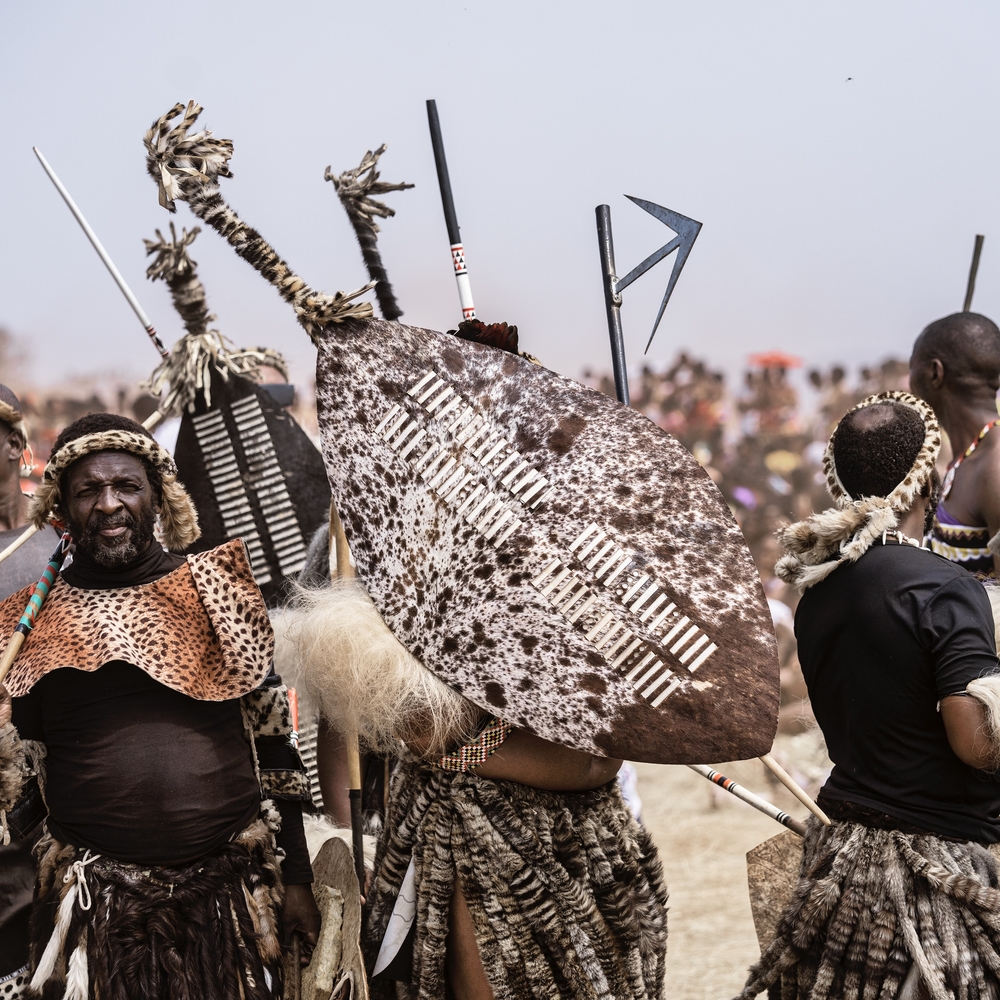
Jabulani Dhlamini, Member of an ibutho (age regiment) posing with a shield during Umkhosi Womhlanga (Reed Dance) at Mashobeni Royal Palace, Pongolo, KwaZulu-Natal, South Africa, 2025.