

“What’s your stack?” Once, that question may have referred to playing cards or a club sandwich. Then fashion people latched onto it to describe an armful of bracelets. Now it refers to peptide injections, which the longevity-obsessed employ in various combinations, or stacks, to boost their stem cells, growth hormones, immunity, mitochondria, gut microbiome, energy, stamina, muscle mass—in short, everything under the sun.
It’s all very cutting edge, very Peter Attia, pre–Epstein files. The problem is, many of these peptides aren’t approved by the F.D.A. They come from compounding labs, some reputable and some not. They rely on substances that might originate in China, from labs that might not be sterile. And I don’t need to tell you how risky it is to inject yourself with an unregulated, potentially impure substance.
But there is one peptide that doesn’t require a prescription, an injection, or a trip to the dark Web. It has reams of actual scientific research in peer-reviewed journals that prove its performance. The substance is GHK-Cu, also known as copper tripeptide, applied topically and safely to the skin. Given all the data attesting to its efficacy, I’m surprised it’s not in every product at Sephora.
Here’s a list of what this hidden gem does: improves skin firmness, elasticity, and clarity; repairs skin-barrier proteins; tightens loose skin and reverses the thinning of aged skin; reduces fine lines and depth of wrinkles, and smooths rough skin; reduces photodamage, mottled hyper-pigmentation, skin spots, and lesions; stimulates wound healing; protects skin cells from UV radiation; reduces inflammation and free-radical damage; increases hair growth and thickness; and enlarges hair follicles.
This list is so preposterously long that it seems like hyperbole. It sounds as if the copywriter at some cosmetic company took hallucinogens before tackling the press release. How could all of this be possible?
And yet the attributes are real, and they come from scientific studies conducted over the past 50-plus years. The only disappointment I have when going through these studies is that I could’ve been bathing in GHK-Cu my whole adult life. Where did the time go?
Let’s start with a definition. GHK-Cu is a small, naturally occurring peptide in the blood plasma that can also be released from tissues in the presence of an injury. As we age, our natural supply of copper peptide declines—along with everything else, thank you so much—hindering our ability to repair cellular damage. Copper in human plasma is at its peak in 20-year-olds, and it’s all downhill from there. When copper peptide is applied to the skin, it penetrates and stimulates the synthesis of collagen, which, as anyone who’s ever bought a skin-care product knows, is key to making the skin look plump and unwrinkled.
Copper peptide supports the skin’s fibroblasts, which are crucial to skin regeneration. They release growth factors that heal the skin. In another study, researchers found that women with sun damage who used an eye cream containing GHK-Cu for 12 weeks ended up with fewer lines and wrinkles and increased skin density and thickness. A different test concluded that copper tripeptide performed better on skin than vitamin C and Retin-A. Given its wound-healing abilities, it can also help heal the skin after laser resurfacing, microneedling, chemical peels, and surgery. When combined with L.E.D.-light therapy, GHK-Cu accelerated wound healing significantly.
With all this cellular activity, scientists were concerned that copper peptide might also stimulate the production of cancer cells. But in subsequent studies, they found the opposite, that GHK-Cu possesses strong anti-cancer properties.
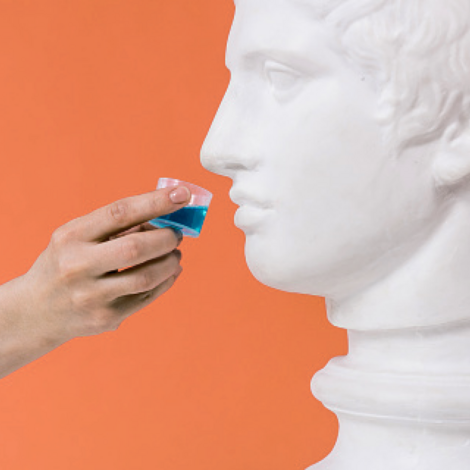
Only a few mainstream brands contain copper peptide in their products, an omission that baffles me now that I know its benefits. The serums that have GHK-Cu often list it as “copper tripeptide-1.” Some are blue and watery; others combine the peptide with glycerin, squalane, or hyaluronic acid to give it a gel-like consistency. To use one, apply it to clean skin, being sure to include the undereye area. Let it dry a bit, then follow with your usual serum, sunscreen, and moisturizer.
Unlike the marketing mumbo jumbo that obscures the unimpressive performance of so many skin-care products, copper tripeptide really works. It doesn’t have the glamour of niacinamide and hyaluronic acid, the weirdness of salmon sperm, or the lore of resveratrol or NAD+. Instead, it has decades of legitimate science on its side. And that’s all I need to know. Henceforth, I will be bathing in it.
Linda Wells is the Editor of AIR MAIL LOOK


