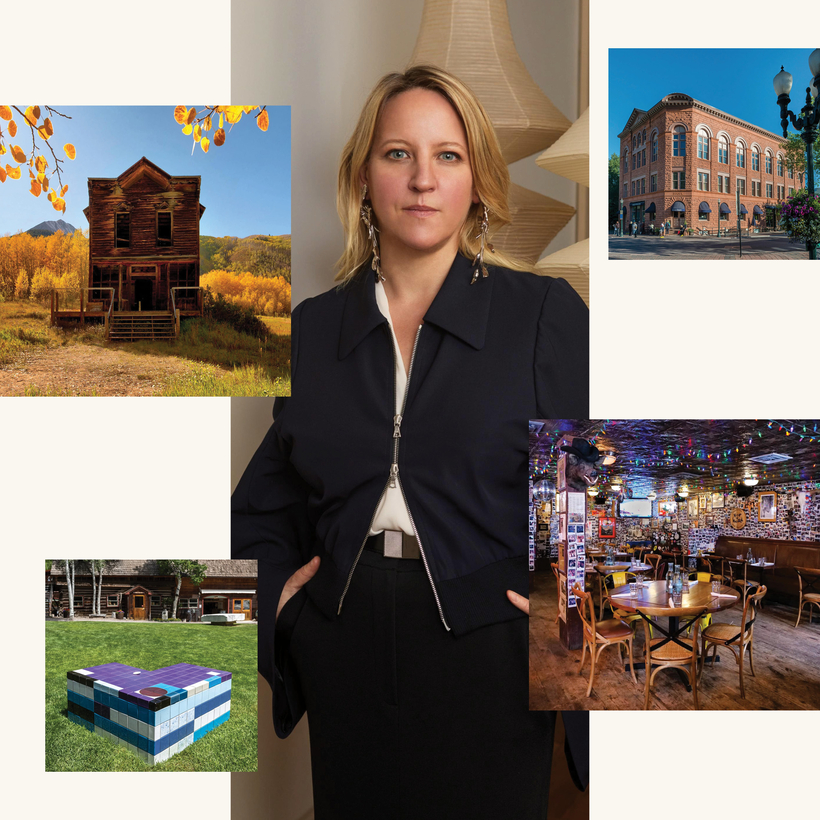
Nicola Lees has lived many lives. In her 20s, she left her hometown of London for Dublin’s Irish Museum of Modern Art. Two years later, she honed her craft back home as a curator at Serpentine Galleries and at Frieze before decamping to New York.
But her career would take an unexpected turn. Just before the coronavirus shut down the world, Lees took a job as the art director and C.E.O. of the Aspen Art Museum. “I’ve come to see geographical remoteness not as a limitation but as a creative catalyst,” she told Hauser & Wirth last year.
Since then, Lees has quietly restored Aspen’s cultural standing—the one it held before high-end ski tourism took hold. Last year, she launched AIR (not to be confused with our very own AIR!), an artist-led contemporary art festival featuring work by Werner Herzog and Caroline Polachek, and giving artists and locals alike a closer-knit sense of place. As the festival returns for its second edition, Lees shares her guide to her adopted city.

Wheeler Opera House
There is something remarkably intimate about the Wheeler. Founded in 1889, it still feels connected to Aspen’s earlier identity as a mining town, while continuing to function as one of the most vital cultural spaces in the valley. This summer, the museum will present a major new commission by Camille Henrot—it feels like exactly the kind of space where experimental performance can still unfold in a deeply personal way. (wheeleroperahouse.com)
Aspen Center for Environmental Studies
ACES has always represented an important dimension of Aspen for me. The philanthropist Elizabeth Paepcke founded the organization in 1968, donating her own land at Hallam Lake to create a wildlife sanctuary and center for environmental education—an extension of the same vision she and her husband Walter had brought to the founding of the Aspen Institute in 1949. That lineage makes ACES feel inseparable from the character of the town itself. The Aspen Art Museum has collaborated with them on projects and conversations around landscape and ecology, and it remains the place I often return to when I need a quieter pace within town. (aspennature.org)

Anderson Ranch Arts Center
Anderson Ranch is one of the rare places where artists from radically different disciplines genuinely converge. The atmosphere is generous and deeply curious. Some of the most meaningful conversations I have had in Colorado have happened there, usually unplanned, taking place informally between studios, or over lunch during the summer session. (andersonranch.org)

Ashcroft Ghost Town
The drive up Castle Creek Valley is extraordinary in every season, but Ashcroft itself has an almost cinematic stillness to it. Founded in 1880 during Colorado’s silver mining era, the town emptied within a decade as Aspen eclipsed it, and that layered history feels embedded into the landscape. The scale of the surrounding mountains makes everything feel very quiet and very small, in the best possible way. (aspenhistory.org)
Avalanche Ranch
Avalanche Ranch feels entirely removed from Aspen’s social pace. The landscape becomes much broader and more elemental there. Spending time in the hot springs after a long drive through the valley always feels restorative—particularly during winter. (avalancheranch.com)
Lost Man Loop
The Lost Man Loop is one of the hikes I recommend most often. The terrain changes constantly, from alpine lakes to exposed ridgelines and expansive wildflower fields. There is a particular and irreplicable clarity that comes from spending several hours at that altitude. (aspennature.org)

Woody Creek Tavern
Woody Creek Tavern still carries a sense of old Colorado that feels increasingly rare. Artists, ranchers, musicians, and longtime locals all coexist there naturally. It’s one of the few places in the valley that has never felt overly curated. (woodycreektavern.com)
Carl’s Pharmacy
Carl’s is one of Aspen’s true institutions. Part pharmacy, part general store, and part social meeting point, it captures a version of the town that predates much of Aspen’s contemporary luxury culture. It remains one of the few places where nearly everyone in town crosses paths. (carlspharmacy.com)