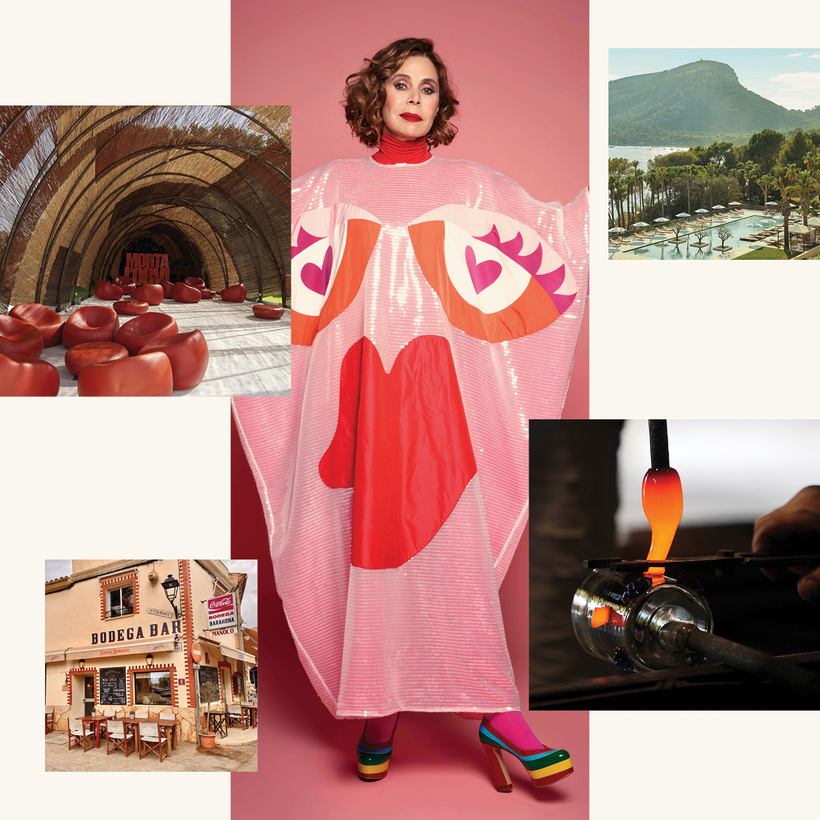
Agatha Ruiz de la Prada didn’t always dream of becoming a designer. As the daughter of an art collector, Prada grew up with the desire to paint. But when art seemed too time-consuming, she turned to fashion, delighting in its “immediate satisfaction.”
Prada began working as an assistant to the designer Pepe Rubio at the age of 20, holding her first fashion show in Madrid just a year later. By 1983, she’d opened her first store and quickly saw her eponymous brand take off globally. Prada’s vibrant and colorful designs, inspired by the likes of Rothko and Warhol, played a significant role in “La Movida,” the Spanish artistic and cultural renaissance of the 1980s.
Over four decades later, that extravagance has not faded. Prada still lives and works in Madrid, near her two children, Tristán and Cósima. Here, the designer shares her guide to the Spanish island where she has a home.
Bistro dEl Jardín
Maca de Castro, a friend of mine, runs this restaurant in the town of Alcudia. She has a Michelin star and is truly fantastic. The restaurant is divided into three spaces: the Michelin-starred dining room serving a formal, quite expensive tasting menu; a more relaxed restaurant; and a tapas bar. Each is absolutely worth going for dinner. (bistrodeljardin.com)
Cap Rocat
Cap Rocat is an extraordinary hotel located in a 19th-century military fortress built to protect the Bay of Palma. My friend Antonio Obrador, who is one of the best decorators on the island, transformed it into the impressive place it is today. It’s my favorite hotel, even if I’ve only stayed there once. (caprocat.com)

Four Seasons Resort Mallorca at Formentor
I haven’t been to Hotel Formentor since it was renovated last year, but I went almost every year before that. It’s an extraordinary place, and in my opinion, the most beautiful spot in Majorca. The hotel was built at a time when there wasn’t even a road to reach it—everything had to be brought in by boat. It has an incredible history and has been visited by countless notable figures. (fourseasons.com)
The Yannick and Ben Jakober Foundation
The Yannick and Ben Jakober Foundation is a small museum dedicated to childhood. Created after the Jakobers lost a young child, its collection is very moving, featuring portraits of children from different periods. They’re now adding six of my pieces to the collection—I think they’re among the most beautiful garments I’ve ever made. It’s a very sensitive, emotional place. (exposicion.hispanianostra.org)
Can Lis
The architect Jørn Utzon only built two things in his life: the Sydney Opera House and his own home. The latter, perched right above the sea, was modestly designed and made with very simple materials, though the result is extraordinary, reflecting Utzon’s incredibly sophisticated mind. Architects from all over the world have traveled to see it, sometimes even climbing onto the roof to get a better of the surrounding landscape. Utzon’s family now lives in another house nearby, and has turned Can Lis into a museum. (https://utzon.foundation/can-l)
Cortana Palma de Mallorca
Located in Palma, Cortana is run by Rosa Esteva, the daughter of Antonio Obrador. She has clearly inherited her father’s exceptional taste—the store is stunning. With a bridal section, home pieces, and ready-to-wear, it’s large, elegant, and incredibly well done. Definitely stop by if you’re in Palma. (cortana.es)

Fundació Miró Mallorca
I’ve always been a great admirer of Joan Miró and of the architect Josep Lluís Sert, which makes me a big fan of this foundation. Sert also happens to be very distantly related to my family. He’s one of two people who worked on this spot, but he worked on the Miró Foundation in Barcelona as well. (miromallorca.com/en/)

Gordiola
I’ve been going to the Gordiola glass factory since I was a child. It’s one of the most beautiful and moving places on the island because they still make glass the same way they did 500 years ago. I’ve always been a small collector of their work—I love everything they do. It’s best to go on a day when it’s not too hot, so you can stay a while to watch them blow the glass on site. Otherwise, you can visit their shop in central Palma. You won’t see the process there, but the craftsmanship is still remarkable. (gordiola.com)
Son Serra de Marina
Located in a lesser-known part of the island, Son Serra de Marina is a wild and unspoiled village with a strong ecological character. As beautiful as it is peaceful, it’s the perfect place for a walk.

Bodega Barahona—Casa Manolo
And finally, there’s Casa Manolo, near Ses Salines. It’s a classic restaurant, run by a family that’s been there forever. Everyone from the king to locals has been. The food is delicious, simple, and traditional—what’s not to love? (instagram.com)