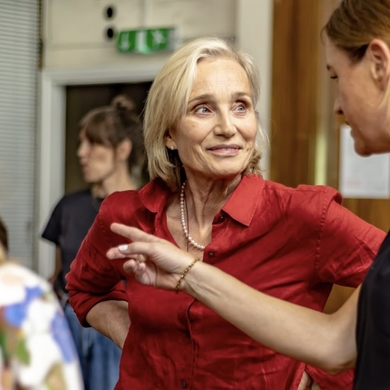
Bringing together two stories set centuries apart, the National Theatre’s production of Electra/Persona asks what happens when a woman’s rage can no longer be contained by the roles society assigns her. Sophocles’s Electra (Cate Blanchett) is consumed by grief after her father, Agamemnon, is murdered by her mother, Clytemnestra, and Aegisthus, her mother’s lover. Rather than accept the new order in her household, Electra refuses to stop grieving—her voice is the only power available to her and by speaking she keeps Clytemnestra’s version of events from becoming the accepted truth. Ingmar Bergman’s Elisabet, by contrast, is an actress who chooses to protest in silence: while performing the title role in Electra, she stops speaking and withdraws from language entirely. Director Benedict Andrews puts the two women in conversation—one who cannot stop speaking, one who refuses to speak at all—to show how repression intensifies emotions until they surface in unpredictable and disruptive ways. Greek tragedy has long given that rage a voice; one thinks also of Medea’s fury and Antigone’s courage. The passion of these ancient women, Andrews’s production proposes, still feels urgent today. As Natalie Haynes writes in The Guardian, “Move over, Odysseus—it’s time for the women of ancient Greece to have their moment in the sun.” Electra/Persona runs at the National Theatre’s Lyttelton Theatre from August 19 to October 10. —Clara Scholl
Arts Intel Report
Electra/Persona

Cate Blanchett in rehearsals for Electra/Persona.