The genius of Charley Harper was to render animals and their habitats not as a naturalist would, counting feathers, but with the postwar confidence, pinpoint control, Pop color, and jazzy, geometric wit of a midcentury modernist. In his own way, Harper was an action painter without the angst and alcohol and overriding ego, injecting flat surfaces with kinetic purpose. For nearly 30 years, he was the in-house illustrator for Ford Times, the culture magazine of the Ford Motor Company, his striking jet-age covers as emblematic of that era as Norman Rockwell’s homespun vignettes were for The Saturday Evening Post. Energy was in the air. The studio where Harper and his wife, Edie, toiled (she was an exemplary collaborator and artist in her own right) had the productive disarray of Andy Warhol’s Factory, minus the zonked-out hangers-on. And even in profiled repose, Harper’s birds look aerodynamic, ready for blastoff potential. But he wasn’t strictly for the birds. His menagerie encompassed all of creaturedom: four-legged critters resting on their haunches or poised to pounce, eyes like headlights; insects dotted along a Mondrian grid or in Pac-Man clusters. This exhibition at the Cincinnati Art Museum displays more than 140 drawings, gouaches, collages, screen prints, paintings, and posters. It’s Saint-Saëns’s The Carnival of the Animals in kaleidoscopic array. —James Wolcott
Arts Intel Report
Charley Harper

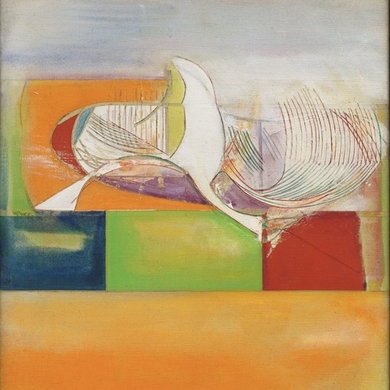
Charley Harper, Glacier Bay, Alaska, c. 1976.