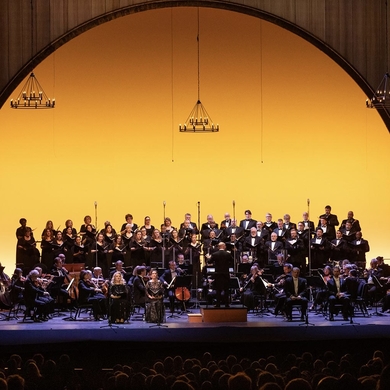
Talk about scene-setting. In the opening measures of The Creation, Franz Joseph Haydn renders the darkness upon the face of the deep in harmonically unmoored instrumentals that plunged the Viennese of the year 1798 into shock and awe. Only then do we hear the tremendous words “In the beginning,” setting us up for the joy and wonder of the seraphim and the bliss of Adam and Eve in Eden, their caroling aglow in a halo of choral voices. There’s not an oratorio in the canon more radiant than Haydn’s gloss on Genesis. What to play, though, should an orchestra wish to offer an encore? Please not Haydn’s intended sequel The Seasons, which scarcely transcends the pretty. The powers that be at the Boston Symphony Orchestra are taking a leap of faith, presenting a newly commissioned Creation (just Creation, no article) by the wildly multi-culti, jubilantly liturgical Osvaldo Golijov. The playwright David Henry Hwang, who hinted at transcendentalist aspirations in his libretto for Huang Ruo’s opera The Monkey King, is credited with Creation’s “book” (the narrative ground plan?), leaving the poet Leah Hager Cohen to supply the “lyrics” (the actual words set to music?). From November 5 to 7, the poised classicist Philippe Jordan conducts Haydn’s masterpiece with Louise Alder (soprano), Bodgan Volkov (tenor), and David Steffens (bass-baritone) in the eloquent solo parts. Golijov’s score has been entrusted to the conductor Eric Jacobsen and an all-star soloist roster that includes the vocalist Cécile McLorin Salvant, the bass-baritone Davóne Tines, Cyro Baptista on percussion, and—most exotically—Kayhan Kalhor, grand master of the Persian spike fiddle known as the kamancheh. For the Tanglewood Festival Chorus, the double-header is a God-given opportunity to flex their range, style, and technique. The BSO x NEC Honors Children’s Choir joins them in the Golijov to supply the extra peal and shimmer of what the Italians call “white” voices but English-speaking peoples are apter to think of as green. —Matthew Gurewitsch