

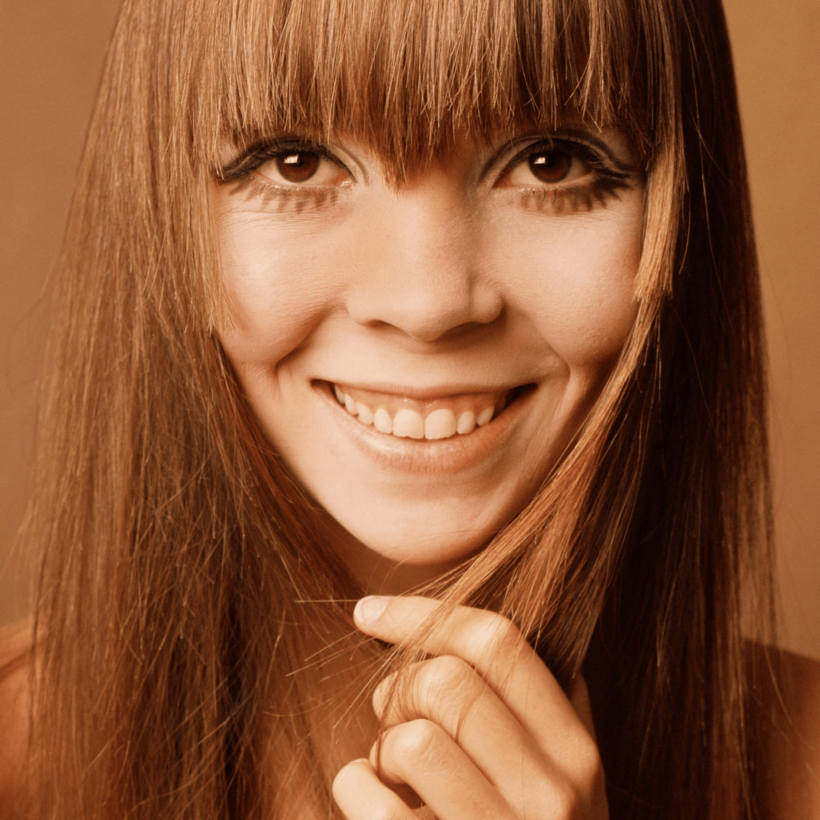
Before we meet, Penelope Tree is insistent that she has “nothing very interesting” to say. You probably don’t need me to tell you that this couldn’t be further from the truth.

There’s the anecdotage from the model’s time as one of the swingiest figures of Swinging London in the sixties, of course, swept off her feet at 17 by the man she calls “Bailey” (as in David), propelled into a world of Vogue photo shoots and dinner with Andy Warhol.

But she can also reminisce about Truman Capote’s Black and White Ball of 1966. (“All the Texans from his book In Cold Blood were there, the detectives and their wives and everyone, about ten of them. Charming, in their Texan clothes, and they sat around one table, their eyes out on stalks.”) Or her drug bust of 1972. (“Being thrown into prison was one of the best things that ever happened to me. When the door slams and you don’t know if you are going to get out, it’s just too real. It was a terrifying moment. I was much more cautious after that.”)

These days, Tree, 76, is happy to talk about everything. “It’s ever since I wrote my book that it’s changed,” she says, looking befringed and fabulous in an embroidered green jacket, jeans and the haircut that launched a thousand Sixties wannabes. Her roman à clef, Piece of My Heart, was published in 2024, and has just been optioned by one of the television biggies, which must, as yet, remain unnamed. One doesn’t need much of a “clef” to unlock the connections between Tree’s story and that of a poor little rich girl called Ari, who becomes the muse and lover of a working-class photographer named Ramsey, as adept at seducing women as he is at capturing the zeitgeist. Emily in Paris is nothing compared with Penelope/Ari in London.

We are talking in the living room of a friend’s house, where Tree stays when she is visiting the city. She spends most of her time in Sussex. “I feel so at home in the English countryside,” she says. She may have grown up in New York, the daughter of a former Conservative M.P., Ronald Tree, and his American wife, a socialite who worked at the U.N. and hung out with the so-called “swans” who flocked around Capote, and yet, she says, “I spent all my summers in the U.K. with my half-brother, Michael, who was much older than me. And all the books I read as a child—The Wind in the Willows, Enid Blyton—just made this where I sort of longed to be.”

She didn’t find out her father was gay until after his death, when she was in her forties. Ari’s love for her father is the most uncomplicated emotion in Piece of My Heart. “He was very kind,” Tree says. Her mother, on the other hand, was “unforgiving” and Tree felt “oppressed by her.”

During our couple of hours together, Tree’s conversation zigzags from Cecil Beaton (her impression of what she tells me was his signature exclamation, best summed up as a vowel-laden gargle, is especially memorable) to Buddhism. (“It’s something you have to practice, and as you practice it slowly, very slowly, does begin to help.”) She also gives clear-sighted accounts of everything from her long battle with eating disorders (she says she “numbed” herself with anorexia and bulimia from 14 to 36) to her relationship with the man she refers to with two words that begin with “B”: one Bailey; the other—her eyes twinkling—“bastard.”

Beaton isn’t the only impression she does, either. Also in her line-up is Capote, whom she makes sound like a strangled Daffy Duck. “I first met him at a lunch of my mother’s, when I was about 13, and I was galvanized by the sound of that voice. At that age, that kind of oddness really is exciting. Afterward, I sent him a short story I had written. And I got a note back from him saying, ‘Keep going.’ ” Which, as evidenced by Piece of My Heart, a page-turner evocation of an epoch, she has. My primary takeaway from reading it? It was much better to be a man in Swinging London than a woman.

Tree does a brilliant Diana Vreeland, too, a nasal drawl like Katharine Hepburn on Lucky Strikes. (Vreeland smoked six packs a day.) It was the legendary magazine editor who called her the morning after the Black and White Ball. “I had put on this dress from Betsey Johnson and thought my life was going to change. It was based on dance gear—black jersey and backless. It was pretty tame by today’s standards, but for then … ” Yet no one seemed to have noticed her.

She was wrong. “Mrs. Vreeland,” who was yet another highfalutin friend of her parents, rang up and said, “Dick Avedon saw you last night and thought you were divine. Would you like to pose for us?” “Us” meant American Vogue, and Tree was soon being photographed by Richard Avedon for its pages. Her career was in the ascendant, although the degree to which her aesthetic anticipated an era as yet incoming meant that she would still go to some castings and be told she was “a total freak and hideous. They would say, ‘But we asked for a pretty girl.’”

She describes Avedon as “a genius in terms of how he connected with people. He made me feel as if I were collaborating with him, as if we were in this thing together. He made me feel I could do this, whereas at my boarding school [in New England] I just felt like a terrible failure a lot of the time.” (She had also been sexually assaulted by a stranger when she was a young teenager.)

Bailey was “really good at connecting, too,” she continues. “I mean, he could be devastating as well, but he’s very good at connecting. It’s a great art. With really good photographers, you are sort of in this bubble with them, and there’s nobody else in the world.”

Tree is still friends with Bailey, who was 29, 12 years her senior, when they met in 1967. She describes their first encounter in London as a coup de foudre. “It was an instant thing. He was way too attractive for his own good. I thought he was the most beautiful man I had ever seen. I thought he was extraordinary. I loved his photographs and his directness. That became a double-edged sword, but at the time it felt so refreshing. I just knew I would be with him. I thought, ‘Well, I am not going to be with him now, but I will be with him in the future.’”

At the time, Bailey was married to Catherine Deneuve. (He has certainly ticked off the beauties, going on, after his relationship with Tree, to marry first Marie Helvin and then another model, Catherine Bailey, with whom he has been for 39 years.) Eventually, he came for Tree, arriving to see her when she was back, modeling and studying, in New York. “He turned up and that was the end of it. Avedon freaked out and walked me round many blocks, but I was quite stroppy and nothing was going to get in my way.”

She gave up college—“I hadn’t been doing much work, I have to say, as working as a model made me exhausted the whole time”—and moved across the Atlantic into Bailey’s black-painted house in Primrose Hill. It wasn’t the Primrose Hill of today. “There was a fish and chip shop, a garage and some kind of second-hand shop run by Fay Weldon’s husband.”

What was it like living in a world of black? “Bailey thought it was cool. It was kind of cool, but it got to me after a while.” As did the fact that “the house was full of remnants of previous relationships. I was so young that I just accepted all that, but yes, it got to me after a while.”

It wasn’t just the remnants of past lovers with which Tree had to deal. Bailey was serially unfaithful. “He had this love of conquest. It was because he could, you know. It was about potency. He had this absolutely incredible charm. There was a lot of ego involved. And it destroyed me. It was really hard. I would love to be one of those people.... I mean, there are women I know who don’t care.”

Her novel is rammed with bad behavior that Ramsey/Bailey doesn’t even bother to disguise, some of it entailing celebrities such as the singer Nico. “Yes, all that stuff happened. I was in denial about it because I couldn’t bear it. But in the end, my body rebelled. I was really angry and I couldn’t express it, so it came out in the form of this terrible acne. And that alienated him from me as well, because female beauty is such an important part of his … It’s a prerequisite.”

He left her for the wife of a friend. Just to make matters worse, “I had to go past newsstands around London with all his, you know, new girlfriends. It was agony.”

It’s like the stuff of fairytale: a young woman whose identity—whose métier—is the way she looks, losing those looks overnight at 21, and with it not only her relationship but her means of earning a living. “It was all so dramatic, being a huge success and then losing everything. It was embarrassing and humiliating. It really stuck in my craw. It was something I needed to work out with therapy and eventually, when I was ready, with the book.”

Now she can see that her acne saved her from a relationship that would have “destroyed” her, and it also forced a profound recalibration of how she operated in the world, one that has served her well as she has grown older. “I started thinking less about how I looked and putting more energy into writing and reading. In my early twenties, I experienced this feeling that I was past it, so as I aged I was already so much more comfortable in my skin.”

Ours is a society that is, she says, “obsessed with form. We overlook the importance of the inner world.” Sometimes even now, she says, four decades after she cracked her eating disorders, “I catch myself thinking, ‘Oh, I am too fat.’ This stuff sort of infiltrates our minds. And then I have to give myself a talking-to.”

She still models occasionally, earlier this year walking the catwalk for Fendi and the British designer Richard Quinn, and appearing in Zara’s 50th anniversary campaign. Her advice to any aspiring young model is, “Develop your own inner life, your own interests. Make sure you are 50-50.”

Of her famous ex-lover, she says, “I think he did genuinely love me. If Bailey is capable of feeling a little bit of guilt—and I am not quite sure about that—then maybe he feels guilty. He always says, ‘Well, I tried to get you back.’ And I say, ‘When was that?’ ”

Eventually, “We just sort of, bit by bit, fell in together again. I wasn’t in love with him anymore—I could see his foibles—but you can’t go through something like that without still loving someone.” She is friends with his wife too, referring several times to “Catherine” during our conversation. It becomes apparent that the two women have compared extensive notes—which she shares with me off the record—on the phenomenon that is “Bailey.”

Tree has since had two long-term relationships and has two children. Motherhood was one of the things that “saved” her from the trauma of her twenties, she says. She has been single now for more than a decade. “I have learned so much more being on my own. I really enjoy feeling free and not having to answer to anyone. At first I had to sit and face loneliness. That is a practice in Buddhism—if you have a very strong emotion, you sit with it rather than fleeing from it. You accept it. And, amazingly, it does dissipate.

“Now it’s my decision what I do with my day,” she says. “I find it wonderful. I never get bored.” She is, she says, “no longer trying to attract a man. I don’t want to be anything for anybody.”

Anna Murphy is the fashion director at The Times of London