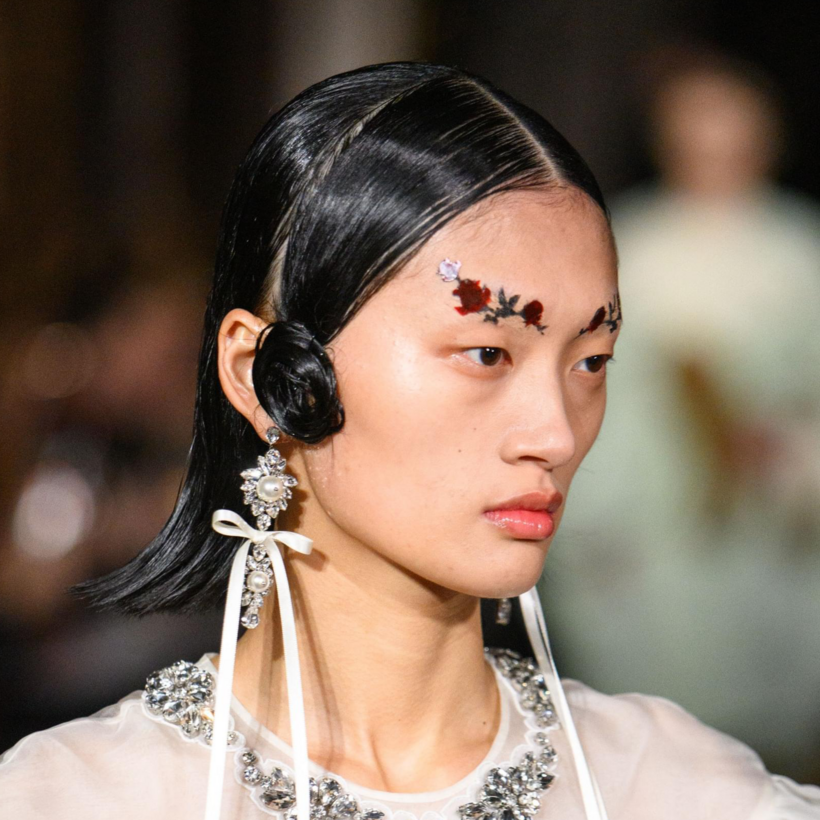

My brows were never Lily Collins thick, but after years of plucking them into Y2K submission, they were practically invisible. Tired of filling them with a brow pencil, I discovered several solutions: eyebrow transplants (as seen on Chrissy Teigen and Jen Atkin), topical growth serums (like prescription Latisse), and microblading.
For eyebrow transplants, surgeons remove hair from the back of the scalp and implant it on the brows. While effective, it’s expensive (the average cost is $7,000) and has a bizarre side effect: the transplanted hairs keep growing as if they were still on your head and have to be frequently trimmed…forever.
Microblading seems an appealing alternative. To fill in sparse brows, a technician uses a small blade to apply pigment in little strokes that resemble eyebrow hairs. The procedure is touted as semi-permanent and is supposed to fade after a year or two.
Once I learned about microblading, I saw it everywhere: on Bella Thorne, Hilaria Baldwin, and Mandy Moore, influencers, my neighbor, my hair colorist, and the faces of women I passed on the street.
I was sold.
Before my appointment, I combed the internet for inspiration, only to uncover thousands of horror stories of misshapen, blocky, faded, and bright red, orange, blue, and yellow eyebrows.
There are, it turns out, many ways that microblading can go terribly wrong. One of microblading’s selling points is that the pigment gradually disappears over time. In fact, it is often permanent and, if the color changes, which it often does, the ink needs to be removed by a professional.
One of the most popular manufacturers of microblading ink and tools, Tina Davies, did not reply to repeated requests for comment. However, in a 2023 speech on YouTube, Davies talked about the problems facing her industry, including “rainbow eyebrows” (eyebrows that turn red, green, or orange over time), ink that is “hard to remove” and “lasts too long,” and people’s “fear of permanence.”
She said her company was working on a better ink, which she presented at the conference. She cautioned, though, that this new formula “doesn’t fade to nothing,” but can be “touched up over and over again, 10, 20 times.”
To fix, remove, or truly fade microbladed eyebrows requires a treatment with saline or a laser. The former entails tattooing over the microbladed area with a saline solution within 48 hours of the original application. If two days have passed after the initial procedure, the microblading ink can only be removed with a laser.
That process is the same as lasering off a tattoo. Different laser wavelengths target specific colors, and the ink can turn yellow, red, grey, or orange throughout the process (a side effect of the microblading pigments that doesn’t happen with tattoos). If the pigment turns yellow, it becomes extremely difficult to remove; sometimes, it can’t be eliminated at all.
Carmen VanderHeiden Brodie, the co-founder and vice president of clinical operations at Removery, the largest tattoo removal company, says that microbladed clients make up almost 10 percent of their business – a number that is steadily increasing.
Most brow ink is easy to eliminate, and, for over 90 percent of their clients, she says the process takes one to three sessions and costs $400 per session. The exceptions are clients with dark skin and red brow pigment, and those whose brows are yellow from a previous attempt with a laser. “I would love to solve yellow,” she says. “I don’t have the answer. Nobody does.”
That’s all I needed to hear. I canceled my microblading appointment and filled a prescription for Latisse. My brows aren’t as thick and luscious as I’d like them to be, but I can live with that.
Susan Rigetti is a journalist, novelist, and the author of three books, including Cover Story and Whistleblower


