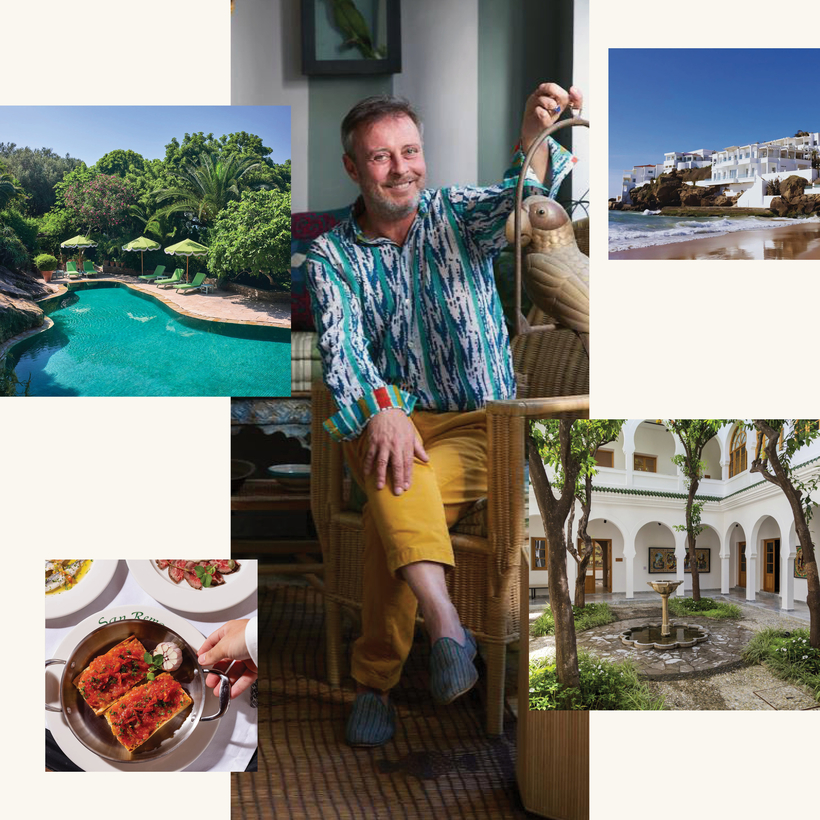
Nicolò Castellini Baldissera was born into one of Italy’s great design families—his great-grandfather was the renowned Milanese architect Piero Portaluppi, while his father, Piero Castellini, designed homes and co-founded C&C Milano, a purveyor of exquisite decorative fabrics. But Nicolò soon set out to carve out an aesthetic of his own. In the late 1980s, he moved to London to study art history before establishing his own interior-design practice.
Over the past three decades, he has worked on projects across Europe, launched furniture lines, and written two books, most recently Inside Milan. When he’s not in his native Italy, he can often be found in Tangier, a city he has long called a second home. “I feel free when I’m here,” he told Alain Elkann. “I feel that everything is possible.” After years spent getting to know the city, he shares his favorite places to eat, shop, and explore.
Villa Joséphine
There is a Fawlty Towers charm to Villa Joséphine. The hotel sits on the Sidi Masmoudi road, in a neighborhood we call the Old Mountain. It was built by Walter Harris, the explorer, spy, and correspondent for The Times of London. Creaky parquet, silver trays, and liveries with epaulettes: it is wonderfully old-fashioned. Every suite has a breezy outdoor sitting room with chintz sofas; the beds are made with Porthault sheets; and dinner is served in the dining room, by a roaring fire, with a menu that has thankfully not been tinkered with. I would be very sorry to see it become too polished. (hotel-villajosephine.com)

San Remo
San Remo has been a staple of Tangier since the 1980s and 1990s. It was recently updated by Nora Larini, the restaurateur behind Nono Sea Taste and other institutions. The menu is a blend of tapas and Italian dishes. It’s a useful place to have in your repertoire for when you want something easy and familiar in town. (instagram.com)

Le Mirage
Le Mirage has the best beach in Tangier, which you can only access if you are a guest of the hotel. It used to be quite common for Tangierines to move here for the month of August—something that occasionally still happens. Because of its position between the cliffs of Hercules’ Cave, the Roman ruins of Cotta, and the Saudi Royal Palace, the beach is completely private. It is a wonderful place to escape Tangier for a few days without really leaving the city. (lemirage.com)
A Walk from the Marchane to Cap Spartel
I was in Tangier during the coronavirus pandemic and lockdown, during which time I often took long walks. I live in the Marchane, a leafy neighborhood lined with townhouses on a plateau above the city. One of my favorite walking routes begins at the Forbes Palace and follows Rue Shakespeare all the way down to the bluff above Markala Beach. Cutting through the cemetery, a goat path brings you down to the Corniche, a road that hugs the coast back toward town. After getting to the Corniche, continue up the hill to Sidi Masmoudi and follow it to the very end, past the Institut de Photographie de Tanger and Yto Barrada’s artist residency, “The Mothership. ” The road soon becomes a path through farmers’ fields and a still-wild Tangier, and leads to Cap Spartel. You can walk down to Agla to swim off the rocks, or up to Parc Rmilat to see Perdicaris House (the subject of the Sean Connery and Candice Bergen film The Wind and the Lion.) It is one of the best ways to understand how quickly Tangier can change from an urban landscape into something almost rural.
The Garage Velázquez Art District
Between the cannon-lined square at the top of the boulevard and Garage Velázquez runs a narrow street that has quietly become a small arts district. I would argue it was Stéphanie Gaou, a native of Cannes, who started the trend with her bookshop, Les Insolites. She is always organizing events, exhibitions, and discussions. It has since been joined by the specialist bookseller Art Tanger, Hicham Bouzid’s print shop KIOSK, the design store Habibi Burton, and Galerie Kent, along with many other little spots. It is a good place to spend an afternoon without a particular plan.
New Tangier
Kenza Bounani’s New Tangier began as a small bag shop, but has evolved into a full-fledged clothing line. Beautifully woven linens and silks are transformed into trousers, coats, and caftans that feel both contemporary and very much Moroccan. Bounani has one atelier in the Marchane, which is by appointment, as well as a new shop at the PHG Polo Club. (newtangier.com)
Maison Citron
For a little coffee, pastry, or ice cream, head to Maison Citron, a dessert shop recently opened by the artist Myriam Chaaib. Thankfully, it is right around the corner from my house and two steps from Villa Mabrouka. (instagram.com)
Kasbah Collective
When I heard that the son of Majid El Fenni, the antique dealer whose shop in the Medina is an Ali Baba’s cave of treasures, had married the daughter of Boubker Temli, the art dealer whose gallery has supplied many of my paintings, I was naturally curious. The pair have curated a beautiful selection of ceramics, furniture, art, and even clothes. Some of my own furniture is also sold there, under the name Casa Tosca. I recently bought a stunning coat made out of a celadon suzani. (kasbahcollective.com)
Laure Welfling
You cannot go wrong with a pair of trousers or a shirt from the designer Laure Welfling. Located on the Place de la Kasbah, her shop has some incredibly elegant pieces that would be perfect for a party in the Medina or the Marais alike. (laurewelfling.com)
The Charf Weavers
A small collective of straw weavers by a marshy river sell lamps, placemats, chairs, and all sorts of wonderful creations. They are often called the Charf Weavers, after the neighborhood where they were located before being displaced by the new high-speed railway. They are now located just off Route N16, to the right of Hawmat El Ouad.

Musée Dar Niaba
I never really thought of Tangier as a museum city, but that is starting to change. Musée Dar Niaba, on the main drag connecting the Grand Socco and the Petit Socco, occupies one of the city’s oldest buildings. It has a Portuguese façade that dates back to the late 16th century. Its exhibitions often bring together 19th- and early-20th-century Moroccan and European painters. (fnm.ma)

L’Orangerie at Villa Mabrouka
It is hard to make any Tangier list without including the Villa Mabrouka. Jasper Conran’s hotel has, in only a few years, changed the way the city is perceived by tourists. In the 2010s, it felt like all visitors were backpackers spending a night in town before moving on to Chefchaouen or Ketama. Mabrouka helped put Tangier back on the map for a different kind of traveler, such as wealthy couples from Rabat and Casablanca who might not previously have considered it for a holiday. I love the terrace for lunch. Thankfully, the new general manager, Meriem Barakat, has done a beautiful job replacing Luca Ravera. It remains one of the loveliest places in town to spend a long afternoon. (villamabrouka.com)
El Dorado
When I am out hunting for antiques in town, in the dusty shops around Rue de Hollande where you can still find beautiful 18th-century tiles or silk embroidery, I stop for lunch at El Dorado. I usually order a big plate of “cotolette d’agnello con frites” or “calamari alla plancha with patatas pobres.” I have worked too hard to build relationships with these dealers to give away all of my secret spots, but I encourage you to go and find them for yourself. Half the pleasure of Tangier is discovering something you were not looking for.
Palazzo d’Italia
The former Casa d’Italia, on the ground floor of the Palais des Institutions Italiennes, is being revived under the direction of Luca Ravera, who used to be the general manager of Villa Mabrouka. Luca left his post to bring this beloved Tangier institution back to life. I have worked with him as an interior design consultant, so I have had the pleasure of watching the project develop. While they slowly peel back the layers of decay, they are also reintroducing the bocce club, growing fresh vegetables for the restaurant in the large garden, and raising the overall quality of food in Tangier. When it opens this November, I expect it to become my regular spot.
Dives and Discotheques
I rarely go out for a night in town, but Tangier does have a number of bars and nightclubs, which I think of as more of an off-season activity. Number One, on the boulevard, is good for a gin and tonic at the bar; Chella, either the hotel or the beach club, for live music and tapas; and Le Cœur de Tanger for late-night dancing. There are plenty of other dive bars and discotheques, especially around the old Cinema Mauritania, that can make for a fun evening. Tangier is one of the safest cities I have ever lived in, but a nightclub in a port city generally requires a little common sense.
You can explore our complete, constantly-updated guide to Tangier here