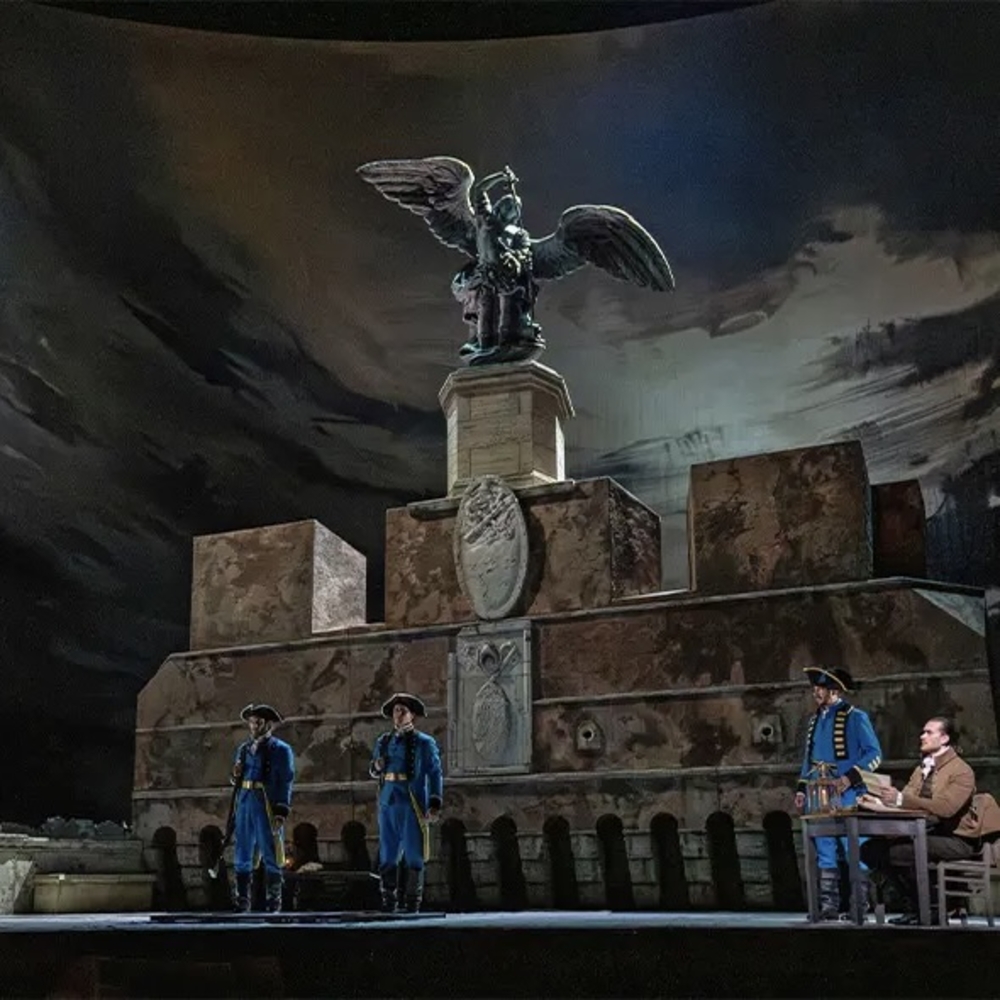
A New Yorker with 72 hours to spare, or 48 if in a hurry, could do this. Jet to Fiumicino, drop the overnight bag, and hotfoot past the bombastic frescoes of the minor basilica of Sant’ Andrea della Valle on to the piano nobile of the Palazzo Farnese and up the steps to the terrazza atop Castel Sant’Angelo. Alternatively, you can visit these locations in three hours from your ticketed seat watching Giacomo Puccini’s imperishable Tosca in David McVicar’s you-are-there staging for the Metropolitan Opera. Between November and May you have north of two dozen opportunities to do so. A partial slate of the big names passing through includes Saioa Hernández, Eleonora Buratto, and Sondra Radvanovsky as Rome’s reigning diva Floria Tosca; SeokJong Baek, Matthew Polenzani, and Roberto Alagna as her firebrand lover Cavaradossi; and Quinn Kelsey, Željko Lučić, and Amartuvshin Enkhbat as Scarpia, the spymaster who doesn’t like their politics. Some of the conductors on the case are Oksana Lyniv, Daniele Rustioni, and Karel Mark Chichon. Why, against this backdrop, Gustavo Dudamel would elect to quit David Geffen Hall, next door to the Met, for a pair of mind’s-eye Toscas in concert at Carnegie Hall is a question for which we can find no good answer. Yes, he has an ace-in-the hole in the bankable Jonas Kaufmann, whose Cavaradossi, opposite Patricia Racette’s Tosca and Bryn Terfel’s Scarpia, set the Met on fire 16 years ago. But Kaufmann and the Met have been Splitsville since the pandemic (it’s the fee structure, stupid!). At Carnegie Hall, he shares the spotlight with Marina Rebeka (absent from the Met since 2017) and Ludovic Tézier (ditto since 2011). Along with the Ruben Bládes/Spanish Harlem special in Washington Heights in May and the rock-out son et lumière with Lizzo at Radio City in September, the incipient opera-in-concert series off the Lincoln Center campus at Carnegie Hall looks to be one more push in the Dude’s Flood the Zone strategy for the Big Apple. Next stop, Greenland? —Matthew Gurewitsch