“When you grow up in L.A., you grow up in this kind of kaleidoscope, a collage of information,” Doug Aitken once said. Roaming the city’s west side as a child, he felt a constant sensory overload that sparked an early urge to create. After studying at the ArtCenter College of Design in Pasadena, Aitken left for New York, drawn by the vibrant art scene of the 1990s.
In 1994, he held his first solo exhibition at Chelsea’s 303 Gallery. Installations at the Whitney Biennial and Venice Biennale soon followed, the latter earning him the International Prize in 1999. Blending film and performance, light and sound, Aitken’s sweeping works breathe life into cityscapes and landmarks—as does his latest work, Lightscape, on now at the Shed, in New York. The film installation pays homage to Los Angeles’s dreamlike beauty while reckoning with a city—and a world—increasingly shaped by division.
These days, Aitken splits his time between Venice Beach and New York. Here, he shares the guide to the city he’s always called home.

The Galley
I like the less slick version of the west side of Los Angeles, the kinds of places with a little bit more tooth and character.
My mother was a journalist and food critic. When I was young, she was always taking me to the off-grid spots and underground restaurants. As Jonathan Gold, the iconic Los Angeles food critic, once said, “food is what makes us human.” The search was always for an amazing restaurant tucked away in a forgotten strip mall or maybe a newly discovered taco truck.
As a kid, I tagged along when my mother would meet with poet Charles Bukowski, and the conversation was often about how to learn the character of a city through the texture of its food and drink establishments. Finding unique places was special—it was a way of claiming what you believed in.
Some of the places on my list, like the Galley in Santa Monica, are a little bit rough around the edges. They might be more akin to the Rolling Stones’s Exile on Main Street than to a Taylor Swift album.
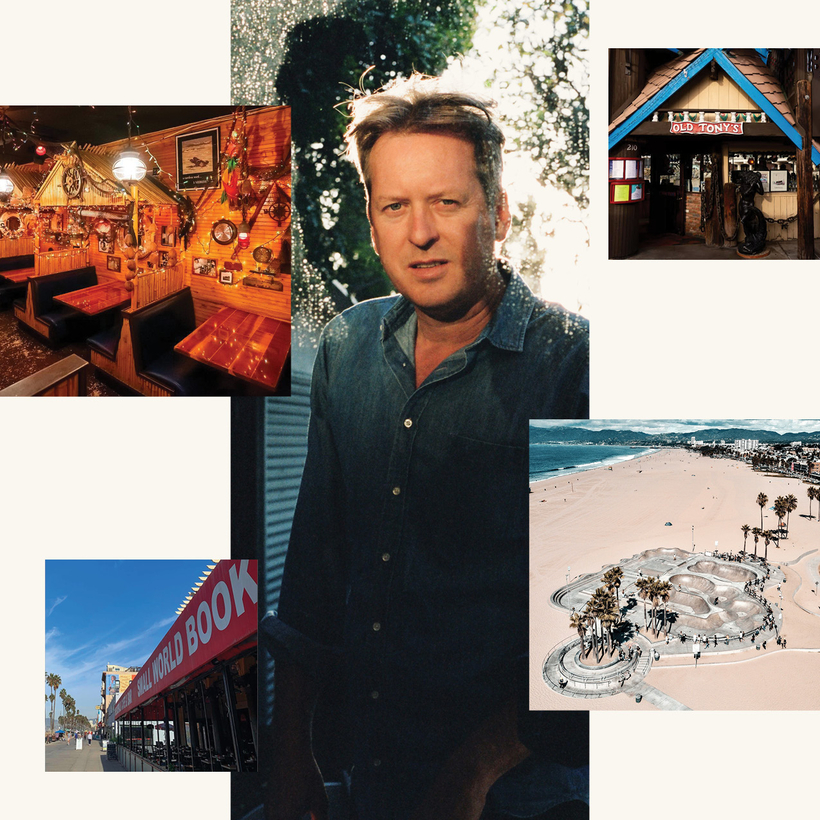
I believe the Galley is the oldest restaurant on the west side. With sawdust on the floor, puffer fish hanging from the ceiling, kitsch-colored lights and vinyl booths, it’s honestly not the kind of place you go for the greatest cuisine. But if you’re with a friend and you want to tell stories deep into the night, it’ll do—and the Bloody Marys are fantastic. (thegalleyrestaurant.net)
Chez Jay
Chez Jay is a short walk from the Galley. When you enter, it’s like walking into the early 1960s. Anyone who tells you they go there for the food should be shot. I was told this was the favorite bar of Dennis Wilson, the Beach Boys drummer who passed away in 1983 because he took it too far. The ambiance, however, is great, and it pulses with energy long after it should hang up its spurs for the night. (chezjays.com)

Small World Books
If you want to add some reading to your walkabout, head to Small World Books, hidden on the Venice Beach Boardwalk, away from the street chaos and Dogtown skate park madness. The staff always eyes me with suspicion, as if I’m trying to shoplift their contemporary literature, but it’s a good and well-stocked joint. (smallworldbooks.com)
Angel City Books & records
Angel City Books is my kind of used book and record store. It’s nestled in a side street where you will be greeted by an old fellow who appears to be the original owner and is always warm and open to share recommendations. I love searching for used books, and there’s some good crate digging for vinyl as well. (angelcitybooks.com)
Townhouse
In Venice, there is the Townhouse, a bar since 1915. It’s mediocre, but in its basement you’ll find the Del Monte speakeasy, where it’s not uncommon to catch someone like Carlos Nino DJing or some surprisingly good live experimental music. (townhousevenice.com)

Tony’s on the Pier
Redondo Beach is not only the name of a Patti Smith song and ground zero for the punk rock aggression of the band Black Flag—it’s also the resting spot of Old Tony’s on the pier.
Old Tony’s is a strange hexagonal bar and restaurant cantilevered over the decrepit wooden pier. If you catch it during the passage from sunset to night, the view can be transcendental, and it will almost make up for their strange and powerful tiki drinks whose color combos Joseph Albers couldn’t have imagined.
The view is accented by a series of celebrity headshots that line the walls; they paint a picture of the area, which throbbed in the 1960s and 1970s before going dark. You pass photographs of Burt Reynolds, Mr. T, and Farrah Fawcett, and remember a lost era of hedonistic glamour and serious bacchanalia. Think of the film Inherent Vice, and you’ll have an idea of this sunbleached gem. (oldtonys.com)
Dear John’s
While we’re on this strange journey, we now have to eat. Let’s dine at Dear John’s, which has no windows and is right off Interstate 405. If you didn’t know about it, you’d never notice it from the outside.
Inside, it’s got to be the darkest restaurant you’ve ever seen. When your eyes adjust, you envisage a portrait of lost Hollywood elegance. It’s timeless, and the food is surprisingly good, and the chef has worked out a supply train of clean and fresh ingredients while remaking classic American dishes from the 1950s. Dear John’s is a serious steak and seafood commitment, and probably not an ideal place to take your macrobiotic friend. (dearjohnsbar.com)
Ramenya
If this all sounds like a nightmare, and instead you just want to sink into an incredible bowl of ramen, go to Ramenya.
The West Coast Cool school artist Billy Al Bengston turned me onto this place on our first meet-up. He said, “Doug, we’ve got to meet at Ramenya.” Slightly confused by his choice, I followed his lead and had his favorite dish, the Tantanmen, and was hooked. Billy was one of the seminal Los Angeles artists to come out of the 1960s Ferris Gallery scene, and had a period where he burned hot with his sergeant-striped paintings. He really captured a moment. (ramenya-la.com)

An ode to west l.a.
I’m grateful to have experienced so much on the west side of Los Angeles. The layers of contemporary history, art, and music give this area a unique resonance, from the art studios of amazing artists like Ed Ruscha, John Baldessari, and Chris Burden, to the newer generations and the constantly changing musical soundscape and street culture.
Venice Beach is radically diverse, and like the moving tides, it changes constantly. It’s the antithesis of the sprawling metropolis of Los Angeles—it’s intimate and of a human scale, and is filled with provocative, strange, and unexpected discoveries.
This is where the American continent ends and drops into the Pacific Ocean. It’s the site of a very unique and powerful energy.
You can explore our complete, constantly-updated guide to Los Angeles here